Principle 5 – Effective Teachers Address Standards
The Common Core State Standards are a clear set of shared goals and expectations for the knowledge and skills students need in English Language Arts and Math at each grade level so they can be prepared to succeed in college and in the workforce. These standards have identified the knowledge the students are expected to learn at each grade. But they do not tell the teachers how the information and materials should be taught. These standards are also researched based and include rigorous content.
Principle 6 – Effective Teachers Scaffold Students’ Reading and Writing
Scaffolding – Simply stated, scaffolding is the way teachers help students by varying the amount of support they provide depending on the students’ needs and the lesson. Teachers will demonstrate, guide, and teach while also modeling how experienced readers read and proofread their writings. Also, there are five levels of support when it comes to scaffolding: modeled, shared, interactive, guided, and independent.
- Modeled Reading and Writing – Teachers will model how expert readers read by reading with expression and reading fluently. They will model writing by writing a composition so everyone can see it (on a smartboard or chart paper), creating the text, doing the writing, and thinking aloud about their use of different writing strategies and skills.
- Shared Reading and Writing – In shared reading, a teacher will read a story and do most of the reading with the younger children joining in to read familiar and predictable words and phrases. With older students, when a novel is too hard to read independently, the teacher will read aloud while students follow along, reading silently when they can. With shared writing, the teacher will use the Language Experience Approach, where the teacher writes what a student talks about on their artwork or journals for them, and they will use KWL charts where the students and the teacher discuss and write down things they Know about a subject or topic, they Want to know about a subject, and at the end they will write about things they Learned about the subject. The purpose of shared writing is to involve students in literacy activities they can’t do independently, create opportunities for students to experience success in reading and writing, and to provide practice before students read and write independently.
- Interactive Reading and Writing – During interactive reading and writing students assume an increasingly important role by actively participating with their teacher and classmates. The reading instructional texts together and take turns doing the reading while the teacher helps them read with expression. They also create text and share the pen to do writings with the teacher and their classmates. They also spell words correctly while also adding capitalization, punctuation, and other conventions. The purpose of this interactive reading and writing is for students to practice reading and writing high-frequency words, apply phonics and spelling skills, read and write texts that students can’t do independently, and have students share their literacy expertise with their classmates.
- Choral Reading – Students take turns reading
- Readers Theatre – Students assume the roles of characters and read lines in a script
- Interactive Writing – Students and the teacher create a text and write a message together. The text is composed by the group and the teacher assists as students write down text on chart paper.
- Guided Reading and Writing – The students are doing the reading and writing themselves while the teacher is only providing support and observing them. In guided reading the teacher will meet with the students in small homogenous groups where they will read a book as the teacher guides them as they read. In guided writing, the teacher will structure the activity and supervise students as they complete writing activities and often provide feedback. Teachers use guided reading and writing to support students’ reading in appropriate instructional-level materials, teach literacy strategies and skills, involve students in collaborative writing projects, and to teach students to use the writing process with revising and editing.
- Mini Lessons – During a mini lesson, the teacher will provide practice activities and supervise as students apply what they’re learning.
- Independent Reading and Writing – At the independent stage, students do the reading and writing themselves. They choose their own books to read, work at their own pace, choose their own writing topics, and move at their own pace. While the students do all of the work the teacher is still continuing to monitor and guide their works. Teachers use this independent reading and writing to create opportunities for students to practice literacy strategies and skills, provide authentic literacy experiences, and to develop lifelong readers and writers.
*These five levels of support illustrate the gradual release of responsibility as the students move from modeled to independent reading and writing. As the students do more of the reading and writing the teachers gradually transfer responsibility to them.
Principle 7 – Effective Teachers Organize for Instruction
Effective teachers organize for instruction by creating their own program to fit the needs of their students and their school’s standards and curricular guidelines. The principle of these programs is for teachers to create a community of learners in their classrooms, for teachers to incorporate the components of the balanced approach, and for teaches to scaffold students’ reading and writing experiences. The five most popular of these programs are guided reading, basal reading programs, literature focus units, literature circles, and reading and writing workshops.
Guided Reading – Guided reading is often a 20-minute lesson with small groups of students who read at approximately the same levels for teacher directed lessons. These lessons include word-identification and comprehension strategies. The goal of these lessons is usually for students to understand what they are reading, which we call comprehension, and not just saying the words correctly.
Basal Reading Programs – These are commercial produced reading programs that feature a textbook of reading selections with accompanying workbooks, supplemental books, and related instructional materials at each grade level. These programs focus on phonics, vocabulary, comprehension, grammar, a spelling instruction and are often aligned with grade-level standards. These also come with testing materials to monitor student’s progress.
Literature Focus Units – Teachers create literature focus units by picking books from a district- or state-approved list of award-winning books that all students are expected to read. These books include: The Very Hungry Caterpillar, Charlotte’s Web, Officer Buckle and Gloria, Holes, and Flora and Ulysses. Everyone reads the same book, and the teacher supports students learning through explicit instruction and reading and writing activities. Through these units teachers teach about literacy genres and authors, and they develop students’ interest in literature.
Literature Circles – In literature circles, a teacher will select fire or six books of varying levels that are often related for small groups of students to read. They will give a book talk to introduce them before forming a group and responding to the book. They will set up a reading and discussion schedule where they work independently while a teacher sometimes sits in on them. Literature circles will help students develop responsibility for completing assignments.
Reading and Writing Workshop – Students do authentic reading and writing in workshop programs. They select books, read independently, and conference with their teacher about their reading and write books on topics their choose. In these programs students read and write more like adults do while making choices and working independently and responsibly.
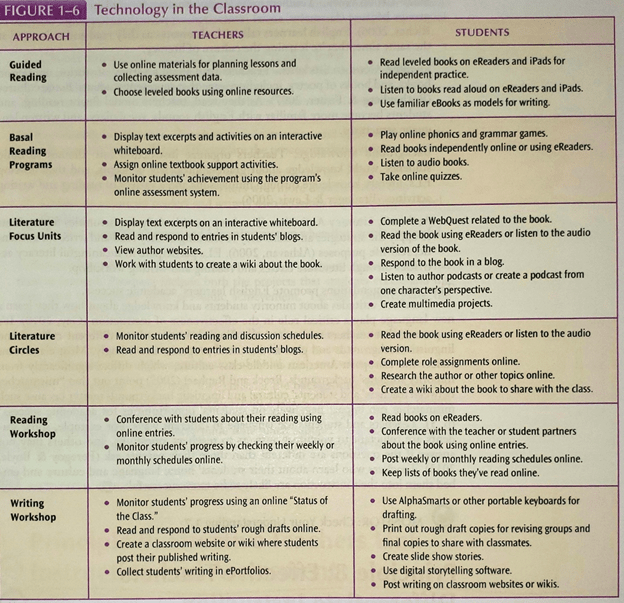
Incorporating Technology Into Instruction is another crucial part of balanced literacy instruction. They often include digital software, the internet, and computer technology. They help by presenting information to students, scaffolding students’[ reading and writing, involving students in activities and projects, responding to students’ work, and assessing students’ achievements.
Below is a figure detailing the different organizational programs and how they could use technology in the classroom:
Nurturing English Learners – English learners benefit from participating in the same instructional program that mainstream students do. It is also more difficult for them to learn to read and write English because they are learning to speak English at the same time. There are, however, a few ways teachers scaffold oral language acquisition and literacy development together. By using explicit instruction, providing many opportunities for oral language participation, having students work in small groups, reading aloud to the students, having some background knowledge, and having authentic literacy activities. Teachers attitudes about minority students also plays a critical role.
Principle 8 – Effective Teachers Differentiate Instruction
Effective teachers adapt their lessons and adjust their instruction because students vary in their levels of development, academic achievement, and ability. If instruction is either too easy or too hard their students won’t learn anything. Teachers differentiate their instruction by varying the content, varying the process in which the lessons are taught, or students are challenged, and they vary the product and how students demonstrate what they have learned. A one-size-fits-all instructional model is obsolete, and differentiation is needed.
Principle 9 – Effective Teachers Link Instruction and Assessment
Assessment is the collecting and analyzing data to make decision about how children are performing and growing. We use these assessments to determine students’ reading levels, monitor students to make sure they are making progress, diagnose students’ progress in specific subjects, evaluate students’ achievement, and document students’ achievement. Teachers collect and analyze this data from observations, conferences, and classroom tests. They then use the data to make decisions and plan interventions.
Linking Instruction and Assessment in Four Steps – Assessment is linked to instruction and some teachers do assessments before they teacher, some while they teach, and others afterwards. There is a cycle to assessments that includes four steps as well.
- Step 1: Planning – Teachers use their knowledge about students’ reading levels, their background knowledge, and their strategy and skill competencies to plan appropriate instruction that is neither to easy nor too difficult. Simply stated, step one involves teachers planning for future instruction using the knowledge they already have.
- Step 2: Monitoring – Teachers monitor instruction that’s in progress by observing students, conferencing with them, and checking their work to make sure their instruction is effective. They then make modifications like reteaching to improve the quality of their instruction.
- Step 3: Evaluating – Teachers evaluate students’ learning using rubrics and check lists to assess students’ reading and writing projects and administering teacher made tests. They also collect samples to document students’ achievements. Simply put, stage three involves checking things to make sure they are working and if not figure out why.
- Step 4: Reflecting – Teaches judge the effectiveness of their instruction by analyzing students’ reading and writing projects and test results and consider how they might adapt instructions to improve student learning. Simply stated, stage four involves teachers reflecting on whether or not their instructional strategies and assessments helped and could they have been better.
When it comes to the assessment tools that teachers have available to them, there are many choices. They can use observations of students as they participate in instructional activities, running records of students oral reading to analyze their ability to solve reading problems, examination of students’ work, conferences to talk with students about their reading and writing, checklists to monitor students’ progress, and rubrics to assess students’ performances, written products, and multimedia projects. These Running Records are a type of assessment where the teacher is taking many notes about what the student is saying and doing during an oral reading. Rubrics on the other hand assess the student’s performance by noting how well they did on an assignment or project.
Videos – These were the most impactful videos to me that I believe I will actually be able to put to use in the early childhood classrooms in which I hope to teach in.
Interactive Writing – https://youtu.be/s4FsR1xiI5o
In this video the teacher is going over a lesson with the whole class. In this interactive writing lesson, the teacher asks many open-ended questions, calls on students to answer some of the questions and participate in writing answers on the board, and includes the whole class to participate in answering other questions and suggesting answers. This interactive lesson is great because she teaches them details of good writing, models good writing, and guides them to use the strategies on their own. She also greatly engages the students throughout by varying her pitch and tone while also using her scaffolding skills when asking questions and helping them.
A Day in the Life of Our Writing Workshop – https://youtu.be/s4FsR1xiI5o
This video shows some great examples and ideas for creating writing workshops and doing a quick focus lesson for 5 to 10 minutes before letting the students begin their writings. Some of her great ideas involve letting discussing how writers get their ideas, when to revise their writing, how the students get comfortable, conferencing with them while they are writing, sharing with listening partners offering suggestions and praise, publishing their works around the room, using mentor texts to model good writing and writing with their friends. The video had many great examples with many great pictures showing what the students would be and are doing.
Choral Reading – https://youtu.be/o_-z8d0sRUA
Choral reading is very effective when working with young students. The book should be relatively short and not too difficult (age appropriate) while also having a bit of rhythm or dialogue. Each student must also have their own copy of the book. This teacher was being very effective by modeling how the students should be reading aloud while also telling the students that she will be modeling how the reading will go first. After the teacher reads the book, the students will all read together in unison while the teacher pays close attention to pacing, fluency and expression. This was a fantastic example of how choral reading should be done.
Readers Theatre Scripts – http://www.readingrockets.org/strategies/readers_theater
This website contained some amazing information for real world classroom instruction. It described the benefits of readers theatre like how it promotes fluency, helps readers learn to read with expression, and builds confidence. It also describes how to integrate readers theatre as a technique for math problems as well. There was even a section on differentiation with English language learners and those with varying reading skills. I have book marked this website and definitely plan to use it in the future.
The video example with the shared reading was another great example of textbook reading strategies in real life.
How would we use these things in the classroom?
One of the best bits of information that will apply directly to all classroom teachers is the effective use of scaffolding. Scaffolding is the way teachers help students by varying the amount of support they provide. This can be a tough one for teachers to deal with because they want to help their students and they want them to succeed, but they can’t just give them the answers. One of the ideas in the shared reading and writing support level includes KWL charts. I have seen a few teachers do these with theirs and this is a great way to spark interest in their students and to see how much they know. Another great bit of information was with use of technology in the classroom. The use of technology in the classroom can be very effective and Figure F 1-6 has some great information. One part I liked was the mention of listening to audiobooks and podcasts. Having the book on hand and listening to the audio version of it can be effective for different learners. They can also better relate to and find out cool facts about the author or the book too.
 Travis Davis ENGED 275