Phonemes, Graphemes, and Phonemic Awareness
Phonemes – Sounds – Phonemes are smallest units of speech and are marked in our textbook using diagonal lines (e.g., /d/).
Phonemes can either be consonants or vowels; phonemes can also include consonant blends of 2 or 3 consonants which appear next to each other in words and their individual sounds blend together as in grass or spring and they can also be consonant digraphs of two letters that come together to make one sound as in chair or shell.
Graphemes – Letters – Graphemes are the letters of the alphabet. In our textbook, they are marked and shown using italics (ck).
Graphophonemic – Letter-sound relationships – The alphabetic principle suggests that there should be a one-to-one correspondence between phonemes and graphemes, so that each sound in consistently represented by one letter. However, the English language isn’t a perfect phonetic language, and there are over 500 ways to represent 44 phonemes using single letters or combination of letters.
Phonemic Awareness – Children’s basic understanding that speech is composed of series of individual sounds, and it provides the foundation for phonics and spelling. This simply describes the awareness and the ability to understand and manipulate the sounds of words orally. It can detail manipulating sounds in words orally, understanding that spoken words are made up of sounds, and that they can segment, and blend sounds in spoken words. Teaching Phonemic Awareness is important because it is a prerequisite for learning to read. It has also been found to be the most powerful predictor of later reading achievement.
Phonemic Awareness Strategies – Children learn to manipulate spoken language in these ways:
- Identify sounds in a word – don’t see the word in writing, but an object or word is given orally
- Categorizing sounds in a word – what word doesn’t belong
- Substituting sounds to make new words – examples: tar to car, tip to top
- Blending sounds to form words – blends sounds to make a word, example: /b/ /i/ /g/
- Segmenting a word into sounds-break word apart, you have feet, break into sounds /f/ /e/ /t/
*Children also use these strategies to decode and spell words
Teaching Phonemic Awareness – Teachers nurture children’s phonemic awareness through language-rich environments they create in the classroom. Teachers sing songs, chant rhymes, read aloud wordplay books, and play games in which children have many opportunities to orally match, isolate, blend, and substitute sounds and to segment words into sounds. This instruction should meet 3 key criteria:
- Activities appropriate for 4-, 5-, and 6-year-olds
- Instruction should be planned and purposeful, not just incidental
- Phonemic awareness activities should be integrated with out components of balanced literacy program.
Some of these phonemic awareness activities include:
- Sound making activities – initial sound or rhyming activities
- Sound-isolation activities – teacher says a word and the student identifies sounds at the beginning, middle, and end of the word
- Sound-blending activities – “I’m thinking of an animal and its called a /d/ /o/ /g/. What is it?”
Here are some other great activities and videos:
Sound-Addition and Substitution Activities
- Willoughby Wallabee Woo
- Apples and Bananas https://www.youtube.com/watch?v=lNNMknj0PyE
- Sound-Segmentation Activities
- more difficult activity
- children identify all the sounds in a given word orally
- Elkonin boxes
- whole class https://www.youtube.com/watch?v=ihUNBB0eCU8
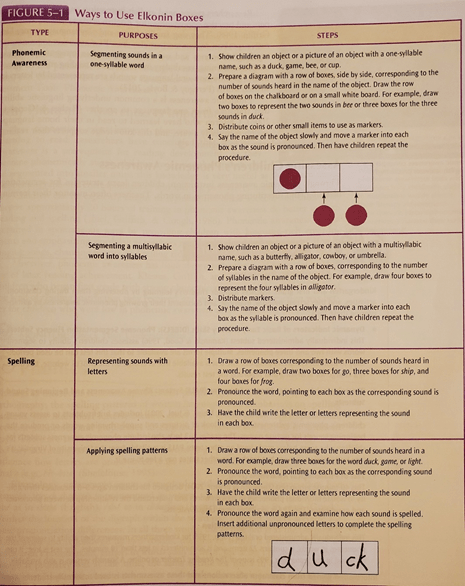
Elkonin Boxes – Elkonin boxes are an instructional method to build phonological awareness skills by segmenting and blending the sounds in words where teachers draw or use drawn boxes which represent each of the phonemes in a word. Students will be shown an object or given a word and then the teacher or the student moves a marker into each box as the sound is pronounced. This could also be done at the student’s desk by placing markers onto cards or on a chalk/white board. Teachers can also use Elkonin Boxes for spelling activities too. If a student is trying to spell a word, the teacher can draw the correct number of phoneme boxes and have the student write the letters representing each phoneme within them. Below is a figure representing many of the ways effective teachers use Elkonin Boxes:
Phonics – the relationship between phonology (which is the sounds in speech) and orthography (the spelling patterns of written language). Its emphasis is on spelling patterns and not individual letters because their isn’t a one-to-one correspondence between phonemes and graphemes in English. Some also describe phonics as the predictable relationships between phonemes and graphemes. The relationship between a sound and the letter(s) representing it is also called the phoneme-grapheme correspondence. Etymology, which is the study of the origin of words, also influences the pronunciation of letters and words.
Digraphs – Digraphs are two letters that come together and make one sound. There are consonant digraphs and there are vowel digraphs. Consonant digraphs represent single sounds that aren’t represented by either letter. The four most common consonant digraphs are ch as in chair and each, sh as in shell and wish, th as in father and both, and wh as in whale while another consonant digraph is ph as in photo and graph. Vowel digraphs involve two vowels making one sound as in nail, saw, soap, and snow.
Diphthongs – Diphthongs are two vowels where their sound begins as one sound and then moves towards the other. Two vowel combinations that are consistently diphthongs are oi and oy. Other combinations include ou as in house (but not through) and ow as in now (but not snow) because they represent a glided sound.
R-controlled Vowels – R-controlled vowels are vowels whose pronunciation is decided by the letter r and its influence. Words like start, award, nerve, squirt, horse, surf and square are all r-controlled vowel words. Some words have a single vowel plus r, others have two vowels plus r, and sometimes the r is in between two vowels. Some can be taught and learned easily through predictability and others are much more difficult.
Phonograms – One-syllable words and syllables in longer words can be divided into two parts: the onset and the rime.The onset is the consonant sound that precedes the vowel while the rime is the vowel and any consonant sounds that follow it. Research has shown that children make more errors decoding the rime and more errors on vowels than on consonants. However, knowing common rimes and recognizing words made from them are very helpful for beginning readers because they can use this knowledge to decode other words. Many teachers also refer to rimes as phonograms or word families when they teach them. For example, one day/week the teacher might focus the lesson on the “ain” family as in brain and stain, and they might focus on the “ing” family in another lesson. Teachers will also use their word walls to incorporate these word families for a variety of phonics activities and more effective student learning.
Teaching Phonics – First off, teaching phonics is no easy task. However, years of research has concluded that the best way to teacher phonics is through a combination of explicit instruction and authentic application activities. They have also concluded that the most effective phonics programs are taught in a systematic and predetermined sequence. The typical sequence for teaching phonics involves beginning with consonants; introducing short vowels (so children can read and spell CVC pattern words); then learning about consonant blends, digraphs, and long vowels; before finally learning about vowel digraphs and diphthongs. Children also learn several strategies for identifying unfamiliar words like sounding out words, decoding by analogy, and applying phonics rules. Below is the most useful phonics rules and the sequence of phonics instruction:
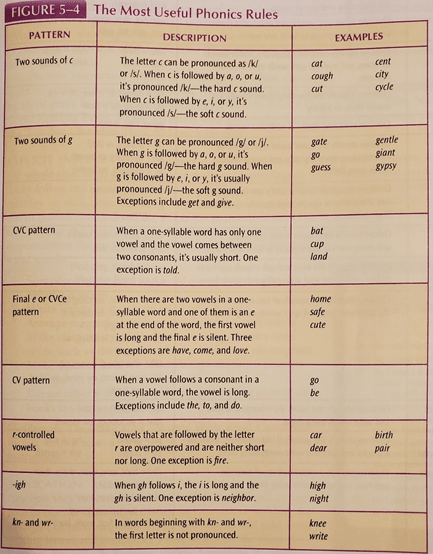
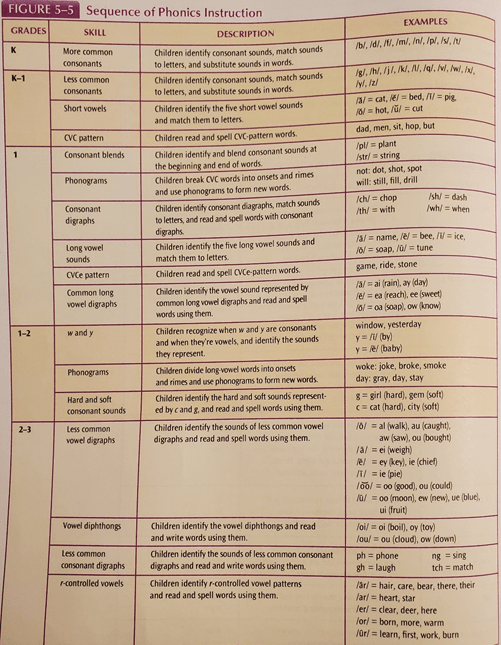
Teachers also present minilessons on phonics to the whole class or small groups of students depending on their needs. These are some of the activities teachers use to provide students more guided practice:
- Sort objects, pictures, and word cards according to phonics concepts
- Write letters or words on small whiteboards
- Arrange magnetic letters or letter cards to spell words
- Make class charts of words representing phonics concepts, such as two sounds of g or the –ore phonogram
- Make a poster or book of words representing a phonics concept
- Locate other words exemplifying the spelling pattern in books students are reading
Stages of Spelling Development – Students need to learn to spell words conventionally so that they can communicate effectively through writing. Learning phonics in primary grades is only part of spelling instruction, but students also need to learn other strategies and information about English orthography. There are five stages students move through on their way to becoming conventional spellers: emergent spelling, letter name-alphabetic spelling, within-word pattern spelling, syllables and affixes spelling, and derivational relations spelling. At each stage students use different strategies and focus on particular aspects of spelling.
Stage 1: Emergent Spelling – In this stage, 3 to 5 year old students string scribbles, letters, and letterlike forms together, but they don’t associate the marks with specific phonemes. They use both upper and lowercase letters but prefer uppercase ones. During this stage children learn the distinction between drawing and writing, how to make letters, the direction of writing on a page, and some letter-sound matches
Stage 2: Letter Name-Alphabetic Spelling – Stage 2 involves 5 to 7 year old children learning to represent phonemes in words with letters. They develop an understanding of the alphabetic principle and the link between letters and sounds. They start representing words with just a couple of consonants before beginning to add vowels. By the end of this stage, they are using consonant blend and digraphs and they are learning the alphabetic principle, consonant sounds, short vowel sounds, and consonant blends and digraphs.
Stage 3: Within-Word Pattern Spelling – Stage 3 involves 7 to 9 year olds beginning to spell most one-syllable short vowel words. They also learn to spell long-vowel patterns and learn there are some words that don’t fit the vowel patter. Students will also confuse spelling patterns and spell words wrong after they reverse the order of letters. In this stage, students learn the concepts regarding long-vowel spelling patterns, r-controlled vowels, more complex consonant patterns, diphthongs and other less common vowel patterns, and homophones.
Stage 4: Syllables and Affixes Spelling – This stage involves 9 to 11 year olds focusing on syllables and applying what they’ve learned about one-syllable words to long, multisyllabic words. They also learn how to break words into syllables, inflectional endings, rules for adding inflectional endings, syllabication, compound words, contractions, and homophones.
Stage 5: Derivational Relations Spelling – The last stage involves 11 to 14 year olds where they explore the relationship between spelling and meaning during the derivational relations stage. They also learn that words with related meanings are often related in spelling despite changes in consonant and vowel sounds. Students in this stage learn the concepts of consonant alternations, vowel altercations, Greek and Latin affixes and root words, and etymologies.
Teaching Spelling – While most people think that teaching spelling simply includes giving students weekly spelling tests, it actually involves much more work than that. A complete spelling program involves teaching spelling strategies, matching instruction to students’ stage of spelling development, providing daily reading and writing opportunities, and teaching students to learn to spell high-frequency words. Some important spelling strategies teaching should be focusing on include segmenting the words and spelling each sound, often called “sound it out”, spelling unknown words by analogy to familiar words, applying affixes to root words, proofreading to locate spelling errors in a rough draft, and location the spelling of unfamiliar words in a dictionary. Teaching spelling also involves many different activities like creating word walls, making words or word lists, word sorts, interactive writing, proofreading, dictionary use, and spelling options such as letter positions in such as “oi” is at the beginning and middle, “oy” is at the end of a word.
Video of the Week – https://www.youtube.com/watch?v=DptnGoIeuUA
This weeks video on the alphabetic principle breaks down the definitions of the most important words of the chapter and has some incredible real world examples. It breaks down the phonological awareness levels into word level, syllable level, onset-rime level, and phoneme level with great examples. The video also included detailed definitions with pictures of examples and exercises for things like onset and rime as well as phonemes and phonics too. This is probably one of the most useful videos for me personally because it explained each of our key concept words and their definitions with visuals and examples. I have already book marked this video along with the flashcards for the FORT. It even contained a typo towards the end where the video misspelled diphthong as dipthong too.
Classroom Application – For me personally, as the father of a 3 year old and 6 year old, this entire chapter was a lot to consider. I feel like I should start going over the 37 rimes and their common words using them. I also feel like that would also make a great addition to a word wall as well. There are clearly some word families and phonograms that are easier or more difficult to learn and practice. So by having those rimes up on a word wall ready to go would be an easy to accomplish and practical addition to any classroom. I also liked the booklist of wordplay books for invented words, repetitive lines, rhyming words, songs and verse, and sounds too. There were many great books in the list and some of them I had never even heard of. If we are talking about classroom application, first I need to read some of those books to develop my skills a bit more when it comes to phonemic awareness and phonics.
 Travis Davis ENGED 275