Reading Fluency – Fluency is the ability to read and write effortlessly and efficiently. Reading fluency is the ability to read quickly, accurately, and with expression. To read fluently, students must recognize most words automatically and be able to identify unfamiliar words easily. Most students will become fluent readers by 4th grade. This also involves three components: automaticity (recognizing words auto), speed (reading at least 100 words per minute), and prosody (reading sentences expressively, with appropriate phrasing and intonation):
- Automaticity – Recognizing words automatically. In order to be a fluent reader, students must be able to identify unfamiliar words quickly or they will have to stop and decode them. Conventional wisdom says that students must know at least 95% of words while others challenge this and say they need to know 98-99% or they will be stopping too often to figure out unfamiliar words.
- Speed – Fluent readers read at least 100 words per minute, and they usually reach this speed by 3rd grade while increasing the rate each year. Fluent readers also vary their speed depending on the selection like its topic or genre and their purpose for reading.
- Prosody – Reading sentences expressively, with appropriate phrasing and intonation. Others describe prosody as the ability to read in expressive rhythmic and melodic patterns. Beginning readers with read word by word with no expression before gaining experience and reading with emphasis. They will then chuck words into phrases, read smoothly with only a few pauses and breakdowns, read with expression, and their reading pace approximates speech.
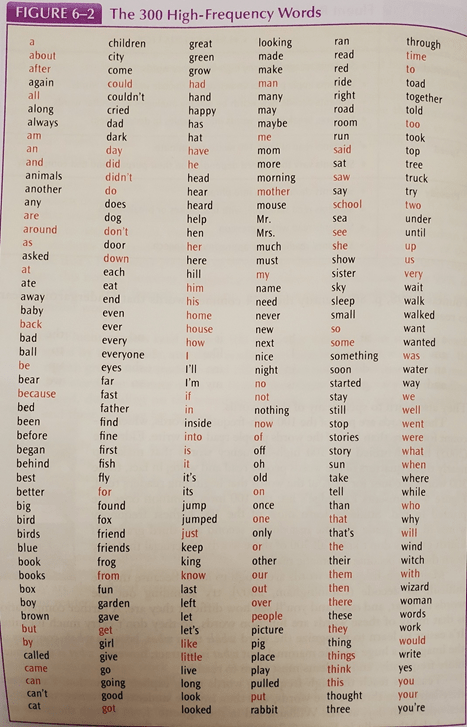
High Frequency Words – These are the most common words that readers use again and again. Often times teachers will create word words at the beginning of the year to help students be able to spell these words correctly without interrupting the class. Most of the time there are also in alphabetical order for ease of use instead of how frequently they are used. Teachers will also add more and more words to their word walls as they learn new words or introduce new topics in their classrooms.
Here is a list of 300 High-Frequency Words:
Word Identification Strategies – Students use four word-identification strategies to decode unfamiliar words: Phonics analysis, decoding by analogy, syllabic analysis, and morphemic analysis.
- Phonic Analysis – Students apply what they’ve already learned about phoneme-grapheme correspondences and phonics rules to decode words. This means they apply their letter sound-symbol correspondences, phonics rules, and spelling patterns to read or write words.
- Decoding by Analogy – Students use the decoding by analogy strategy to identify words by associating them with words they already know. They their knowledge of phonograms and word families to deduce the pronunciation or spelling of an unfamiliar word. This is a big step for students to use this strategy moving on from a more structured one.
- Syllabic Analysis – Students break multisyllabic words into syllables and then apply their knowledge of phonics to decode the words. This strategy is often used by more experienced readings as there is many rules which can and should be used.
- Morphemic Analysis – Students use their knowledge of root words and affixes to read or write an unfamiliar word. They locate the rot word by taking off prefixes or suffixes to find the meaningful part of the word. Prefixes are added to the beginning of a root while, and suffixes are added to the end of a root word.
Reading Speed – Students must develop an adequate speed or rate to have the cognitive resources available to focus on the meaning of whatever they are reading. Some factors that affect this speed include:
- Students who have a background knowledge about a topic can read more quickly and connect the ideas they’re reading to what they already know
- Students who are knowledgeable about the genre, text structure, and text layout can anticipate what they’re reading.
- Students who speak English fluently have an advantage in developing reading speed because they know more words, are familiar with English sentence structure, and recognize metaphors and other literacy features.
Activities to Increase Reading Practice – Teachers also provide daily practice opportunities to increase fluency and speed by offering a combination of teacher-guided and independent reading practices like:
- Choral Reading – Students work in small groups or together as a lass for choral reading. They experiment with different ways to read poems and other short texts aloud. More fluent classmates serve as models and set the reading speed.
- Readers Theatre – Students practice reading a story script to develop speed and expressiveness before performing it for classmates. Researchers have found that readers theatre significantly improves students’ reading fluency.
- Listening Centers – Students read along in a book at their instructional reading level while listening to it being read aloud at a listening center.
- Partner Reading – Classmates read or reread books together. They choose a book that interests them and decide how they’ll read it; they may read aloud in unison or take turns reading aloud while the partner follows along.
*Once students become fluent readers, the next goal is working on their stamina, or how many minutes can they sit and read.
Prosody Continued – When students read expressively, they use their voices to add meaning to the words. Some of the components of prosody include:
- Expression – Students read with enthusiasm and vary their expression to match their interpretation of the text.
- Phrasing – Students chunk words into phrases as they read and apply stress and intonation appropriately.
- Volume – Students vary the loudness of their voices to add meaning to the text.
- Smoothness – Students read with a smooth rhythm and quickly self-correct any breakdowns.
- Pacing – Students read at a conversational speed.
While these components mainly affect oral reading, prosody also plays an important role during silent reading, too, because students’ internal voice affects comprehension. Teachers emphasize prosody by modeling expressive reading by reading aloud and using their think-aloud procedures.
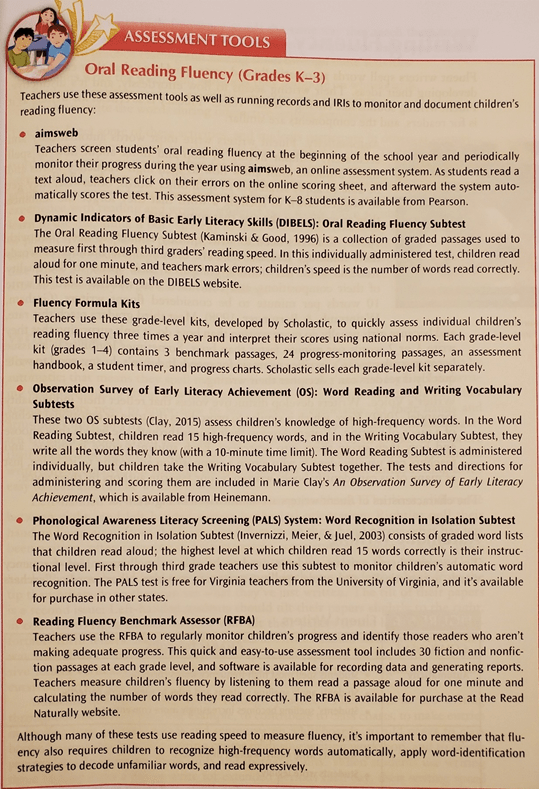
Assessing Reading Fluency – Teachers typically assess and monitor reading fluency informally by listening to them read aloud during guided reading lessons, reading workshops, or during other reading activities. Teachers collect data at the beginning of the year and at the end of each month or quarter to document progress. They assess and collect data regarding students’ accuracy, speed, and prosody. Teachers will check students’ knowledge of high-frequency words and their ability to use word-identification strategies to decode other words, they will time students as they read an instructional-level passage aloud and determine how many words they read correctly per minute, and they will choose excerpts for students to read from both familiar and unfamiliar instructional-level texts. As they listen, teachers will judge whether students read with expression and will use rubrics during their assessments.
Here is a list of several assessment tools teachers will use to assess oral reading fluency in grades K-3:
Writing Fluency – Fluent writers spell words automatically and write quickly so that they can focus on developing their ideas. Fluent writing sounds like talking and it has voice. Fluency is as crucial for writers as it is for readers and the components of automaticity, speed, and writers voice are similar.
- Automaticity – Students spell most high-frequency words correctly, students apply spelling patterns and rules to spell words correctly, and students’ spelling becomes increasingly more conventional.
- Speed – Students write quickly, students write easily and without discomfort, students write legibly, and students develop keyboarding skills to words process quickly.
- Writer’s Voice – Students us alliteration, onomatopoeia, repetition, and other literacy devices and students make their writing distinctive.
Writer’s Voice – The writer’s voice reflects the person doing the writing. This is also the tone or emotional feeling of a piece of writing. Students who gain experience as readers and writers will learn to vary their tone, entertain, inform, and persuade. Doing lots of reading and writing helps students develop their voices.
Assessing Writing Fluency – Teachers assess writing fluency as they observe students writing and examine their compositions. They consider these questions when assessing their students:
- Do students spell most words automatically or do they stop to figure out how to spell many words?
- Do students write quickly enough to complete the assignment, or do they write slowly or try to avoid writing?
- Is students’ writing legible?
- Do students write easily, or do they write laboriously, complaining that their hands hurt?
Dysfluent Readers and Writers – A dysfluent reader and/or writer is one that is not fluent in reading and/or writing by 4th grade. Estimates state that 10-15% of these “older” students have difficulty recognizing words and their achievement is slowed. In other classrooms, these dysfluent readings and writers have difficulties decoding words, reading at an appropriate speed, or reading expressively. This in turn leads to a struggle getting ideas down on paper, forming letters legibly, and spelling common words correctly.
Dysfluent readers read hesitantly, slowly, and/or without expression. Some questions teachers consider when assessing or screening these students:
- Do students read most words automatically, or do they stop to decode may common words?
- Are students able to identify most grade-appropriate multisyllabic words?
- Do students read quickly enough to udne3rstand what they’re reading, or do they read too slowly or too fast?
- Do students chunk words into phrases when they’re reading, or do they read word by word?
- Do students read grade-level texts expressively, or do they read in a monotone?
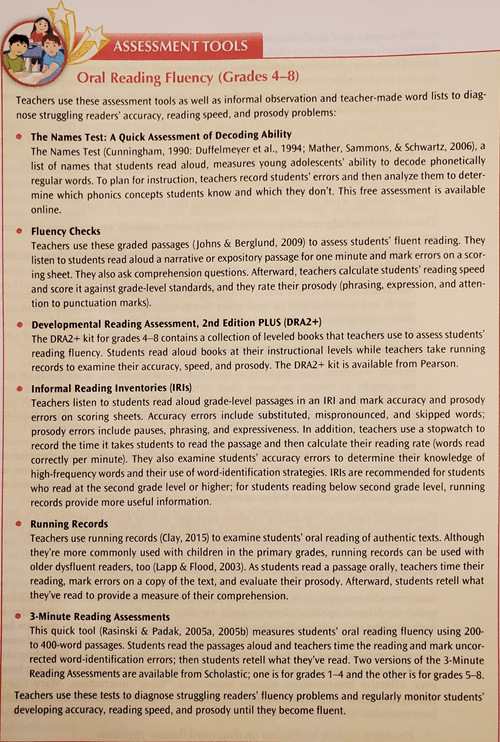
Here are some assessment tools teachers use for oral reading fluency in grades 4-8:
Similarly, teachers consider these questions when assessing and screening for fluency in writing:
- Do students spell most words automatically, or do they stop to sound out spellings of many words?
- Do students write quickly enough to complete assignments, or do they write slowly or try to avoid writing?
- Is students’ writing legible?
- Do students write laboriously, complaining that their hands hurt?
These questions help teachers quickly identify older students who may not be fluent readers and writers.
Here are some effective interventions to help students with their fluency:
- Explicit instruction on diagnosed fluency problems
- Increasing the time for students to read books at their independent level
- Modeling fluent reading and writing
- Clarifying connections between reading fluency and comprehension
- Expanding opportunities for writing
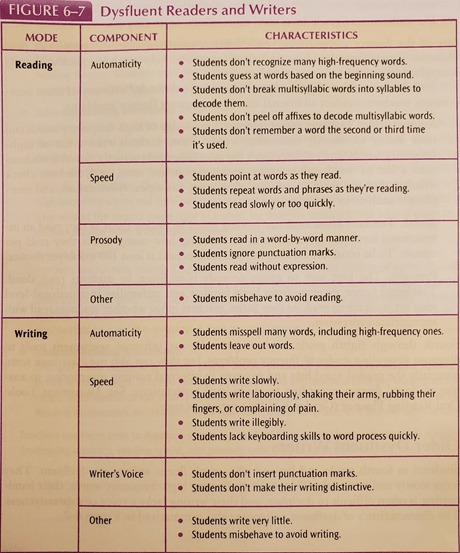
Here are the components and characteristics of dysfluent readers and writers:
Obstacles to Fluency – There are six main obstacles to fluency in readers and writers:
- Lack of Automaticity – To help with this obstacle, teachers use explicit instruction to teach students to read and write high-frequency words. Each week they focus on five words and involve students in these activities to practice them:
- Locate examples of the words in books they are reading
- Practice reading flash cards with words to a partner
- Play games using words
- Write the words and sentences they compose with them on whiteboards
- Spell the words with letter cards or magnet letters
- Write the words during interactive writing activities
- Unfamiliarity With Word-Identification Strategies – Teachers include these components in their intervention programs to develop students’ ability to tread and spell words:
- Develop students’ background knowledge and introduce new vocabulary words before reading
- Teach word-identification strategies
- Provide more time for reading and writing practice
- Slow Reading Speed – The most important way that teachers intervene with slow reading speed is by providing daily practice opportunities to develop students’ reading speed and stamina. Some activities to assist students in increasing their reading speed are to provide a combination of teacher-guided and independent reading practice, including choral reading, guided reading, readers theatre, listening centers, and partner reading. Books must also be level appropriate and involve a topic they’re interested in. Another way to improve reading speed is with the repeated readings procedure. During this procedure, students reread the same text 3 to 5 times striving to improve their speed and reduce their errors.
- Slow Writing Speed – The best way to improve students’ writing speed is through lots of writing. Dysfluent writers often have trouble sustaining a writing project through the writing process. However, these informal writing activities are productive ways to increase writing speed:
- Quickwriting – Students choose a topic for quickwriting and write without stopping for 5 to 10 minutes to explore the topic and deepen their understanding. The writing is informal, and students are encouraged to pour out ideas without stopping to organize them.
- Reading Logs – Students write entries in reading logs as they read a story or listen to the teacher read a novel aloud. In their entries, students share their predictions, write summaries, ask questions, collect quotes, and reflect on the reading experience.
- Simulate Journals – Students assume the role of a book character and write entries from that character’s viewpoint in simulated journals. They delve into the character’s thoughts and actions to deepen their understanding of the novel they’re reading or that the teacher is reading aloud.
- Learning Logs – Students write entries in learning logs as part of thematic units. They’re using writing as a tool for learning as they take notes, draw and label graphic organizers, summarize big ideas, and write answers to questions.
- Lack of Prosody – Teachers emphasize prosody by modeling expressive reading every time they read aloud and using the think-aloud procedure to reflect on expression, loudness, and varied pacing. Some activities to help with expression when reading is:
- Having the teacher work with students to phrase or chunk words together to read with expression
- Having the teacher work with students to break sentences into phrases and read the sentences expressively
- Having students participate in choral reading
- Having students participate in echo reading
- Having students participate in readers theatre
- Voiceless Writing – Doing lots of reading and writing helps dysfluent writers develop their voices. As they read books and listen to the teacher read others aloud, students also develop an awareness of the writer’s voice. Some activities to help students develop voice in their writing:
- Doing lots and lots of reading and writing
- Practicing their voice during informal writing
- Modeling their writing off of other types of writing
- Writing every day for 15-20 minutes
Classroom Application – We must get our students to READ! READ! READ! That is what I got out of this chapter. Our authors even stated multiple times throughout the chapter that the best thing to improve reading speed or to improve writing speed is simply through lots of reading and writing. Whether the students are emerging readers, fluent readers, or older dysfluent readers, having the students participate and giving them daily practice opportunities to read will improve their abilities. And of course, we have to remember things like reading books and passages at their ability levels and using word walls throughout the year. But the biggest classroom application for me from this chapter would be to provide the students opportunities throughout the day to have the students read both silently and aloud.
One of the other great tid bits from the chapter involved remember that students who are either dysfluent or below grade level have a comprehension rate much lower than their fluent classmates. This will cause these students to take more time when reading passages and they may need to reread passages to comprehend them. I will need to remember this when allotting time for taking tests or having students work on worksheets for lab activities. Not every student will fully comprehend questions the first time reading them and not every student will be able to finish things in a timely manner so I must be prepared to work with them and not punish them.
 Travis Davis ENGED 275