Academic Vocabulary – These are words that are frequently used in language arts, social studies, and math. These words are found textbooks and books students read and teachers use them in minilessons and discussions. Students use them in classroom assignments and are expected to understand them for high-stakes tests.
Three Tiers of Words: Basic Words – These words are used socially, in informal conversation and rarely require instruction about the meaning of these words.
Academic Vocabulary – These words have wide applications in school and are used more frequently in written than in oral language. Teaching these words expands students’ knowledge and has a powerful impact on learning.
Specialized Terms – These are content-specific technical words and are often abstract. They aren’t used frequently enough to devote time to teaching them when they come up during language arts, but they’re the words that teachers explicitly teach during thematic unit and in content area classes.
Levels of Word knowledge – Students develop knowledge about a word gradually and through repeating oral and written exposure to it. This word knowledge happens in levels where students move from not knowing the word at all to recognizing that they’ve seen it before and then to a level of partial knowledge before fully recognizing and knowing the meaning of the word in different ways.
- Unknown Word – Students don’t recognize the word
- Initial Recognition – Students have seen or heard the word or can pronounce it, but they don’t know the meaning
- Partial Word Knowledge – Students know one meaning of the word and can use it in a sentence
- Full Word Knowledge – Students know more than one meaning of the word sand can use it in several ways
* Students are described as flexible word users when they reach the fourth level, but students do not reach the fourth level with every word they learn. In this level they understand the core meaning of a word and how it changes in different contexts.
Word consciousness – This is a student’s interest in learning and using words. Word consciousness increases students’ word knowledge and their interest in learning academic vocabular. The goal is for students to become more aware of words, manipulate them playfully, and appreciate their power. Students who have word consciousness exemplify these characteristics:
- Students use words skillfully, understanding the nuances of word meanings
- Students gain a deep appreciation of words and value them
- Students are aware of difference between social and academic language
- Students understand the power of word choice
- Students are motivated to learn of unfamiliar words
Word Study Concepts – Students need to learn about the word, not just memorize it.
Multiple Word Meanings – Words have a variety of meanings and for some words these multiple meanings develop from the noun or verb forms while others develop through wordplay and figurative language.
Synonyms – Synonyms are words that have nearly the same meaning as other words or simply are words with similar meanings. For English this is because we have borrowed so many words from other languages.
Antonyms – Words that express opposite meanings are called antonyms.
Homonyms – These are words that are pronounced the same but have different meanings. Homophones are words that sound alike but are spelled differently. Similarly, Homographs are words with identical spellings but different meanings and pronunciations. ***These are very important because they are very confusing for many students when they are writing.
Root Words and Affixes – Teaching students about root word and affixes shows them how words work. Many words come from a single root word in which many words and their definitions are pulled from. Latin is the most common source of English root words while Greek and English is another important source. Some root words are also whole words while others are only word parts. When root words are whole words, they are called free morphemes.
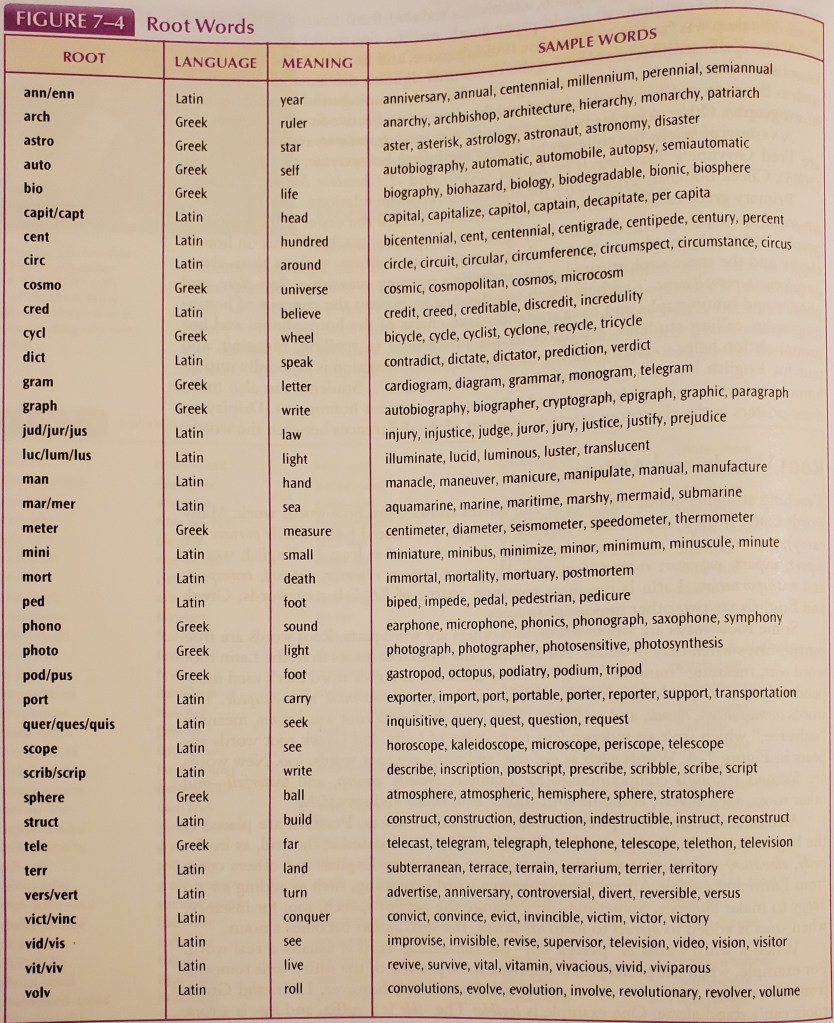
Affixes are bound morphemes that are added to words at the beginning or at the end of a words. A Bound Morpheme is a morpheme that cannot be uttered alone with meaning, or, in other words, it cannot be said by itself to make an actual word. Prefixes are placed at the beginning (of the root/base word) and suffixes are located at the end (of the root/base word).
Etymologies – The history of words and their meanings. The history of the languages, particularly English in our case, offer fascinating information about word meanings and spellings. The English language in particular used to be a very phonetic language, but over time we adopted and developed related words from Greek, Latin, and English languages as well. When students understand English, Latin, and Greek root words, they appreciate the relationships among words and their meanings. This appreciation and fascination can also foster a passion for learning and understanding as well.
Vocabulary Instruction – Vocabulary instruction plays an important role in balanced literacy classrooms because of the crucial role it plays in both reading and writing achievement. These are the components of vocabulary instruction:
- Immerse students in words through listening, talking, reading, and writing
- Teach specific words through active involvement and multiple encounters with words
- Teach word-learning strategies so students can figure out the meanings of unfamiliar words
- Develop students’ word consciousness, their awareness of an interest in words
Vocabulary – The meaning of words students are reading. Knowing the meaning of words helps students comprehend better because it is difficult to understand the text when the words don’t make sense.
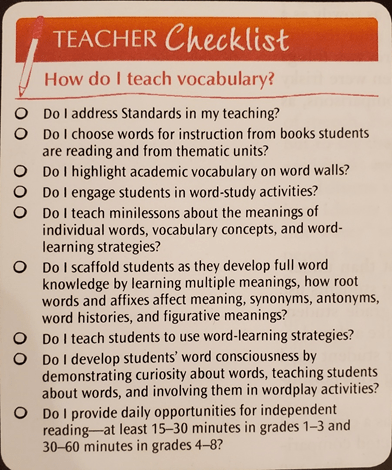
Explicit Instruction – Teachers explicitly teach students about academic language and vocabulary which usually involve Tier 2 words. In this explicit instruction, teachers provide multiple encounters with words; present a variety of information, including definition, contexts, examples, and related words; and involve students in word-study activities so they have multiple opportunities to interact with words. Teachers also consider what students already know about a word and that learning a new unfamiliar word takes the most time to teach. They often use minilessons to provide information about words and engage their students in activities to get them to think about using these words in their daily writing and in conversation.
Mini Lessons – These are short lessons in which concepts, procedures, strategies, and skills are taught. They shouldn’t be more than 10 minutes long. They are to introduce a topic and make connections between the topic and previous selections or ideas.
Word–Study Activities – Students examine new words and think more deeply about them as they participate in word-study activities. Some create visualizations of words while others categorize words or related words. Teachers use these word-study activities to teach new academic vocabulary:
- Word Posters – Students choose a word and write it on a small poster: then they draw a picture to illustrate it. They also write a sentence using the word on the poster.
- Word Maps – Students create a diagram to examine a word they’re learning. They write the word, make a box around it, draw several lines from the box, and add information about the word in additional boxes they make at the end of teach line. Three kinds of information are typically included in a word map: category for the word, examples, and characteristics or associations.
- Possible Sentences – To activate background knowledge about a topic and increase their curiosity before reading a book or a chapter in a content area textbook, students write possible sentences using vocabulary words. After reviewing the definitions of set of words, students work with classmates to crat sentences suing the words an afterward share them. Then later on, the students review and revise those that aren’t accurate.
- Dramatizing Words – Students each choose a word and dramatize it for classmates, who then try to guess it. This is much like charades; except they are simple acting out a word. Dramatization is an especially effective activity for English learners.
- Word Sorts – Students sort a collection of words taken from the word wall into two or more categories.
- Word Chains – Students choose a word and then identify three or four words to sequence before or after it to make a chain.
- Semantic Feature Analysis – Students learn the meanings of conceptually related words by examining their characteristics in a semantic feature analysis. Teachers select a group of related words, and then make a grid to classify them according to their characteristics.
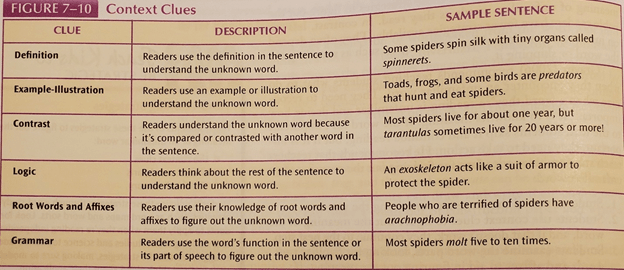
Word–Learning Strategies – Students can do a variety of things when they’ve come across an unfamiliar word while reading. Some techniques work better than others, but there are three key effective word-learning strategies: Using context clues, analyzing word parts, and checking a dictionary.
How To Figure Out Unfamiliar Words – Students must also know what to do when they encounter an unfamiliar word as they read. They must decide how important it is to know the meaning of the word or if they can simply skip it and continue reading. Teachers should teach students these steps for figuring out the meaning of an unfamiliar word:
- Students reread the sentence containing the word.
- Students use context clues to figure out the meaning of the word, and if that doesn’t work, they continue to the next step.
- Students examine the word parts, looking for familiar root words and affixes to aid in figuring out the meaning, if they’re still not successful, they continue to the next step.
- Students pronounce the word to see if they recognize it when they say it. If they still can’t figure it out, they continue to the next step.
- Students will check the word in a dictionary or ask the teacher for help.
How To Assess Vocabulary Knowledge – Teachers follow the four-step instruction-assessment cycle as they teach vocabulary and particularly during literature focus units and thematic units. They identify academic vocabulary words, plan minilessons and instructional activities, monitor students’ progress, and evaluate their achievement. Teachers also reflect on their teaching effectiveness at the end of the unit. There are four key steps to assessing vocabulary knowledge:
- Planning – Teachers plan ways to build students’ current vocabulary knowledge related to the unit and build upon their prior knowledge as well
- Monitoring – Teachers use informal assessment tools to monitor students’ progress like observations and conferences
- Observations – Teachers watch how students use new words during word-study activities, minilessons, and discussions. They also notice how students apply word-learning strategies during guided reading and when they’re reading aloud.
- Conferences – Teachers talk with students about the words they’ve used in word-study activities and in their writing. They also ask what students do when they come across an unfamiliar word and talk about word-learning strategies.
***Teachers also use these monitoring tools to check that their instruction is effective and them make modifications when necessary.
- Evaluating – Teachers use more authentic and formal assessments such as rubrics, quick writes, word sorts, and visual representations to evaluate students’ vocabulary knowledge.
- Rubrics – Teachers include items about vocabulary on rubrics to emphasize the importance of academic vocabulary. For oral-presentation rubrics, teachers emphasize the use of technical words related to the topic, and for writing they emphasize precise vocabulary.
- Quickwrites – Students quickwrite about a word listed on the word wall, explaining what they know about the word.
- Word Sorts – Students complete a word sort activity to demonstrate that they can identify the connections among words related to a book they’ve read or a thematic unit.
- Visual Representations – Students create a word map about a word, draw a picture to present a word’s meaning or create some other visual representation of a word or a group of related words.
***These evaluations require students to go beyond simply providing information
- Reflecting – Teachers take time at the end of a unit to reflect on their teaching, including the effectiveness of their instruction. They can also ask students to reflect on their growing word knowledge. If students self-assessed their word knowledge using the levels of word knowledge at the beginning of the unit or they can complete the assessment again to gain insight on their learning.
Classroom Application
One of the best parts of the chapter was learning about the various ways to teach new vocabulary to students. The idea of students making a poster to represent a new word or making word maps are great ideas. These word-study activities could be used in a variety of subjects and grade levels as well. I also liked the part about teaching students how to figure out the meaning of unfamiliar words. When our students get to high school, and possibly middle school these days, they can just simply google whatever the unfamiliar word is to learn everything there is to know about it. But for other students, they need to be able to try to decode it on their own and figure it out. Teaching students to reread, use context clues, and using a dictionary are crucial skills that all students should be able to attempt before a teacher needs to intervene. With the help of word walls too, teachers should have to spend as much time defining words for their students when the students have the tools to figure it out themselves.
 Travis Davis ENGED 275