Comprehension – The process of constructing meaning using both the authors text and the reader’s background knowledge for a specific purpose. Comprehension is the main goal of reading and is a creative and multifaceted thinking process in which students engage with text.
Text Complexity – Simply stated, text complexity refers to how well a reader can complete an assigned task with a particular text. Text complexity is also a way to determine the comprehension demands of a book or other text using reader and text factors.
What Readers Think About When Reading – When students are reading, they are actively engaged with the text, and they think about many things as they comprehend the text. Here are some of the things readers do:
- Active prior knowledge
- Examine text to uncover its organization
- Make predictions
- Connect to their own experiences
- Create mental images
- Draw inferences
- Notice symbols and other literacy devices
- Monitor their understanding
Comprehension Factors And Roles In Comprehension – There are also many factors and roles that affect comprehension and are placed into Reader Factors and Text Factors. Below is a table detailing these different factors:
***ADD image here tomorrow***
Prerequisites for Comprehension – In order for students to comprehend a text, they must have adequate background knowledge, understand most words in a text (vocabulary), and be able to read fluently. If any of these are lacking, students aren’t likely to understand what they’re reading.
Background Knowledge – Having both world knowledge and literary knowledge is a prerequisite because they provide a bridge to new text. When students don’t have adequate background knowledge, they’re likely to find the text challenging, and it’s doubtful they’ll be successful. However, teachers can do things to build this useful background knowledge. By doing things like using visual representations and talk to build knowledge, involving students in authentic experiences such as field trips and examining artifacts, using photos/pictures, picture books, websites, videos, and simply talking and explaining concepts.
Vocabulary – Because it is difficult to comprehend a test that’s loaded with unknown words, it is recommended that teachers create a word-rich environment in their classrooms and teach word-learning strategies. They can also preteach key words when they’re building background knowledge using KWL Charts, anticipation guides, and other prereading activities.
Fluency – Students need to be able to read and recognize words automatically so their cognitive resources aren’t depleted by decoding unfamiliar words and they can devote their attention to comprehension. Basically, they can’t comprehend text when their brains are trying to decode words and read. Teachers can do things like repeated readings, having students read at their independent/instructional level, and use sight word flashcards.
Comprehension Strategies and What Readers Do – Students use many comprehension strategies to help their understanding as they read. Some are cognitive, meaning they involve thinking, and others are metacognitive, meaning they involve reflecting on their thinking. These strategies are also explicitly taught to your students throughout the school year. Here are 12 strategies readers use for comprehension and how readers use them, how it aids comprehension, and some activities to help students.
- Activating Background Knowledge – Students think about a topic before they start reading and think about relevant information and vocabulary to use while reading. Readers think about what they already know about the topic. It aids comprehension because readers use their background knowledge to fill in gaps in the text and enhance their comprehension. Activities to help students include anticipation guides, exclusion brainstorming, graphic organizers, KWL charts and rereading plans.
- Connecting – Readers make text-to-self, text-to-world, and text-to-text connections. Readers personalize their reading by relating what they’re reading to their background knowledge. Activities include making charts and using sticky notes to list the connections, discussions, and reading logs.
- Determining Importance – Readers identify the big ideas in the text and notice the relationship among them. It aids comprehension because readers focus on the big ideas, so they don’t become overwhelmed with details. Activities include making graphic organizers.
- Drawing Inferences – Readers use background knowledge and clues in the text to “read between the lines”. It aids comprehension because readers move beyond literal thinking to grasp meaning that isn’t explicitly stated in the text. There are four steps to drawing inferences:
- Activate background knowledge about topics related to the text
- Look for the author’s clues as you read
- Ask questions tying together background knowledge and the author’s clues
- Draw inferences by answering questions
- Evaluating – Readers reflect on their reading experience and evaluate the text and what they’re learning. This strategy is used throughout the reading process. It aids comprehension because readers assume responsibility for their own strategy use. Activities include reading log, journal entry, thumbs-up, and thumbs-down.
- Monitoring – Readers supervise their reading experience, checking that they’re understanding the text. This inner conversation that happens while you’re reading. It aids comprehension because readers expect the text to make sense, and they recognize when it doesn’t so, they can take action. Activities include think-alouds, discussions, and mini lessons.
- Predicting – Readers make thoughtful guesses or predictions about what will happen or what they’ll learn in the book they’re reading. It aids comprehension because readers become more engaged in the reading experience and want to continue reading. Activities include a KWL chart, discussions, shared reading, think-clouds.
- Questioning – readers ask themselves questions about the text as they read. These questions often lead to predictions and drawing inferences. It aids comprehension because readers use questions to direct their reading, clarify confusions, and make inferences. Students must be taught how to and what questions to ask themselves as they’re reading. This is done through modeling and teacher think-alouds.
- Repairing – Readers use repairing to fix comprehension problems that arise during reading. It aids comprehension because readers solve problems to regain comprehension and continue reading.
- Setting a Purpose – Readers identify a broad focus to direct their reading through the text. It aids comprehension because readers focus their attention as they read according to the purpose they’ve set. Answering the question “Why are you reading?” assists students in knowing what they need to get out of the text.
- Summarizing – Readers pick out the most important ideas and the relationship among them and briefly restate them, so they can be remembered. It aids comprehension because readers have better recall of the big ideas when they summarize. Activities include graphic organizers and orally telling the teacher what they have read.
- Visualizing – Readers create mental images of what they’re reading. It aids comprehension because readers use the mental images to make the text more memorable.
Comprehension Skills – These are the skills that involve literal thinking and are like questions to which there’s one correct answer. Students use the determining importance strategy to identify main ideas, and they use these related skills:
- recognizing details
- noticing similarities and differences
- identifying topic sentence
- comparing and contrasting main ideas and details
- matching cause and effects
- sequencing details
- paraphrasing ideas
- choosing a good title for a text
Another group of comprehension skills is related to the evaluating strategy: Recognizing the author’s purpose, detecting propaganda, and distinguishing between fact and opinion.
The table below explains how comprehension strategies fit into the reading process:
***ADD image here tomorrow***
How To Create An Expectation Of Comprehension – Comprehension involves teaching students how to understand what they’re reading. To do this, teachers use explicit instruction, reading, and writing to develop students’ understanding of fiction and nonfiction texts. Teachers create an expectation of comprehension in these ways:
- Involving student in authentic reading activities each day.
- Providing access to well-stocked classroom libraries.
- Teaching students to use comprehension strategies.
- Ensuring that students are fluent readers.
- Providing opportunities for students to talk about the books they’re reading.
- Linking vocabulary instruction to underlying concepts
Ways To Teach Comprehension – Teachers teach individual comprehension strategies and then show students how to integrate several strategies simultaneously. They do this by introducing each strategy in a series of minilessons where they describe the strategy, model it for students as they read a text aloud, use it collaboratively with students, and they provide opportunities for guided and then independent practice. The Figure below suggests several activities for each strategy:
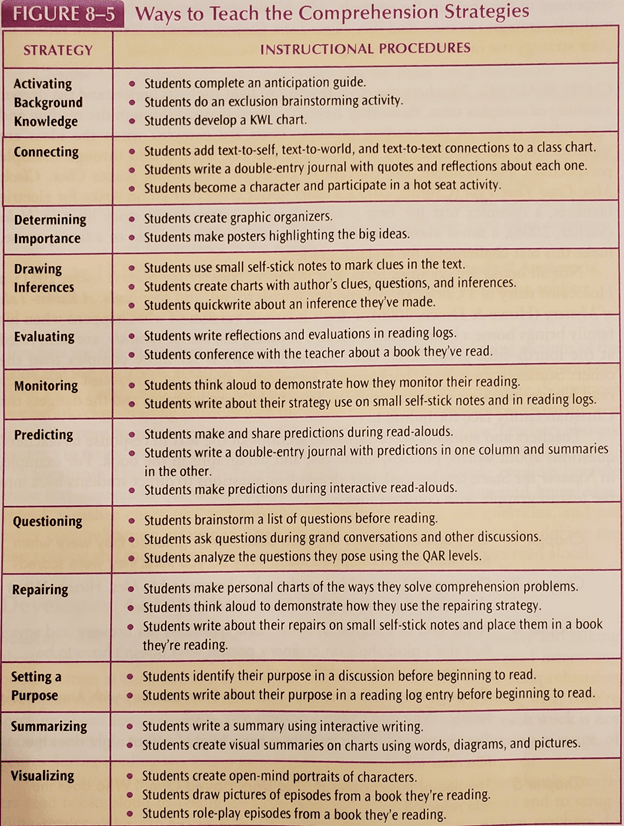
Reciprocal Teaching – Reciprocal Teaching is an instructional activity where the students become the teacher in small group readings. The teacher models and helps the students to guide the small group activity. The students then learn to guide group discussions using summarizing, question generating, clarifying, and predicting. This is a reading technique that is thought to promote students’ reading comprehension.
Assessing Comprehension – Teachers use the integrated instruction-assessment cycle to ensure that students are developing their abilities to understand complex texts and to use increasingly more sophisticated strategies to deepen their understandings of texts. They do this in four steps:
Step 1: Planning – Teachers make decisions about how they’ll teach comprehension strategies, and they decide how to monitor students’ progress during instruction and evaluate it afterward.
Step 2: Monitoring – Teachers monitor and assess students’ comprehension informally every day. They use several informal assessment procedures to do this. Here are two examples:
- Cloze Procedures – During cloze procedures, teachers examine students’ understanding of a text using a fill-in-the-blank like activity where students supply a deleted word from a passage taken from a text they just read.
- Story Retelling – Teachers will often have young children retell stories they’ve read or listened to to assess their literal comprehension. These should include all of the big ideas and important details from the text and teachers will often use rubrics or checklists to score the students retelling.
- Teachers also uses running records and think-alouds to monitor and assess their students as well.
Step 3: Evaluating – Teachers assess students’ knowledge about reading strategies and other reader factors using many of the same ways they monitor students’ progress during instruction. Students can also create projects like a double-entry journal, hot seat, sketch-to-sketch, and open-mind portraits.
Step 4: Reflecting – Students will meet with their teacher for a conference to reflect on what they have learned about reading factors. Teachers can also reflect on the effectiveness of their instruction and how they might improve it.
Factors Affecting Student Motivation – Motivation is intrinsic, social, and a network of interacting factors. There are many factors that contribute to the engagement or involvement in reading and writing with some focusing on the teachers’ role and others focus on the students. Here is a table showing many of the factors affecting students’ motivation:
***ADD image here tomorrow***
Classroom Application – One of the best tidbits I found from this chapter was in regard to the factors affecting students’ motivation. The last two years have been tremendously stressful for both teachers and students with motivation towards schoolwork and challenging tasks at all time lows. The 6 pages detailing motivation and the chart labeled “Figure 8-6 has some fantastic ideas and great reminders for teachers. One of the bests bits of information talked about how to engage the students and much of it doesn’t take much effort to do. The passage mentions things like expressing their own ideas and opinions, letting the students choose topics for writing and books for reading, and to have students share some of their writings with the class. Knowing which factors affect students’ motivation and how to address concerns is a great thing to practice so it becomes automatic.
 Travis Davis ENGED 275