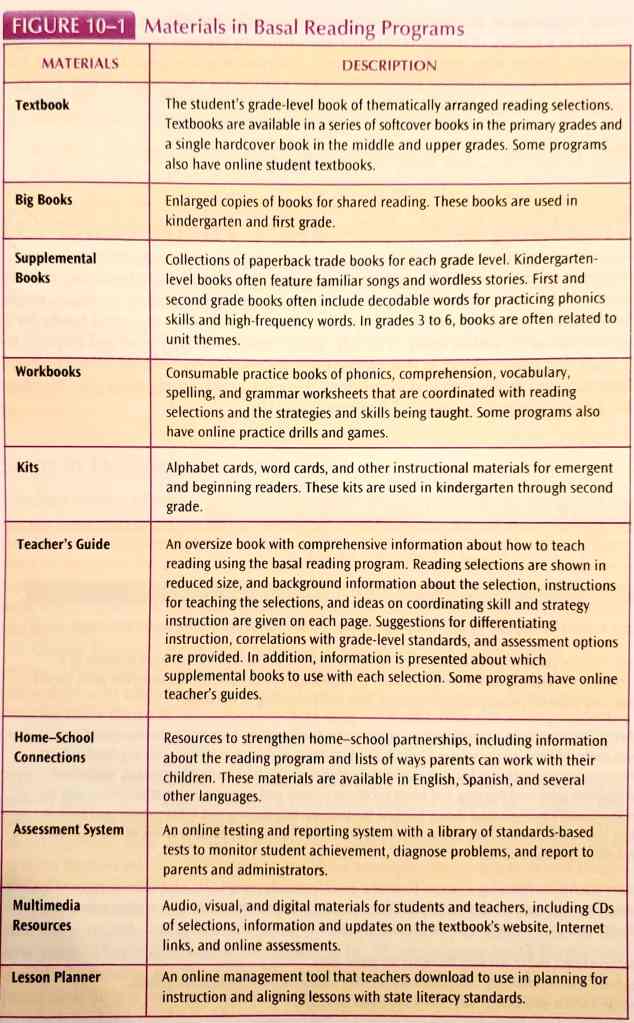
Basal Reading Programs – Commercially produced reading programs are known as basal readers. These programs feature a textbook of reading selections with accompanying workbooks, supplemental books, and related instruction materials at each grade level. Phonics, vocabulary, comprehension, grammar, and spelling instruction is coordinated with the reading selections and aligned with grade-level standards. The teacher’s guide provides detailed procedures for teaching the selectins and related skills and strategies. Instruction is typically presented to the whole class, with reteaching to small groups of struggling students. Testing materials are also included so that teachers can monitor students’ progress. Publishers tout basal readers as a complete literacy program, but effective teachers realize thy aren’t. Below is an overview of the instructional approach for Basal Reading Programs:
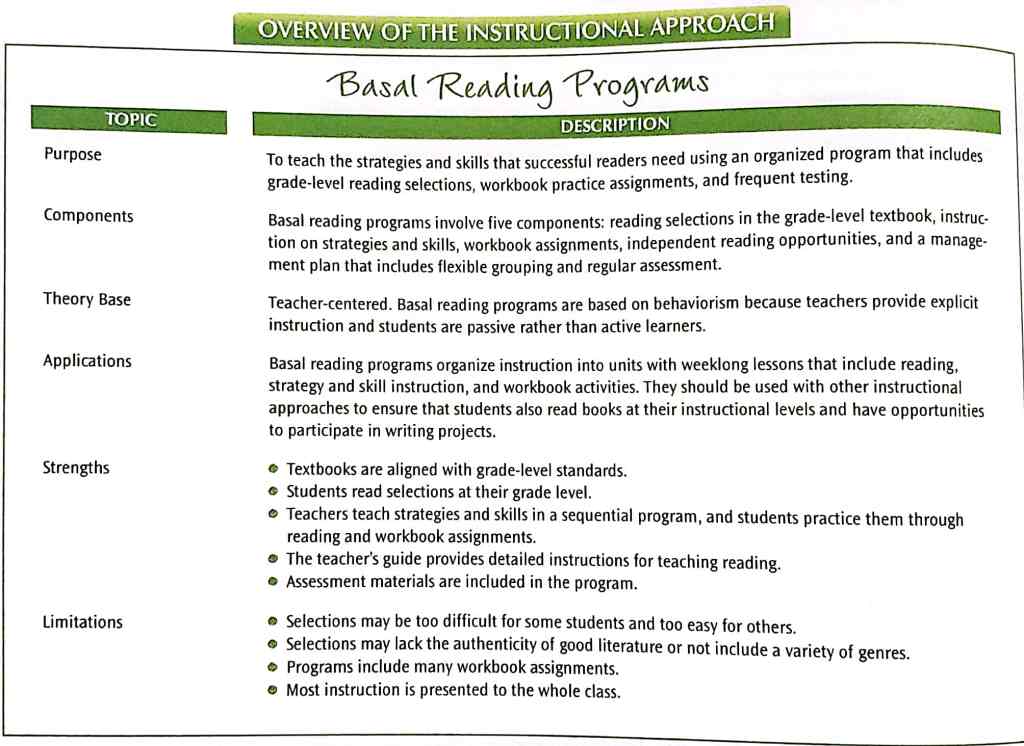
Components of a Basal – There are five components to a basal reading program: reading selection in the grade-level textbook (anthology), instruction on strategies and skills, workbook assignments, independent reading opportunities and a management plan that includes flexible grouping and regular assessment.
Materials in Basal Reading Programs – Figure 10-1 below shows the materials in Basal Reading Programs:
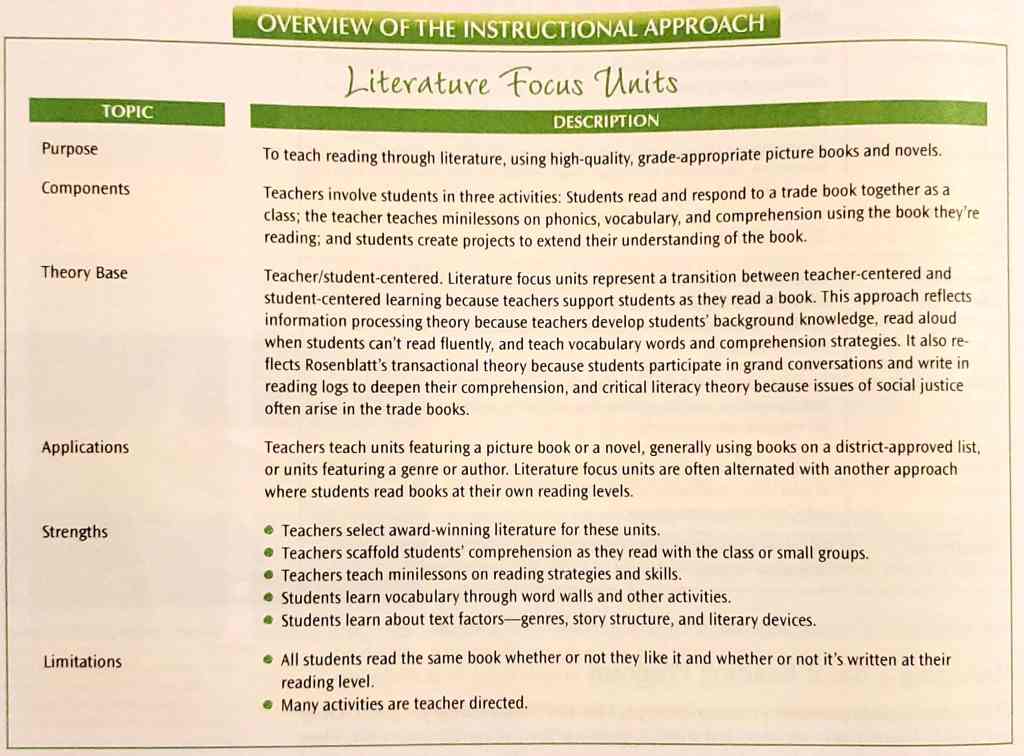
Literature Focus Units – Literature focus units are units featuring popular and award-winning stories, non-fiction books, or poetry. They also feature either a single book: chapter or picture book, genre unit, or author study. Literature focus units include activities incorporating the 5 stages of the reading process too:
- Prereading – build background knowledge
- Reading – read the selection either independently or with the teacher
- Responding – discuss the book and then write in reading logs
- Exploring – word-study activities and comprehension activities
- Applying – students apply their learning through different projects
Steps in Developing a Literature Focus Unit – There are 6 steps in developing a literature unit:
- Select the Literature
- Set goals
- Develop a unit plan
- Coordinate grouping patterns with activities
- Create a time schedule
- Assess students
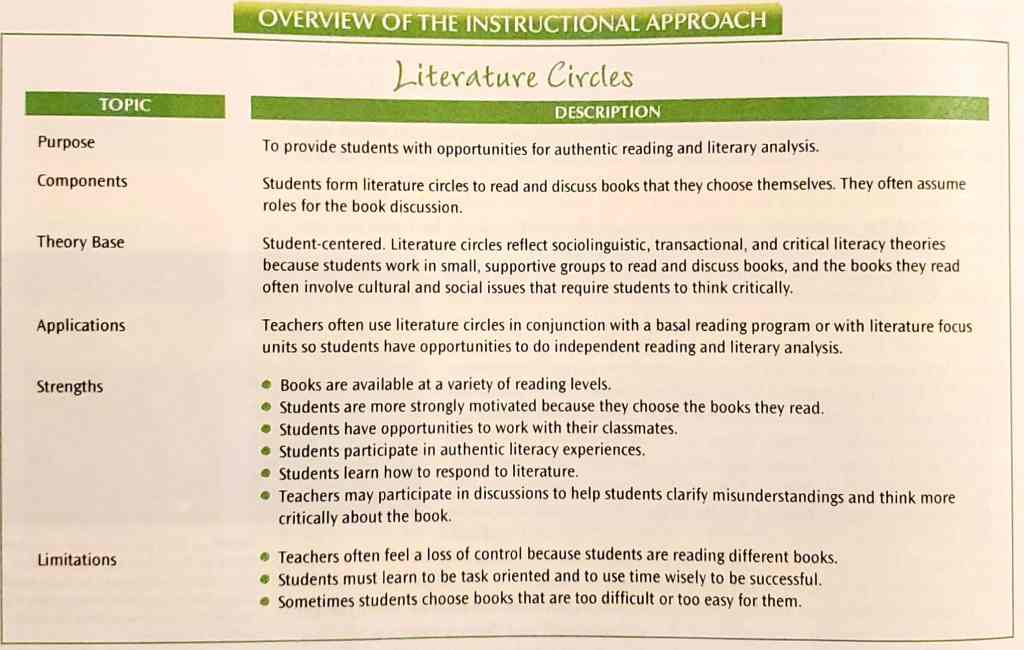
Literature Circles are small, student-led book discussion groups that meet regularly in the classroom and are often called book clubs.
Key Features of a Literature Circle – There are three key features for literature circles:
- Choice: Students typically choose what book they want to read, they groups they participate in and setting the schedule for readings and discussions, and how they’ll share their book with classmates.
- Literature: The books students choose need to be interesting and at students reading level. It is recommended that students choose picture books or shorter books at first so students can learn the process of literature circles before. These books are typically fiction books or stories but can also be nonfiction works as well.
- Response: Students then discuss what they are reading through literature circles (when they discuss). Here they summarize, make connections, learn vocabulary, and explore the author’s use of text factors. These students participating in literature circles learn through the discussions and talking to their peers.
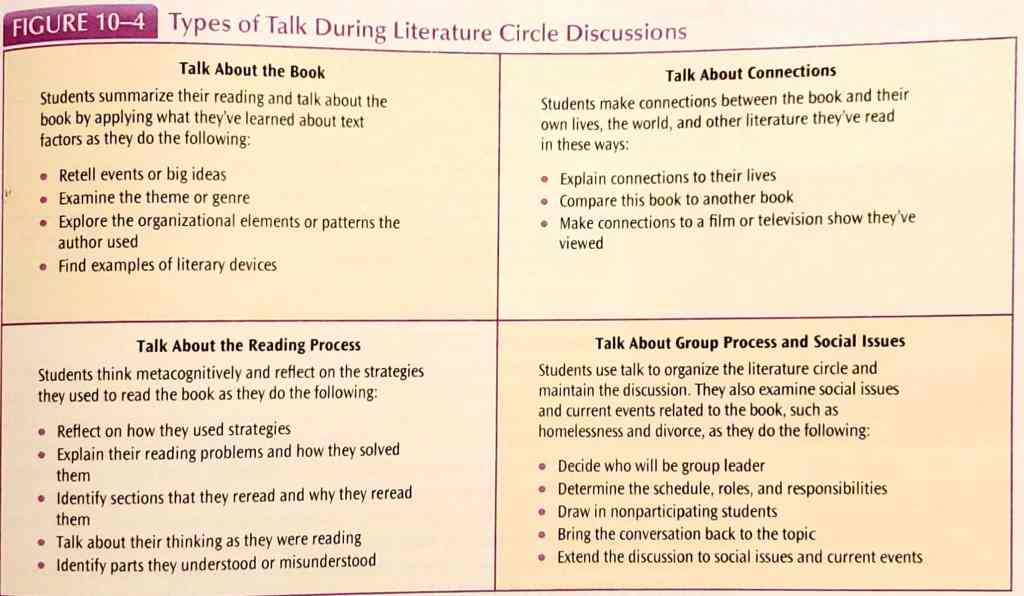
Types of Talk During Literature Circle Discussions – There are many different ways students talk to each other and talk during literature circles. Figure 10-4 presents four of these ways:
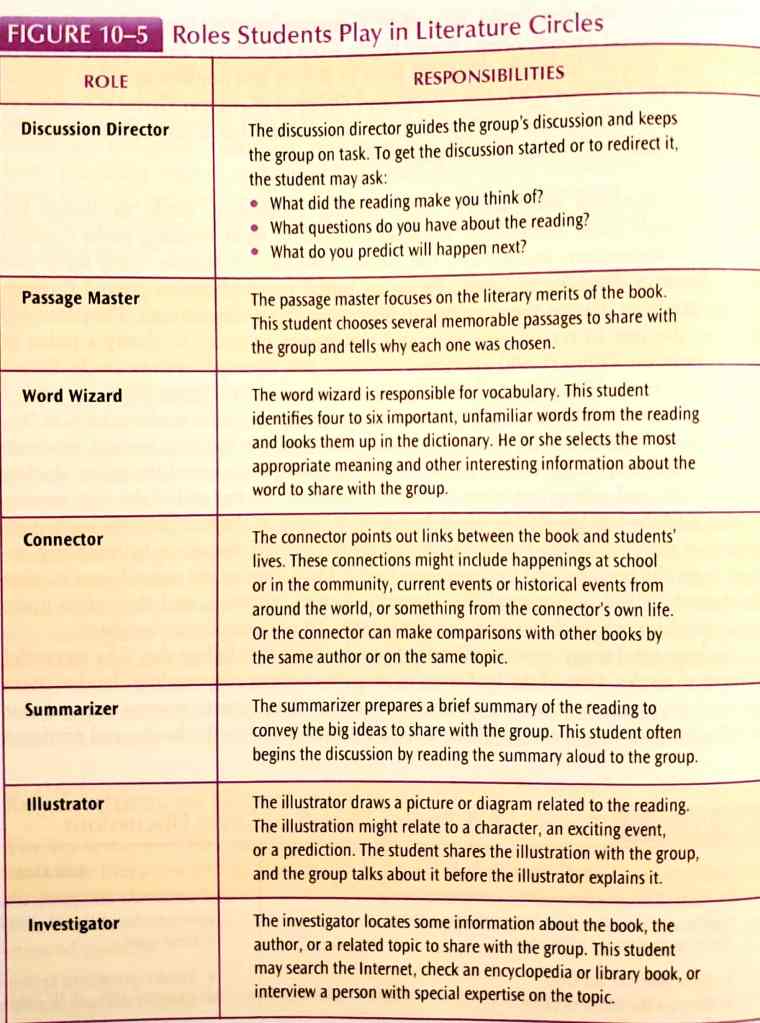
Roles Students Play in Literature Circles – Many teachers have students assume roles and complete assignments in preparation for discussion group meetings. These roles are detailed below in figure 10-5:
Below is an overview of the instructional approach to Literature Circles:
There is also a 7-step series of activities teachers use when organizing literature circles in the classroom:
- Step 1: Select Books
- Step 2: Form Literature Circles
- Step 3: Read the Book
- Step 4: Participate in a Discussion
- Step 5: Teach Milestones
- Step 6: Share With the Class
- Step 7: Assess Learning
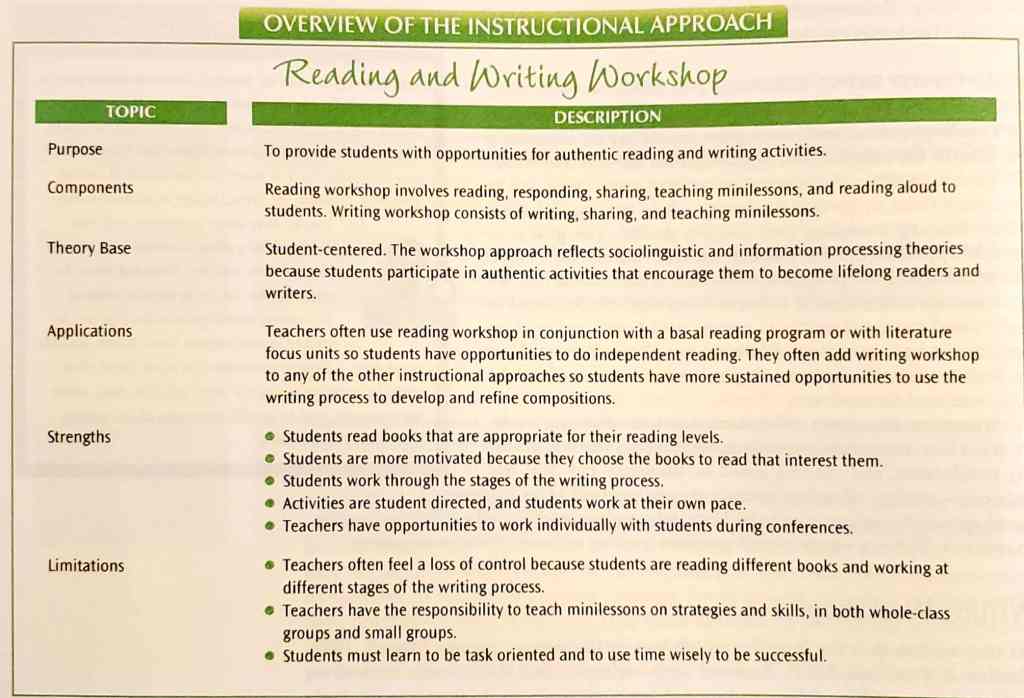
Reading and Writing Workshops are a student-centered approach to student learning where students are involved in authentic reading and writing projects. The components for a reading workshop involve reading, responding, sharing, teaching mini lessons, and reading aloud to students. Writing workshops involve writing, sharing, and teaching mini lessons. These workshops also include three main characteristics:
- Time – Students have large chunks of time and the opportunity to read and write. Reading and writing also become the core of the literacy curriculum.
- Choice – Students assume ownership of their learning through self-selection of the books they read and their topics for writing. Students choose their own books instead of everyone reading the same book or the teacher choosing the book. They also choose their own writing projects and choose topics related to their hobbies or content area units.
- Response – Students respond to books they’re reading in reading logs that they share during conferences with the teacher. They also do book talks with classmates to share books they’ve finished reading and they share their rough drafts and completely compositions they’ve written too.
Think-Alouds – A procedure in which teachers or students verbalize their thoughts while reading or writing to describe their strategy use.
Grand Conversations – Students talk about the text with their classmates about stories and poems and in discussions about nonfiction books and chapters in content area textbooks. In these conversations, students share their personal responses and tell what they liked about the texts.
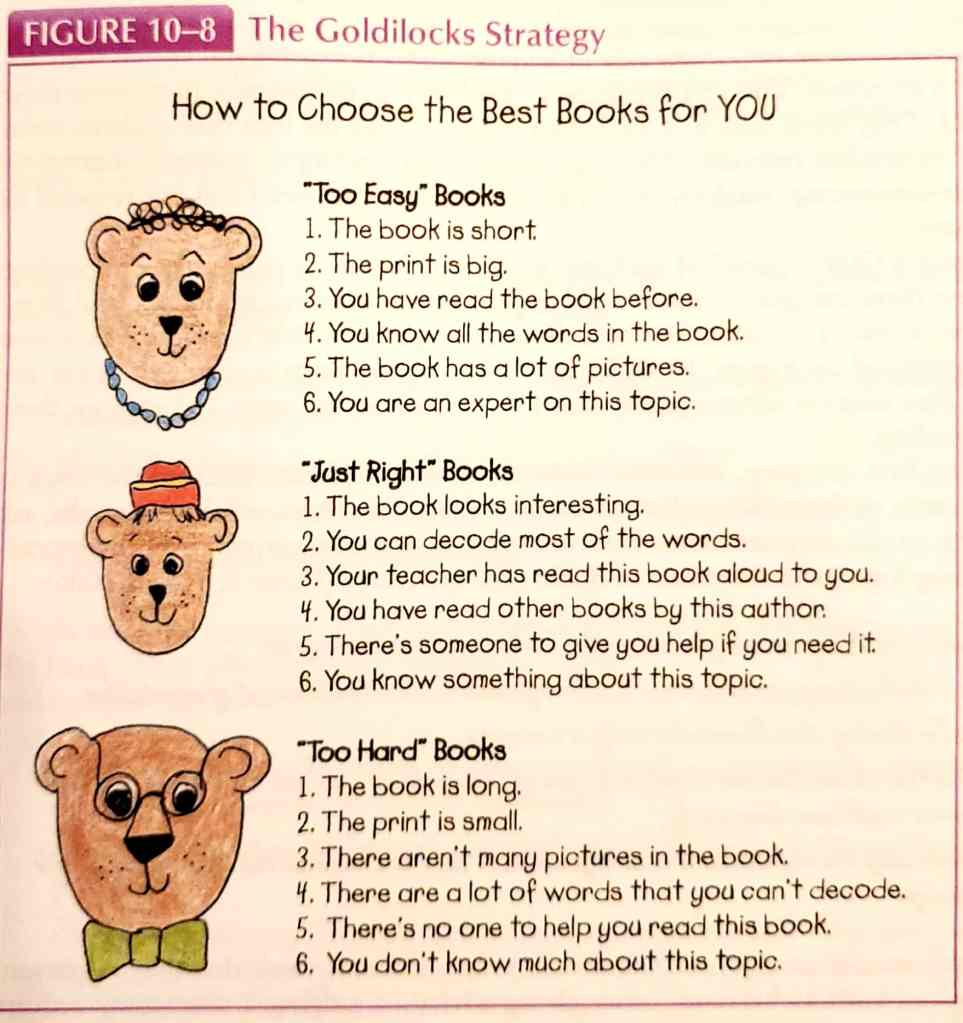
Goldilocks Strategy – This is a strategy for choosing books based off the folktale “Goldilocks and the Three Bears”. Using the folktale as the model, teachers create three categories of books: “Too Easy” books, “Too Hard” books, and “Just Right” books. The easy books are books the student has read before or can read fluently, the too hard books are unfamiliar and confusing, and books in the just right category were interesting and contained just a few unfamiliar words. The books in each category vary from student to student according to their reading levels. This approach is interesting because it can work at any level.
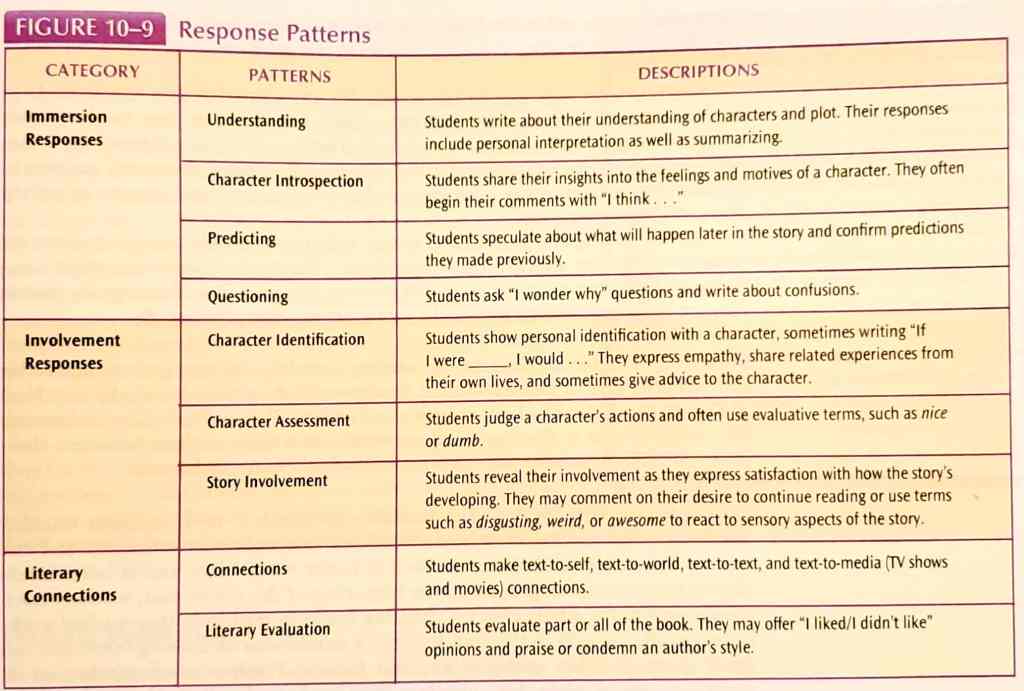
Responses in Reading Workshop – Students usually keep reading logs in which they write their initial responses to a book. They also dialogue with the teacher about the books they’re reading, and the journal allows for ongoing conversation with the teacher. There are three categories when it comes to these responses:
- Immersion Responses – Students indicate whether the book is making sense to them. They draw inferences about characters, offer predictions, and ask questions.
- Involvement Responses – Students show that they’re personally involved with a character, often giving advice or judging a character’s actions. They also reveal their own involvement in the story as they express satisfaction with how the story is developing.
- Literary Connections – Students make connections and evaluate the book. They offer opinions, sometimes saying “I liked…” or “I didn’t like…” and compare the book to others they’ve read.
SSR – Sustained Silent Reading is an independent reading time set aside during the school day for students in one class or the entire school to silently read self-selected books. It has similarities to reading workshops in that the students are reading and reading books they choose themselves, but reading workshops have five components whereas SSR has only one: reading.
Management of the Workshops – Teachers establish their workshop environment in their classrooms in the beginning of the year. They provide time for students to read and write and teacher them how to respond to books and to their classmates’ writings. They also develop a schedule for reading and writing workshop with time allocated for each component as well as make a classroom chart to monitor students’ progress. Teachers also take time during reading and writing workshops to observe students as they work together in small groups.
Classroom Application – One of the best tid bits from chapter ten that I thought would be really useful was the use of roles students play in literature circles. This keeps the circles and discussions livelier so the same few people who like to talk a lot take over discussions and others hardly get a word in. I also feel like this is great for students to see how their role can influence their thoughts on the book as well. I also like the idea that each person has a job, and they get to feel like they are part of a team and community furthering their interest and involvement. I also personally liked the idea of explaining to students that their choices in books matter by relating it to Goldilocks and the Three Bears. I can remember when I was in elementary school getting books that were way to hard for me because they were about a cool subject. I would only ever look at the pictures or attempt to read them briefly. Explaining this idea to young students sounds like a great idea to me.
 Travis Davis ENGED 275