Differentiation – Differentiated Instruction is based on an understanding that student differ in important ways. Differentiation is also providing specific ways for students to learn as deeply as possible and as quickly as possible without assuming one student’s road map for learning is identical to anyone else’s. Differentiated instruction is also characterized as rigorous, relevant, flexible, and complex.
- Rigorous – Teachers provide challenging instruction that encourages student’s active engagement in learning.
- Relevant – Teachers address literacy standards to assure that students learn essential knowledge, strategies, and skills.
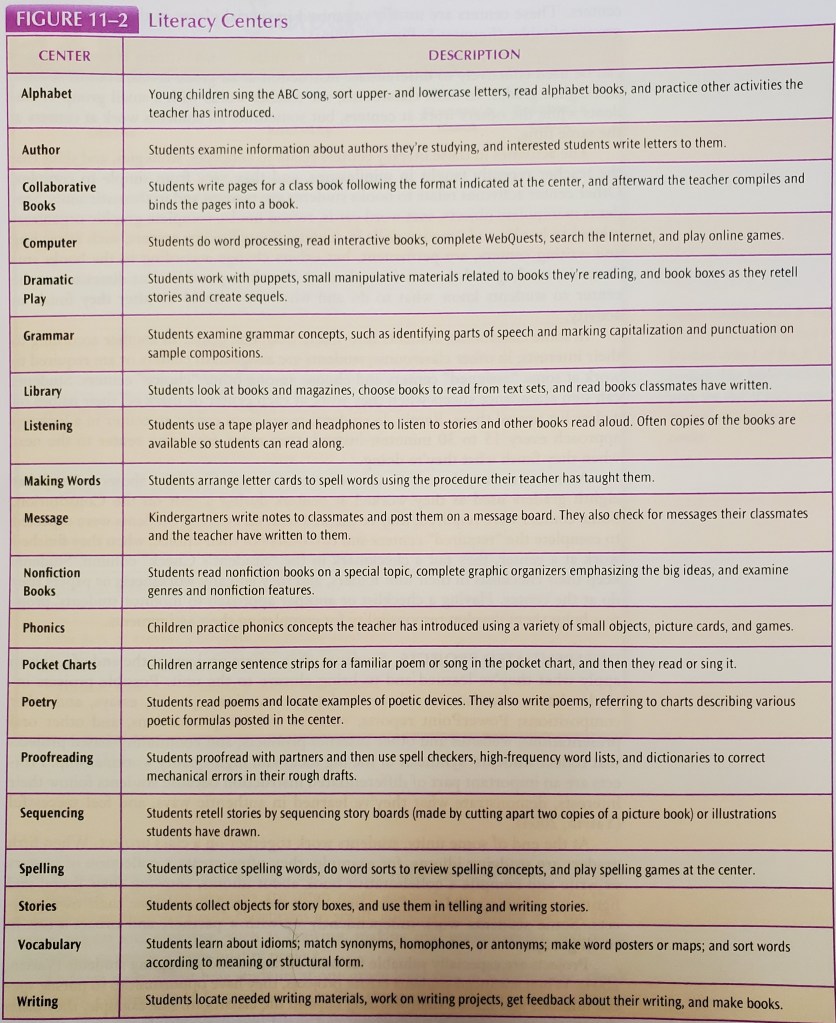
- Flexible – Teachers use a variety of instructional procedures and grouping techniques to support students.
- Complex – Teachers engage students in thinking deeply about books they’re reading, compositions they’re writing, and concepts they’re learning.
Teachers Modify Instruction In Three Ways:
- Content (what): This is the “what” of teaching, the literacy knowledge, strategies, and skills that students are expected to learn at each grade level. It is also how well does the student know the content. If not at all, they may receive more practice. If they know it, the activities they do may be more challenging or the teacher may move them through the content quicker.
- Process – This is the “how” of teaching, the instruction that teachers provide, the materials they use, and the activities students are involved in to ensure that they’re successful. A student may need more hands-on activities or be placed in a smaller guided reading group if needed.
- Product – Teachers vary the complexity or requirements of a project. The product is the result of learning, and it demonstrates what students understand and how they can apply it.
Grouping for Instruction – Teachers use three grouping patterns for instruction: whole class group work, small groups, and individually. Decisions about which type of grouping to use depend on the teacher’s purpose, the complexity of the activity, and the students specific learning needs. In differentiated classrooms, students are grouped and regrouped often and are not always grouped by academic performance.
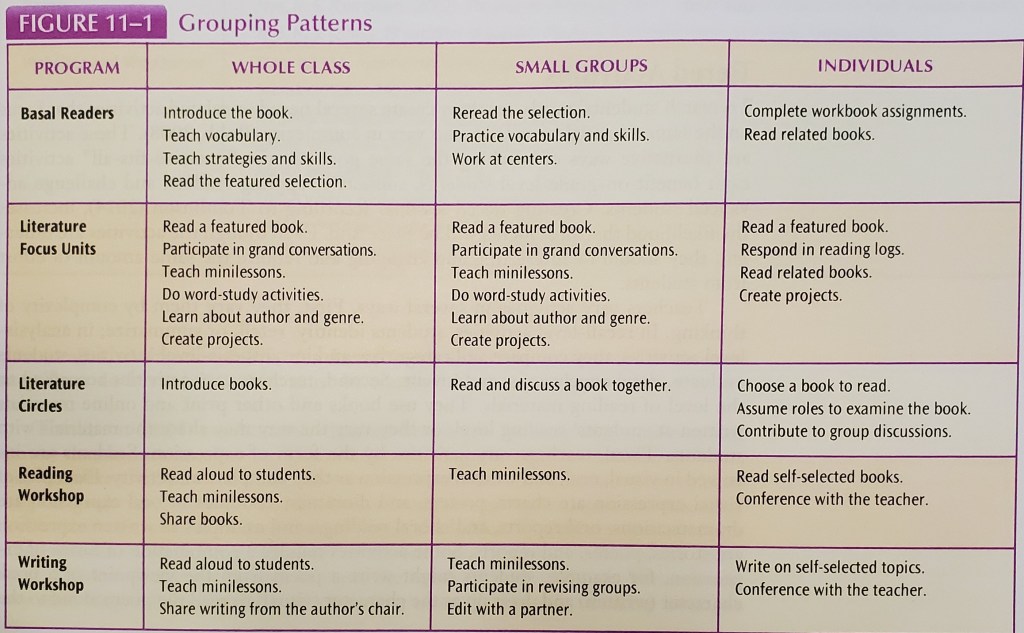
Guided Reading – Guided reading is usually done in small groups and can also be helpful for English learners, older readers, and those struggling who need more teacher support to decode and comprehend books they’re reading, learn reading strategies, and become independent readers. These are 25–30-minute lessons with four or five students who read at the same level. The students do the reading themselves and they use books that the students can read with 90-94% accuracy. The teacher will observe each of the students for a few minutes to check their fluency skills among other things as well as their attempts to identity words and solve reading problems. These observations can be helpful for teachers to plan future lessons as well as interventions.
Tiered Activities – Teachers create tiered or related activities that focus on the same essential knowledge but vary in complexity to match student needs. They vary activities by first varying the complexity thinking. Second, by varying activities according to the level of reading materials. Third, by varying activities by the form of expression. Tiered activities is also not RTI. Tiered activities have 3 different assignments as well: assignments that are on grade-level, assignments that are for struggling students, and assignments for advanced students. The advanced assignments are more challenging than the others and are not simply extra work.
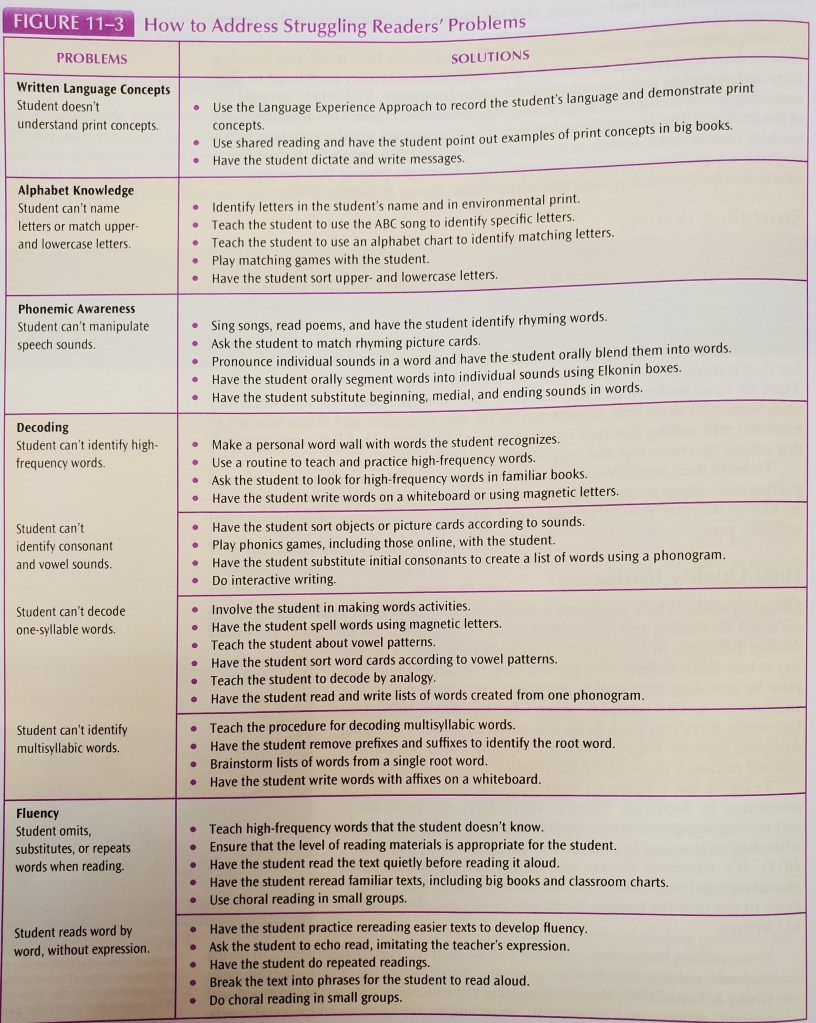
Characteristics of a Struggling Reader – These factors predict early reading difficulty in kindergarten or first grade:
- Difficulty developing concepts about written language, phonemic awareness, letter names, and phoneme-grapheme correspondences
- Slower to respond than classmates when asked to identify words
- Behavior that deviates from school norms
- Children with a family history of reading difficulties are more like to experience reading difficulties as well.
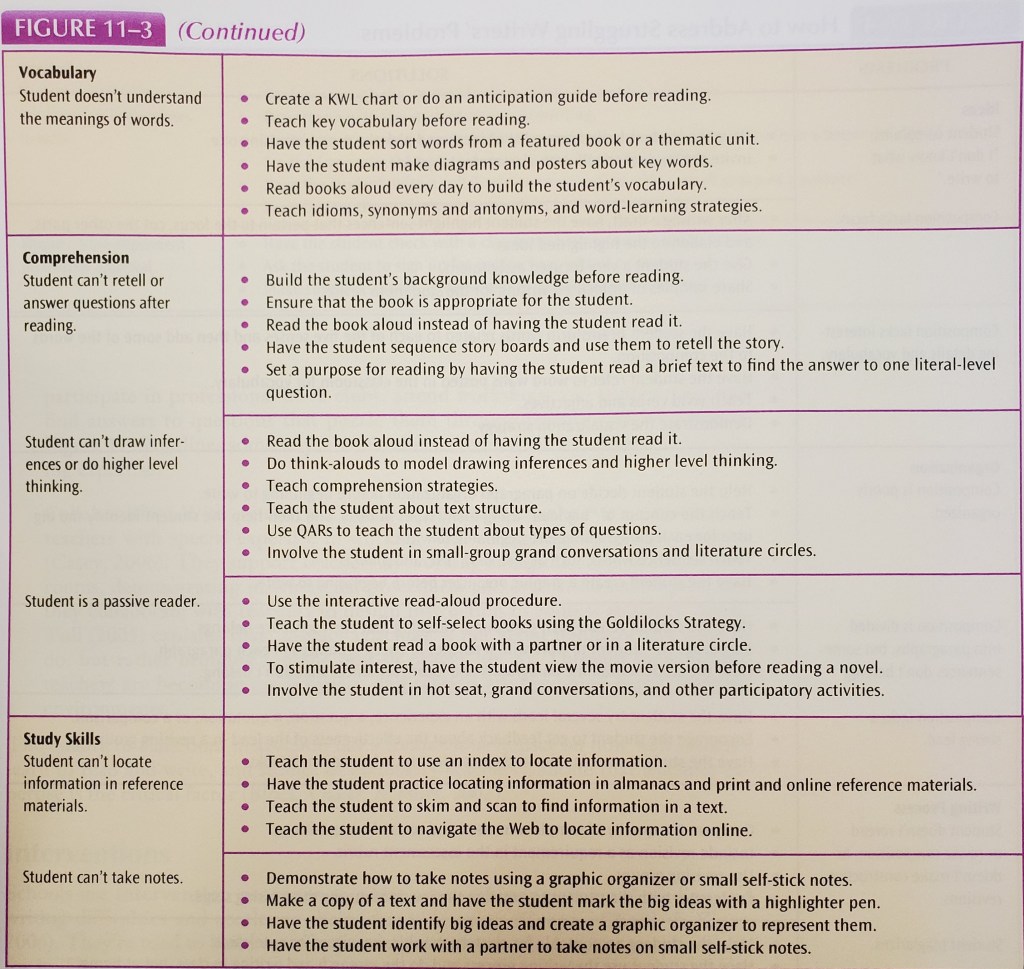
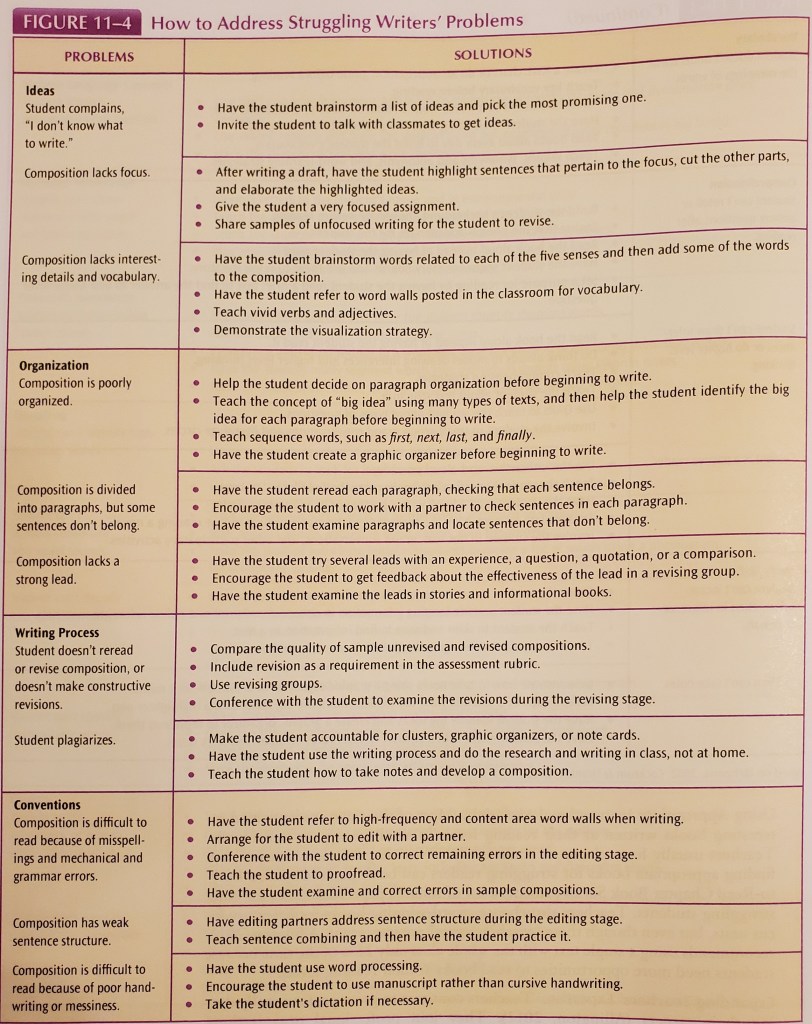
Characteristics of a Struggling Writer – Students struggling with writing will:
- Have difficulty developing and organizing ideas
- Struggle with word choice and writing complete sentences and effective transitions
- Have problems with spelling, capitalization, punctuation, and grammar skills
- Other students struggle with the writing process and using writing strategies effectively
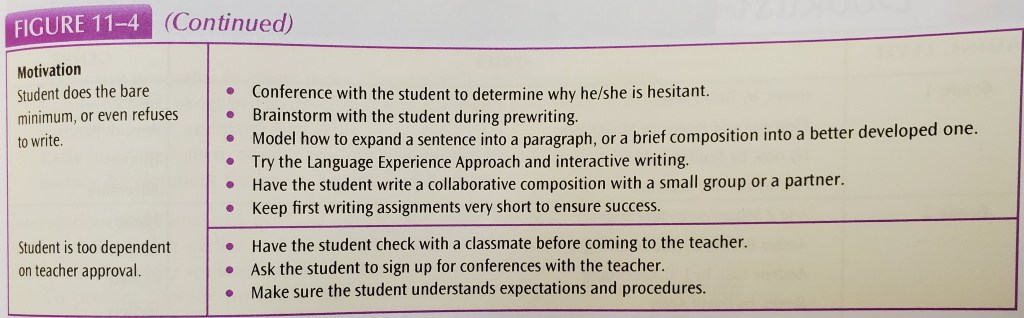
- Show little interest and do the bare minimum
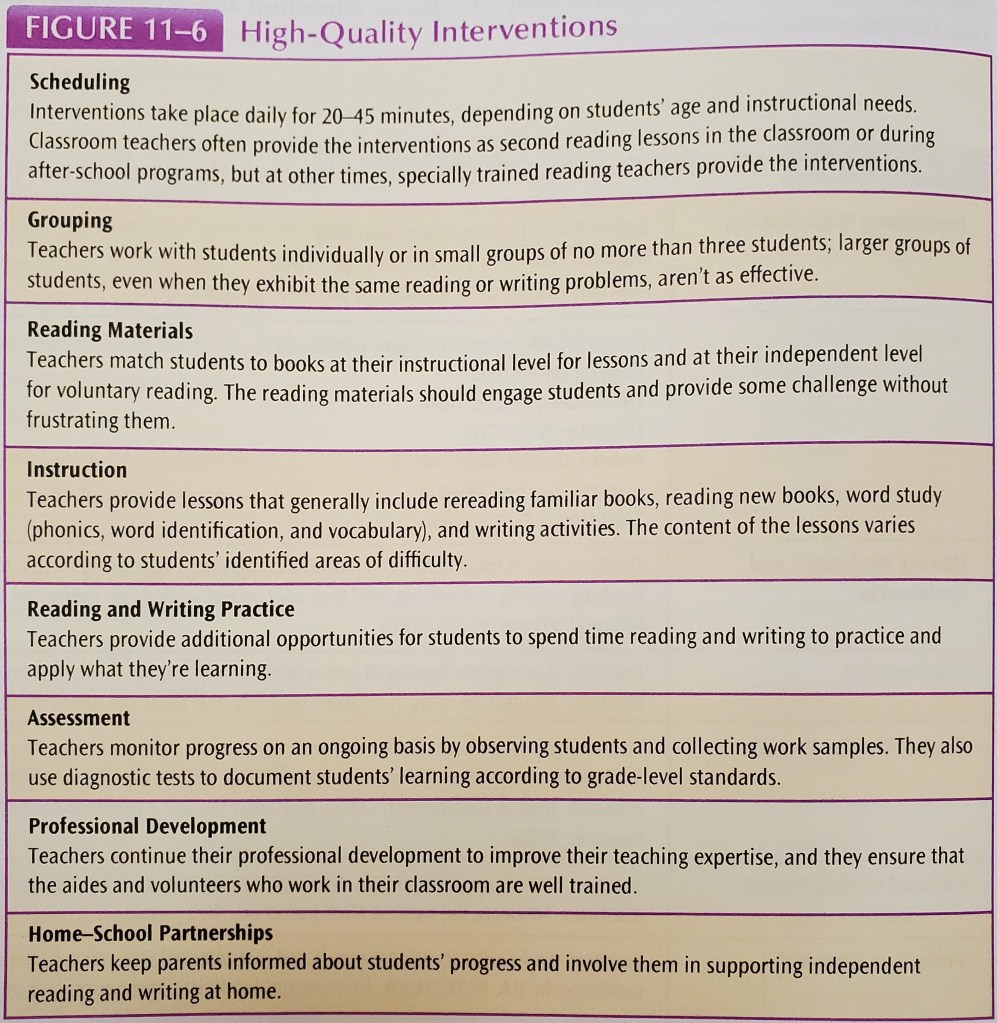
- Helping struggling students requires both high-quality classroom instruction and sustained personalized intervention.
High-Quality Classroom Instruction – Teachers use a balanced approach that combines explicit instruction in decoding, fluency, vocabulary, comprehension, and writing along with daily opportunities for students to apply what they’ve learned. It is also standards driven and uses research-based procedures and activities.
There are four components to enhance literacy development of struggling readers and writers:
- Differentiating Instruction
- Appropriate Instructional Materials-books for struggling readers too
- Expanding Teachers’ Expertise-professional development
- Collaborating with Literacy Coaches
The quality of classroom instruction has a tremendous impact on how well students learn to read and write. Teacher expertise is the critical factor!
Interventions – Schools use intervention programs for economically disadvantaged children and their parents to address low-achieving students’ reading and writing difficulties and accelerate their literacy learning. For early interventions, there are two programs funded by the United States federal government: Head Start, which is a program similar to preschools, but here children grow rapidly in their knowledge of concepts about written language and understanding of literacy behaviors; and Even Start Literacy Program which integrates early-childhood education and literacy instruction for parents into one program. Teachers have developed three types of interventions for preschoolers, kindergartners, and first graders:
- Preventive programs to create more effective early-childhood programs
- Family-focused programs to develop young children’s awareness of literacy, parents’ literacy, and parenting skills
- Early interventions to resolve reading and writing problems and accelerate literacy development for low-achieving K-3 students
Reading Recovery – 30-minute daily one-on-one tutoring by teachers for the lowest-achieving first graders. Reading recovery lessons involve these components:
- Rereading familiar books
- Independently reading the book introduced in the previous lesson
- Learning decoding and comprehension strategies
- Writing sentences
- Reading a new book with teacher support.
Response To Intervention (RTI) – RTI is a schoolwide initiative to identify struggling students quickly, promote high-quality classroom instruction, provide effective interventions, and increase the likelihood that students will be successful. It involves three tiers with all decisions being data driven:
- Tier 1: Screening and Prevention – Teaching high quality instruction and screening all students
- Tier 2: Early Intervention – Early interventions, individualized instruction targeting specific needs, often happens outside the classroom
- Tier 3: Intensive Intervention – Special education teachers provide more intensive intervention to individual students and small groups
Interventions for Older Students – ¼ of students in the upper grades are struggling readers who need effective classroom interventions in addition to high quality reading instruction. These interventions should include:
- High-quality reading instruction: vocabulary and comprehension focus
- Instructional-Level Reading Materials: appropriate reading material for their age and reading level
- More Time for Reading: struggling students don’t read at home, they need to practice at school
Classroom Application – The best thing for me personally being both a math interventionist and resource teacher would be the chart/table with the great information on how to address struggling writers’ problems. Occasionally, I will have some free time in-between interventions, and I will usually walk around and try to find a student or two who need help with their assignments. Many of the middle school and high school students have to assignments called “daily writing” where they need to write a minimum of two paragraphs, and sometimes more, about a certain topic or topic of their choosing. I have found out during these last couple months that many of them have trouble writing/typing their thoughts down or are simply not sure when and how to begin their writings. But if I ask them a few questions or we brainstorm ideas the students could talk their way through 4 or5 paragraphs. And when I try to get them to start writing it all down, they freeze up and are never really sure what to write or where to begin. Going over some of the problems and how to address these problems with the students would help them tremendously. Even breaking down a few of the most relevant or most important ones could be used to help younger students as well.
 Travis Davis ENGED 275