Reading Instruction and Teachers’ Belief Systems
Systematic Instructional Approach – A structural learning approach that includes direct teaching, a logical instructional approach, ample opportunities for students to practice specific skills, and for students to move along a defined trajectory related to the sequencing of skills. These approaches may also be influences on their teaching styles and reflect a part of their belief system.
How Teachers Come to Know About Reading and Learning to Read
Autobiographical Narrative
Throughout a lifetime of interaction with the world around us, teachers and students both acquire knowledge in different ways. We acquire knowledge about reading and learning to read as we interact with people, processes, ideas, and things in our world. Teachers will develop a powerful tool called an Autobiographical Narrative that helps link their personal history as a read to instructional beliefs and practices. Some teachers like to read and others do not even though they know how. Others may have previously struggled with reading and their emotional scars influence their autobiographical narrative.
Professional Knowledge – The knowledge acquired from an ongoing study of the practice of teaching. This knowledge comes from teacher’s interactions within the world around them and from teacher education programs. The knowledge base they build upon comes from and includes learning about current theories related to teaching practices, modern research and practices, books and journals, workshops and other courses teachers take and the conferences they attend.
Literacy Coach – Someone who uses their expertise in reading and learning to read to provide professional development opportunities and resources for teachers and others to develop expertise in the classroom. Their primary role is to support teacher learning by providing a variety of activities like developing a curriculum with colleagues, making professional development presentations, modeling lessons, providing resources, and visiting classrooms to provide feedback.
Perspectives on Learning to Read
Alphabetic Principle – This principle suggests that there is a correspondence between letters and sounds. Learning to read English involves learning how the alphabetic writing system works. Interaction to facilitate development of this principle is required for learning and understanding that graphemes (letters) are the basic units of writing while phonemes are the sounds they make. Understanding how beginning readers master the alphabetic system is something teachers need to understand while using their knowledge of English writing to identify words.
Orthographic Knowledge – Knowledge of likely spelling patterns. Readers will use their abilities to group common letter patterns into syllables. They also us their knowledge of likely and unlikely letter sequences when encountering multisyllabic words. Skillful readers will chunk words into syllables automatically when perceiving letters while devoting less attention to encoding putting less energy into identifying words.
Schema Theory and Reading Comprehension
Schemata – The prior knowledge, experiences, conceptual understandings, attitudes, values, skills, and procedures a reader brings to a reading situation. Schema (the singular term) refers to how humans organize and construct meaning in their heads. Students use knowledge they already have to give meaning to new events and experiences. This means they take in the new information and give meaning to it by relating it to previous knowledge. Much of this is done automatically requiring minimal processing of working memory resources to allow problem solving to proceed with minimal effort and meaning making while reading becomes more efficient.
Schemata influence reading comprehension and learning. Schema function in at least three ways to facilitate comprehension. First, schema helps organize text information efficiently and effectively. Secondly, schema can help children predict upcoming information by allowing readers to make inferences about what happens or is likely to happen in a text. Thirdly, schema helps readers elaborate, speculating, judging and evaluating material, to help reason with print and make sense of it all.
Metacognition – The knowledge about regulation of some form of cognitive activity. For reading, metacognition refers to:
- Self-knowledge – The knowledge students have about themselves as readers and learners. Readers that are aware of their self in relation to texts and tasks they are better able to use reading strategies effectively.
- Task-knowledge – The knowledge or reading tasks and the strategies that re appropriate given a task at hand. Experienced readers are strategic readers and they use their task knowledge to meet the demands of their texts. They are also aware of whether or not they have understood what they have just read and what to do if they haven’t.
- Self-monitoring – The ability of students to monitor reading by keeping track of how well they are comprehending. Experienced readers expect reading to make sense, and if the reading does not make sense they know they need to go back and use correction strategies to get back on track.
Implicit – What something is supposed to mean or what a reading is supposed to mean that makes the most sense.
Explicit – Something that is stated clearly and in detail which leaves no room for confusion.
Teachers can make instruction implicit or give students implicit messages where students need to “make sense of it all”. Teachers can also make implicit messages about reading strategies explicit. Teachers use explicit instruction by modeling, demonstrating, explaining, rationale-building thinking aloud, and reflecting. Teachers use these practices to help students develop metacognitive awareness and strategic knowledge as well.
Reading from a Language Perspective
Piaget – Jean Piaget stated that language reflects thought and does not necessarily shape it. He states this because he spent most of his life observing children and their interactions with their environments. He developed a theory of cognitive development that explains how language acquisition is influenced by more general cognitive attainments. What is meant by this is that when child explore their environment they interpret and give meaning to their experiences. These events and their interactions are critical to development
Vygotsky – A Russian psychologist that also viewed children as active participants in their own learning. However, he believed that children who begin to talk more and acquire language competence begin to learn more. He also believed that as children begin to talk more out loud and carry on with external dialogue, they begin to have inner speech and thoughts which help regulate their own problem-solving abilities.
Psycholinguistics and Reading
Psycholinguistic view of reading combines a psychological understand of the reading process as well as an understand of how language works. This idea reflects upon how readers act on and interact with written language while making sense of a text. Readers also make mistakes or “miscues” because they are anticipating meaning and sampling a text for informational cues based on their expectations. Readers will search for and coordinate information cues from three distinct systems in written language: the graphophonemic, the syntactic, and the semantic.
Graphophonemic System – The print itself provides readers with a major source of information in this system. The symbols and marks on the pages represent speech sounds and more experienced readers will not have to use all the available graphic information in a word or sentence to decode and recognize it.
Syntactic System – The grammatical relationships within sentence patterns provides information to readers and this system depends on readers possessing knowledge about how language works. This system involves readers using their knowledge of the meaningful arraignment of words to construct meaning from the text. Readers can read the words in a sentence and understand a great meaning than just what the words say.
Semantic System – The schemata readers have while reading a text. This includes their background knowledge, experiences, conceptual understandings, attitudes, beliefs, and values.
3 Models of Reading:
Bottom-up – This model of reading involves the process of translating print to sounds. The process starts with decoding graphic symbols into sounds. Then the reader first identifies parts of letters, recognizes letters, combines letters to recognize spelling patterns, links spelling patterns to words, and then proceeds to sentence, paragraph, and text-level processing.
Top-down – This model of reading starts with translating print to meaning by beginning with the reader’s prior knowledge. The reader initiates the process by making predictions about the text and its meaning as well as decoding the text into sounds to “check” their hypothesis about the texts meaning.
Interactive – This model involves the process of translating print to meaning by using both prior knowledge and print. Readers start by making predictions about a text and/or decoding graphic symbols. The reader formulates hypotheses using the information from the semantic, syntactic, and graphophonemic sources of information.
Below are two great graphics describing the bottom-up and top-down processing and the information processing models of reading.
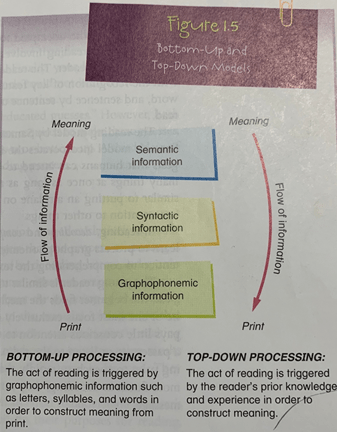
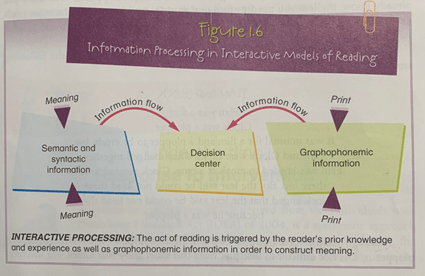
Vacca, J. L., Vacca, R. T., & Gove, M. K. (2012). Reading and learning to read (8th ed.). New York: Longman.
Classroom Application:
One of the best pieces of information I picked up from the chapter was the section describing metacognition. I always tended to have a very hard time reading in classroom setting, and even at home, because I would become distracted very easily or I would get lost in my thoughts. But learning about self-regulation and having knowledge about how I was as a learner could have been tremendously helpful. Student who know how they learn and read become better learners. I also think that if I would have been taught different ways to read a text strategically to ensure I was comprehending the material I could have become a better reader. Knowing when to ask for help with a text or how to look up unknown words are critical strategies for successful readers. If I could help readers learn about metacognition and how to be better students by using self-reflection I wouldn’t feel so bad about my own struggles knowing I helped them avoid the same mistakes. Helping students learn to do things differently and better is a great feeling.
 Travis Davis ENGED 275