Curriculum Perspectives
Curriculum – In the broadest sense, a curriculum is all the courses offered at a school. This often includes a set of courses and their content. Others consider curriculum to be what the teachers and the students actually do as they engage in the classroom. Decisions about curricula involve the instructional objectives or target the teacher emphasizes for the classroom literacy program; the materials the teacher selects and uses for instruction; the learning environment the teacher perceives as most conducive to children’s development as readers and writers; the practices, approaches, and instructional strategies the teacher uses to teach reading and writing; and the kinds of assessment the teacher perceives are best to evaluate literacy learning.
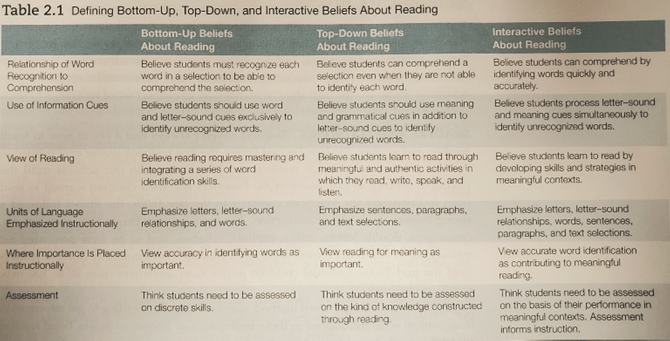
Whole Language – A progressive, child-centered movement and belief system focusing on the whole word approach to language and learning. Spelling patterns are not always reliable and the focus should be on the whole word. A whole language curriculum focuses on meaning learning experiences which include students’ reading, writing, speaking, and listening about things that are important to them and is also considered a solid top-down philosophy.
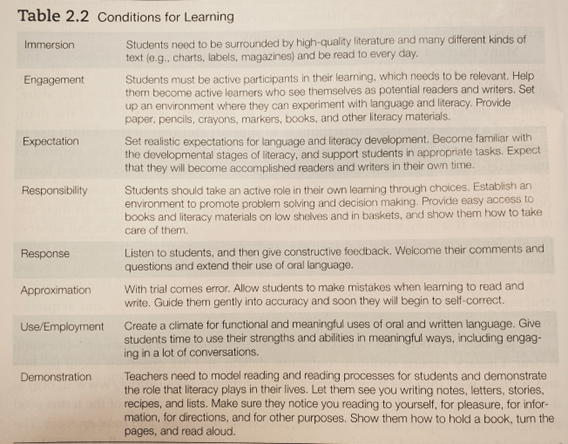
Classroom Conditions for Learning – Brian Cambourne proposed that children acquire early competence with oral and written language most easily when certain conditions are present in their environment. Effective classroom conditions happen with demonstrations, responses, and approximations during learning. Effective classroom teachers use “expectation messages” to continually repeat and reinforce dialogue to support their students to become effective users of literacy. These teachers tell their students:
- Becoming an effective reader, writer, speller, and talker is worthwhile, and will greatly enhance the quality of your life
- All members of the learning community are capable of becoming effective readers, writers, and spells
- The best way to become an effective user of literacy is to share and discuss the processes and understandings you are developing with other members of the learning community.
- It is safe to take risks and try things out in this setting
- Everyone is responsible for his or her own learning.
*Top-down Approach – A meaning-based approach that assumes that if children engage in meaningful reading and writing activities with the support of teachers and peers, they will be literate.
*Bottom-up Approach – A skills-based approach to reading is one where the emphasis of instruction is on skills such as phonics, alphabet recognition, fluency, and spelling – all of which help students write and decode texts.
Instructional Approaches
Basal Reading Approach – An all-inclusive set of commercially produced materials for providing classroom instruction. They are typically organized to illustrate and develop specific skills that are presented systematically in sequential order and taught continuously throughout all grades. These programs include materials such as whole-group interactive lessons and small-group differentiated lessons and feature level texts, formative assessments, practice books, and online components like virtual field trips, games for practicing vocabulary, interactive support, and digital copies of all the printed materials. These Basal Reading programs could be considered bottom-up approaches because they present skills to be taught in a sequence or an interactive program featuring unedited children’s literature selections, authentic informational texts, strategy instruction, and writing opportunities.
*From the chapters notes – A Basal Reading Program:
- provides a balanced literacy program
- provides a scope and sequence of skills and strategies to be taught (road map of where you’re going and what you’re teaching)
- gives you lesson plans, sometimes even the script of what to say to students
- includes workbooks and anthologies
Language-Experience Approach (LEA) – LEA is especially prevalent in Pre-K and kindergarten classrooms. It is often associated with story dictation, the recording of the language of students on chart paper and sing what they say as the basis for reading instruction. LEA also includes planned and continuous activities such as individual- and group-dictated stories, the building of word banks of known words, creative writing activities, oral reading of prose and poetry by the teacher and students, directed reading thinking lessons, investigation of interests using multiple materials, and keeping records or student progress. LEA can provide opportunities for meaningful text for students from diverse backgrounds. One of the main features of LEA is that it embraces the natural language of children and user their background experiences as the basis for learning to read. This approach is also used with English Language Learners.
Literature-Based Approach – This approach focuses on the individual reader, what reading level they are at, and using high-quality literature. The approach also focuses on accommodating individual student differences in reading abilities and at the same time focus on meaning, interest, and enjoyment. Reading the important part of this approach and students should be reading texts that they are interested in. Letting students choose books, reading about topics they are interested in, and writing about these interested topics is a great way to motivate and engage them. Teachers depend on literature for guided reading. Guided reading is a widespread approach to teaching reading that uses leveled books. A Leveled book collection is a large set of books organized by level of difficulty from easy to read books for younger students to longer, complex books that advanced readers select. Teachers will also use individual conferencing to discuss what students are reading about, to ask questions about the text and encourage students to think about the text, and to discuss any difficulties they had with reading the text. These conferences help students become more strategic readers and increase comprehension.
Technology-Based Approach – Learning to read using desktop and mobile devices. These online and technologically advanced ways of learning can greatly enhance student learning. Some of these ways include: videoconferencing with authors or students from around the world, creating video clips and class blogs, reading e-books, and collaborating documents online with others. Students can also access and retrieve vital information immediately. There are also a number of great tools, games, apps, and software available to help students learn to read and practice reading more effectively. Many programs are extremely interactive while others are simply for reading and writing. Teachers can also use technology to administer assessments, analyze data, make predictions, and differentiate instruction. If used correctly and effectively, technology can be an extremely successful tool in the classroom.
Individualized Instruction – Individualizing instruction happens when teachers are providing differentiated instruction to students. Teachers must first understand the learning profile of the individual student by reflecting on previous knowledge and direct experiences in reading classrooms over time. However, the term individualized instruction can mean different things to different people. Some believe it means programmed and prescriptive instruction while others believe it means flexible grouping for instruction. “Individualization is a process of personalizing teaching to provide instruction that recognizes and responds to the unique learning needs of each child.” (Vacca et al., 2018, p.46).
Integrated Approach – This approach suggests that the best way to teach is to use the best features from all of the approaches. To best meet the needs of students, teachers integrate different pieces of approaches to determine the instructional needs of their students. They determine what to teach using the Common Core State Standards (CCSS) and then they consider how to teach it. Simply stated, integrated teaching combines the best features of all the other approaches. The integrated approach also involves immersing students in reading, writing, talking, listening and viewing activities. The learning in this approach is done through a series of connections and not just by talking at separate time throughout the day. Language is integrated across other subject curriculums and topics like science, social studies, book studies, and themed units.
Explicit strategy Instruction – Directly teaching students what they need to know and providing opportunities for practice until they apply the skill independently. Effective teachers using explicit strategy instruction will model and demonstrate useful strategies that good readers employ. They also offer direct, explicit demonstrations of the thinking strategies uses by good readers when they read. This means they model the thinking that skilled readers use when engaged.
Instructional Scaffolding – Providing enough instructional guidance and support for students so that they will be successful in their use of reading strategies. Effective teachers will teacher specific skills and strategies for which students need to learn based on formal and informal assessments and data.
Classroom Application – One of the best bits of information from this week’s chapter has to do with the conditions for learning. At the beginning of the school year, all of the teachers and aides at the school I work at made social contracts to better our school and our classrooms. The teachers then made social contracts about our expectations and rules for the classroom directly with the students the first week of school. I mention this because I think that it’s important that students know what is expected of them and what is expected from the teacher. Knowing that all members of the classroom are a part of the community of learners and that each one of them is capable of becoming effective readers and learners is important. When students know that it is safe for them to take risks and to try things out the become more engaged and become better learners. When teachers apply the effective classroom conditions and create a safe environment with a deep engagement for learning students become more effective users of literacy. I personally was a bit surprised by a few of the things I read and I realized that I definitely need to work on some of the topics the authors discussed in the chapter. I also think its incredible that a teacher’s expertise in teaching is more important than being an expert in the subject matter. Knowing how students learn can be much more impactful that knowing the subject and that was very interesting to me. It shows me that even though I may be very good at math, I may not be a very good math teacher.
Notes from the weeks readings and videos:
Reading A-Z https://www.readinga-z.com/helpful-tools/about-running-records/
We will be using Reading A-Z for tutoring a student and making running records for this student. Part of this weeks reading was to read about running records using the A-Z program. Running records are one part of a three part process for placing students in the correct placement level for their reading texts. Part 1 involves students reading benchmark passages or benchmark books and capturing their reading behavior on running records. Part 2 involves students retelling the text and using rubrics to score them. Part 3 involves students taking an oral or written comprehension quiz. Running records are used to place the students at their appropriate level so they can read appropriate leveled texts. They are also used throughout the year to monitor student’s progress. The different developmental levels of student readers also have differing schedules for how often they should be reassessed. There were lots of detailed instructions on how appropriate texts are to be found and how to assess for comprehension as well. Rubrics and scoring sheets are used throughout and the scores are used to either keep students at their current level, move them down a level, or to move them up a level. Some students may also need a bit more instruction before moving up or down as well.
Notes from the videos:
This video is a documentation of a teacher giving a running record assessment with a 6-year-old boy. We see the teacher making notes on sheets of paper with the words from the story. She is marking whether or not the student is correctly reading and speaking the words in the story. After making marks for the words read correctly/incorrectly, she then moves on to asking comprehension questions about the story. She writes down and takes notes on the student’s answers. She also asks several open ended questions to help guide/scaffold the student to their answers. She also introduces new words into the student’s vocabulary after going over several questions and describes their definitions as well. For instance, she mentions a baby cow is called a calf.
In this video a teacher is administering a running record for a student who is reading a story. She marks down on paper whether or not the student read the words correctly. When the student is done reading the first part of the story, the student then reads another section of the story quietly while the teacher goes over her notes and scores the assessment. The teacher mentions to the student that she will be asking some questions after he reads the section. She asks him several open-ended questions and questions about the story. After answer a few questions, the teacher asked the student to draw an answer for one of the questions from the story. She used lots of positive reinforcement and encouragement throughout
This video is about the units and the components of language. It states that language consists of three units. The first unit is phonemes. This is an individual sound. The second unit is a syllable. This is a unit of spoken language larger than a phoneme which contain a vowel and consonant or just a vowel. The third unit is word. Word: the unit of language which are the main block from which sentences are made. He then goes on to discus the components of language. The first part is phonetics: the student of speech sounds that humans can make to produce language. The next component is phonology: the study of speech sound of a particular language. Next is morphology: the study of the smallest unit of meaning (word) in a language. After that is Syntax: the study of how individual words are combined to create sentences. As words are grouped together when we communicate following grammar for a certain language, this is called syntax. The fifth component is semantics. Semantics refers to the ways in which a language conveys meaning. The last component is pragmatics: refers to the ways the members of a speech community use the language. Language usage differs from place to place and in different situations.
This video is about good instruction and effective teachers. One effective teachers uses nonsense words to work on their reading ability by looking at just the letters and the phonics with them. Another teacher breaks students into ability groups to better help those in need of extra help. The narrator also mentions two questions to ask if your school is doing a good job: Do they assess all students regularly? And is the instruction explicit? The video then goes on to discuss phonemic awareness, phonics, and many other educational terms teachers use in their daily lessons for reading and learning to read. Later in the video, the narrator discusses assessments and how teachers use assessments to identify the reading abilities of their students. Some students need a bit extra support and individualization. They also discuss testing options for special education or IEP’s for students for them to be successful.
Beliefs About Reading and Curriculum Perspectives
The Traditionalist teacher focuses on teaching and groups students according to their similar needs, interests, backgrounds or abilities. The teacher disseminates information, lectures, and dominates instruction; viewing the student as a receptacle that receives knowledge in a passive and compliant manner.
The Progressive teacher focuses on activating student’s ability to engage in active self-learning experiences. Students are grouped in a way that represents their diverse needs, interests, backgrounds or abilities. The teacher views their role as a facilitator, coach and as an agent of change; guiding students to learn through discovery as they construct their new understandings and build knowledge.
The Critical Theorist teacher focuses on developing student’s critical thinking and groups students to reflect their diverse needs, interests, backgrounds or abilities. The teacher facilitates learning through the promotion of dialogue and inquiry; encouraging students to question and engage in current issues in the world. The critical theorist believes that learning occurs through authentic experiences within in the world within which students live.
The Existentialist teacher focuses on respecting the individual to develop themselves as they believe students are capable and competent in being able to direct their own learning. Teachers help students define their own essence by exposing them to a variety of paths they make take in life. They believe students should choose the material they wish to learn about and accept complete responsibility for their thoughts, feelings, actions and learning.
It is important to acknowledge what your philosophical stance is because it is “crucial to achieving balance in the teaching of reading because instruction involves the kinds of decisions that teachers make based on how children learn to read and how they can best be taught” (Vacca et al., 2018, pp.33-34). Your philosophical stance will strongly influence which model of instruction you will predominantly use as a teacher of reading: bottom up, top down or an interactive model.
Teachers with a traditional philosophical stance will typically gravitate towards the bottom up curriculum perspective to teaching reading. “Teachers who possess a bottom-up belief system believe that students must decode letters and words before they are able to construct meaning from sentences, paragraphs, and larger text selections” (Vacca et al., 2018, pp.35-36). They believe that each word must be recognized; that word and letter-sound cues are used exclusively to identify words; and, they place an emphasis on letters, letter-sound relationships and words.
Conversely, teachers that hold progressive, critical theorist and existential philosophical stances will typically embrace a top down curriculum perspective to teaching reading. Vacca et al. (2018) state “teachers who have a top-down belief system consider reading for meaning an essential component of all reading instructional situations” (p. 36). They believe that comprehension can occur without identifying each word; that all cues are used to identify words; and, they place an emphasis on sentences, paragraphs, and text selections.
Comprehensive Programs & Effective Teachers
Teachers draw on multiple approaches to achieve a comprehensive program. You have learned about some of these in the pre-requisite course ENGED275 Developing Literacy. These instructional approaches include:
- The Basal Reading Approach – is a method of teaching children to read that employs books, workbooks and activities in a sequence in which each book or activity is designed to build on the skills learned previously. The Reading A-Z subscription you have for this class is an example of a basal reading approach.
- The Language-Experience Approach – is based on the children’s language and experiences. During this approach the children dictate words and sentences about their experiences and the teacher writes down what they say. This could also be the experience of writing a collaborative book where each child creates one page in the book. “It is most frequently used as a supplement to other programs and is especially useful with students who are at the beginning stages of learning to read” (Vacca et al., 2018, p.42). For this reason, it is a popular instructional approach in early elementary classrooms.
- Literature-Based Instruction – a type of instruction in which authors’ original narrative and expository works are used as the core for experiences to support children in developing literacy. The types of activities done with the literature are the natural types of things children and adults would do when reading and responding to any good book. For example, it is natural to share and talk about a good book after reading it; it is not natural to answer ten questions about the book. The teacher’s role becomes one of planning and supporting authentic learning experiences.
- Technology-Based Instruction – Technology based reading strategies are becoming a more and more common practice in today’s literacy instruction. Technology based reading includes the use of software, applications, mobile and desktop devices to teach reading. Technology is revolutionizing the way that teachers teach, and students learn.
- Individualizing Instruction –focuses on the needs of the individual student. Teaching is specific and targets one need at a time. This teaching method can be used on its own, or it can be part of differentiated teaching. Some students who receive individualized instruction need teachers to help them understand and learn.
- Integrated Language Arts – the provision of language experience throughout the grades by immersing students in reading, writing, talking, listening and viewing activities and can cut across subject matter areas.
*https://uws.instructure.com/courses/566363/pages/comprehensive-programs-and-effective-teachers?module_item_id=17566922 – Typo between language and experience – no space
Effective teachers are explicit in their instruction and adapt their instruction based on students needs. They monitor student progress during (formative assessment) and after instruction (summative assessment). Through consistent and regular monitoring of student’s ability to know, understand and apply these new skills and practices, effective teachers can identify what skills need to be retaught and adapt instruction to the individual needs of their students. Likewise, they can then plan to provide opportunities for students to apply both newly acquired and already established skills and strategies in a variety of contexts and across the curriculum. Effective teachers provide a wide range of reading experiences in all areas of the curriculum providing multiple opportunities throughout the learning schedule daily.
 Travis Davis ENGED 275