Instructional Principles for Students Speaking Diverse Languages and Dialects
Translanguaging – A contemporary concept for educators which includes a view of English language learning that is characterized by speakers moving from one language to other languages when they communicate. When teachers use translanguaging, LOTEs (Languages of than English), and allow students to integrate their heritage language into social and instructional conversations in the classroom they can provide a safe environment for ELL students and can foster academic achievement.
Here are some second-language acquisition principles for classroom practice:
- The social context for learning a second language must be a setting in which students feel accepted and comfortable.
- Students in small groups and pairs should have natural opportunities for meaning-making and authentic communication.
- Students need time to listen and process without the pressure of oral and written production. They are often rehearsing and creating systems while silent.
Instructional Strategies for Students Speaking Diverse Languages
It’s important for teachers to remember that learning a second language should not mean losing the student’s first language. Teachers can support ELLs in the following ways:
- Including environmental print from the child’s first language in the classroom. Lael objects in the first language and in English so that everyone is learning a second language.
- Make sure that the classroom and school libraries have books in languages other than English as well as books written in English representing the cultures of the children.
- Encourage children to bring in and share artifacts, music, dance, and food from their cultures, and encourage their parents to participate in selecting the artifacts.
- Help children publish and share their writing in their first language.
- Enlist the help of bilingual aids – other students, parents, teachers’ aides, or community volunteers.
- Use commercial or student-produced videos and computer software to support language learning and improve self-esteem.
- Help ELLs find support on the internet. There are chat rooms, available 24 hours a day, in which students can met others speaking their first language. They can engage in peer discussions as well as share ideas about learning English.
- Connect with families. Welcome them into the classroom to observe and to share their language and culture. Even though their English may be limited, they often enjoy teaching the numbers, days of the week, greetings, and other common expressions.
Teachers can also use other techniques and approaches to help ELLs. Some of these include: sheltered English adaptations, using Sheltered Instruction Observation Protocol, instructional conversations, response protocol, wordless books, and content area practices.
Instructional Conversations – An effective way to engage students in diverse language classrooms where teachers facilitate students’ prior knowledge and experience about a topic, build on the students’ backgrounds, engage in extensive discussion, and guide understanding.
Response Protocol – A way to encourage productive talk and academic language development by having teachers elaborate on student language. This approach and its design provide a framework for teachers to ask questions and how to elaborate on short-answer and one-word responses.
Cultural Diversity in Literacy Classrooms
Instructional Beliefs About Cultural Diversity
Contribution Approach – An approach to cultural diversity which focuses on holidays and festivities that are celebrated by a particular culture.
Additive Approach – A multicultural approach which focuses on thematic units about different cultures that are integrated into the curriculum. This thematic approach can also address multicultural issues.
Transformative Approach – A more social multicultural approach where students read and discuss various cultural perspectives. This approach provides students with opportunities to red about cultural concepts and events that are different from their own, make judgments about them, think critically, and generate conclusions.
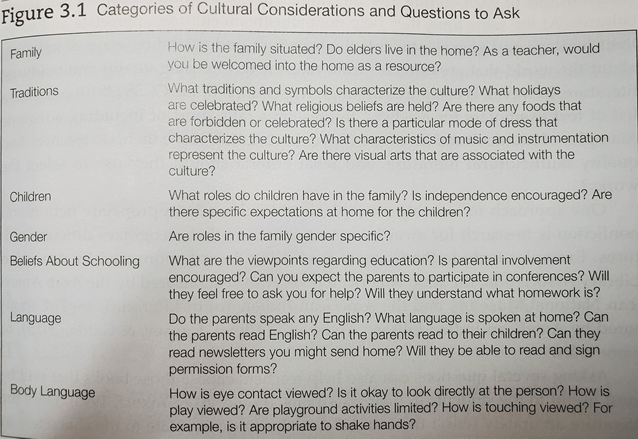
Below is a table detailing the categories of cultural considerations and questions to ask.
Academic and Cognitive Diversity in Literacy Classrooms
Instructional Beliefs About Academic and Cognitive Diversity
Academic and Cognitive Diversity – Our glossary textbook glossary defines this word as: the situation that results when children learn faster than, slower than, or differently from what is expected in school. The importance here is that teachers need to recognize that students have diverse academic needs and that teachers need to be aware of instructional principles and strategies that address cognitive differences. These beliefs are often grounded in definitions, categories, and labels as well.
Dyslexia – A specific reading disability in which individuals have difficulty in processing the phonological components of language. Others state dyslexia as a specific learning disability associated with differences in the ways people process language.
Exceptional Students – Students who have been identified as being gifted or talented with the term giftedness being defined as abundant talent in any of seven intelligences.
***It is important to note that just as the number of ethnic and minority students in special education is disproportionately high, the number of ethnic and minority students in gifted and talented programs are not adequately represented (as in they are at lower rates than others).
Federal Legislation
Public Law 94-142 – A significant piece of legislation regarding the instruction of students with disabilities. Public Law 94-142, the Education for All Handicapped Children Act, passed in 1975 and includes principles such as: evaluation procedures must not be discriminatory, all children are entitled to a free and appropriate education, and an individualized education program (IEP) must be designed for all children with disabilities.
Individuals with Disabilities Education Act (IDEA) 2004 – Public Law 94-142 has been restructured over the years with many added stipulations and changes. Some of these stipulations include that states must consider a child’s response to scientifically based interventions or alternative research procedures for identifying students with specific learning disabilities and that special education teachers must be highly qualified. Many of the criteria from IDEA laid the groundwork for Response to Intervention (RTI).
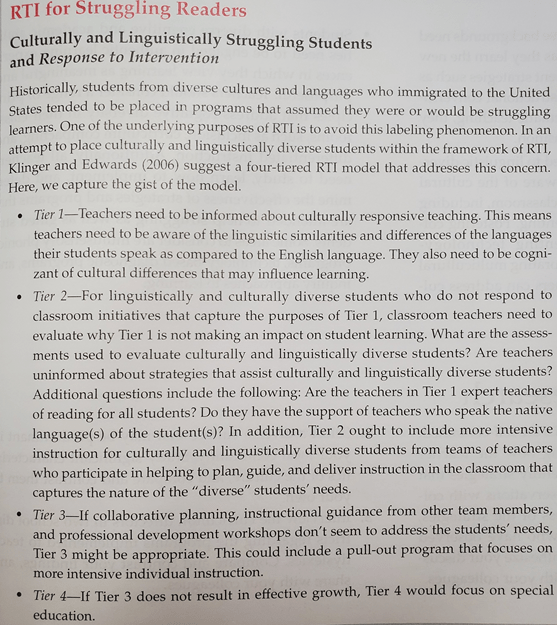
Below is a chart describing the four-tiered model for RTI and diverse learners.
Instructional Principles for Academic and Cognitive Diversity – The essential components for an effective literacy program include instruction of phonemic awareness, phonics, vocabulary, comprehension, and fluency. There are also suggested guidelines for literacy learning for all students, including those with diverse literacy needs. Teachers should: assess students regularly, focus instruction on critical literacy strengths and weaknesses, use authentic learning experiences, use students’ interests for instruction, provide students with positive feedback, and engage parents in the learning process. Effective teachers also deal with inclusion, curriculum compacting, and differentiated instruction as well.
Inclusion – Children with special needs are included in the regular classroom and receive assistances from the regular education teacher as well as the special education teacher. This means teachers are incorporating the diverse needs and abilities of all students into classroom instruction. Besides instruction that focuses on their strengths and setting high learning outcome goals, inclusion gives special education students the opportunity to learn from their peers, to develop friendships and social skills, and accept challenges they normally would not as well as showing other students about the nature of differences in the real world. Some of these differences include showing differences in learning while others include showing atypical social skills and the different needs of others.
Curriculum Compacting – To keep gifted students engaged and challenged, teachers will compress a curriculum in an alternative way. Teaches do this by identifying a unit’s objectives and outcomes, enriching this curriculum using innovative methods, assessing student’s knowledge and skills based on those outcomes, and collaborating with the student to enrich knowledge using accelerated avenues.
Differentiated Instruction – A type of instruction based on assessing students’ needs on a regular basis, implementing multiple approaches to learning, and blending whole class, small group, and individual instruction. There are differences within classrooms about what individuals know and how they learn. Teachers will custom tailor lessons and activities in multiple ways for students to learn and express what they have learned. The overall idea for this is that the teaching is adapted for all learners to meet individual needs.
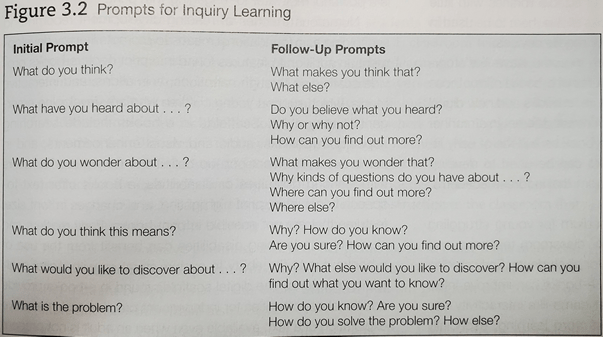
Inquiry Learning – A classroom approach for teaching math and science where teachers can challenge gifted students and those with special needs in literacy learning. Children are curious learners and this learning focuses on the meaning-making process. This happens when children experiment, solve problems, and discover how the world functions. Teachers use prompts to foster inquiry learning and to encourage active participation. The figure below shows several prompts teachers may use:
Classroom Application:
This chapter was full of great information for teachers to use directly in their future classrooms. Some of the sections I believe might be most useful for classroom application discuss cultural diversity in the literacy classroom. There was a large amount of information on how to discuss diversity in the classroom and how these diverse learners learn. It was also interesting to read about how teachers should be labeling everything in the classroom in the student’s native language and that we can’t simply dismiss it. But in reality, we should be encouraging students to use their native languages and supplying them with diverse educational materials. Throughout the chapter there were very useful lists and principles about how to work with multicultural students and the best ways to help ELLs. I have made special post it notes for a couple sections in the chapter in case I ever have the opportunity to work with multicultural students. Knowing the best ways to help these students be successful learners and learn to read is very important to me and I wouldn’t want to say or do the wrong thing.
I also like how the book touched on the beliefs and approaches to learning teachers may have coming into a classroom. Understanding the four approaches characterized by schools was another topic I reflected upon. Taking the heroes and holidays approach or the contributions approach to cultural diversity and learning can lead to glossing over the victimization and oppression that has occurred. While it may seem well intentioned for teachers to celebrate these holidays, it can also reinforce negative stereotypes about these cultures too. Although learning about these heroes and holidays is better than nothing, we still must try to be better about educating our students about the world and its ever-changing people.
Notes about the videos
This great video discusses differentiating instruction. They discuss meeting the needs of everyone in the class and understanding that all students have different background knowledge they bring with them. They also discuss pairing students and how sometimes effective teachers will pair similar ability students and other times they will pair different ability students. One key point was at the very end when one of the speakers mentions, “Making it accessible to everyone”.
This video discusses the differences between differentiated vs individualized vs personalized learning. The video mentions that differentiated learning connects the academic goals to students diverse learning needs, and individualized learning is about the student and if they have mastered something or not. Personalized learning combines both differentiated and individualized learning. This starts by getting to know the students as individuals and building a learner profile about them. Next is to set goals with the student. Then teachers will build pathways with their students before working with the students to fill in these pathways with instructional pacing, technology tools and other resources and assessments. This individual pathway is circular. It starts with the learner profile, then the academic goals, next the instructional pacing, and finally the skill assessment before moving back to the learner profile. Collecting data and revisiting pathways to check progress and mastery is key.
This brief but full of information video describes the impact the 1974 law that required public schools provide students a free and appropriate education and the changes that have been made since. It included some of the technical changes to the laws and how the impact schools across America. One of the most important changes was that special education teachers need to be highly educated.
These two videos discuss cueing in the English language and how deaf or those hard of hearing learn to read. What was really incredible for me, as someone who is hard of hearing and wears hearing aids, was just how similar many sounds in our English language are. I have always been a pretty good lip reader, but that is generally only because I also can hear people speaking a little bit. So even when I can’t hear them completely, I can still make out some of their words to fill in the gaps. But with the cueing system, it makes lip reading much easier. As for sign language, it always amazing me how fast and incredible ASL speakers are. This very informative video demonstrates many of the issues ASL learners run into and the similarities and differences to standard language learners. It was extremely powerful to watch and understand because there was no sound as well.
This great video discusses the SIOP model for teaching English learners. It details what effective teachers do and how they deliver their lessons with content objectives supported, language objectives supported, and the students are engaged. Throughout the teacher’s lesson, she calls on many different students, presents materials in different modes, using clear and effective language, and uses positive feedback to her students. She discussed objectives and had students repeat important information many different times.
 Travis Davis ENGED 275