Informational Text – Text that is explanatory in nature and conveys factual information to increase an individual’s knowledge of a subject matter. There are many different types of and genres of informational text, including textbooks, technical texts such as “how to” books, manuals, newspaper and magazine articles, reports, summaries, and online resources, as well as books about science, history, social studies, and the arts.
Academic Language – The words that are not typically used in everyday conversations, but rather vocabulary that relates to academic content.
Readability – The relative accessibility or difficulty of a text. Readability formulas can help estimate the difficulty of any text, but they are not intended to be precise indicators. These formulas typically involve a measure of sentence length and word length to ascertain a grade-level score for text materials.
Organizing Informational Text Instruction
Informational Text Circles – Similar to literature circles, informational text circles are a cooperative learning strategy in which students assume different roles as they read in small groups.
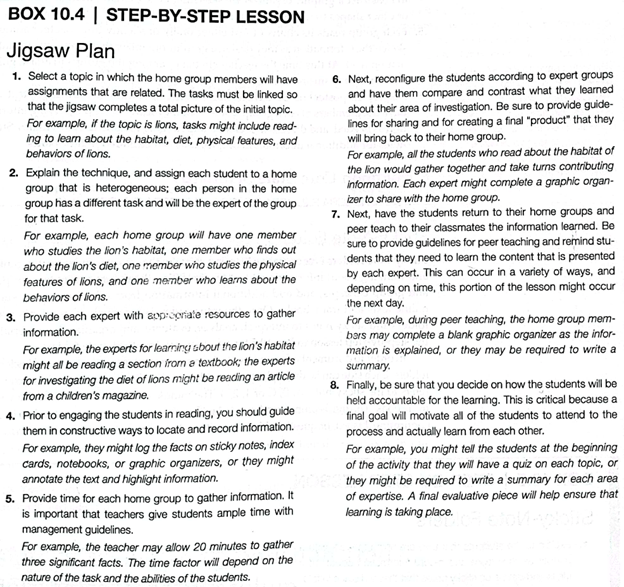
Jigsaw – A cooperative learning strategy in which students assume roles as they read and share their understanding of the content in small groups. Or, A cooperative learning strategy in which students read selections of informational text and become experts in the topic. The experts share with members of small groups.
Below is an example of a step-by-step Jigsaw Lesson Plan.
Idea Sketches – Idea sketches are the use of graphic organizers that students complete in small groups as they read informational text/textbook material. Here is how idea sketches work:
- Introduce the overall topic under study and activate the students’ background knowledge through discussion. Point out the organization of the text by referring to main topics and subtopics.
- Chunk the text by dividing it into manageable sections. Topic headings or subtopics work best for this.
- Divide the class into small groups or pairs, and assign (or have students select) the chunk they will read.
- Instruct the groups to place the topic of inquiry (topic or subtopic) in the center of a large poster board and circle it. This is the beginning of the “sketch.” Model how to construct a graphic organizer by sketching boxes, circles, triangles, diamonds, or other shapes to represent main ideas and details.
- Each group reads its chunk of text either orally or silently, and together students sketch the information as they design a graphic organizer that represents the information read. At this time the teacher circulates among the groups to assist, guide, and clarify any misinformation.
- Display the poster boards in chronological order according to the original text and have the members of each group share what they learned. Add clarifying information as needed and discuss the relationships among the poster board topics. Sticky notes for additional information or questions can be added to the boards.
Trade Books – Literature and informational books widely available in bookstores; Used by teachers to supplement or replace sole dependence on textbooks and reading or content area instruction. In other words, informational books used to supplement the curriculum and content textbooks.
Text Sets – Groups of books that share related concepts in different formats, or a group of trade books that have a common theme. Teachers need to use a variety of genres when considering informational texts and educational researchers recommend using text sets that include storybook formats.
Informational/Nonfiction Text Types
Narrative Informational Text – Books and texts in which the author typically tells a story that conveys factual information. Many time the author tells a fictional story that conveys factual information. *These books are typically read from beginning to end
Expository Informational Books – Books that contain information that typically follows specific text structures such as description, sequence, cause and effect, comparison and contrast and problem solving. These books do not contain stories and they often contain features such as a table of contents, a glossary, a list of illustrations, charts, and graphs. *These books do not have to be read in any particular order.
Mixed Text Informational Books – These books narrate stories and include factual information in the surround text and are sometimes referred to as combined-text trade books. With books of this type, it is important to help the students distinguish fact from fiction.
Idea Circles – A literature circle in which readers engage in discussions of concepts they have been exploring in trade books and other types of texts. These Small peer-led group discussion of concepts are fueled by multiple text sources. The teacher introduces and the students go off and read different informational texts. Then, they all bring back information about the concept from different resources and discuss facts and relationships with the concept.
Classroom Application – While this chapter covered a great deal about informational text and such, one of the key things that stood out for me was how to organize the reading of informational texts. Particularly, using informational text circles and the jigsaw cooperative learning strategy. These interactive learning strategies can be very effective for students. One of the reasons is because they are not being overwhelmed with having to learn so much about a particular topic. In these cases, the students are put in groups and each student is assigned a particular role in the learning process. Some students are visual information gatherers, fact finders, picture takers, and cartoon creator. While some are “textmasters” who discuss the vocabulary and text directly while also summarizing with or for the group. With the jigsaw method, students are put into groups, and they are each assigned a different section to focus on. One student might be looking for details about the geography of a region, one might be looking at the climate, and another might be looking at imports and exports. The students in their groups then get back together and share all of the knowledge they have gained. As a team they each share details to get a much bigger picture of their topic instead of focusing on learning all the details by themselves. These interactive and cooperative learning strategies are great for many different topics and when done effectively students can learn more from their peers and their teacher together.
Video Notes
https://youtu.be/oNBv1sVDiBI – Informational Text Whole Group Reading Lesson: This video involves a whole group kindergarten class using schema maps and informational text during an interactive read aloud. During this great lesson and read aloud, the students are active participants and there are numerous opportunities for learning through conversation and discussion. The lesson starts off with the teacher asking about schema and its definition. After defining it, he then moves on to the lesson topic and asks the students about what type of schema they already have for weather. They then talk about and list all the things they know about weather before they begin the read aloud. As they begin to read the book, they go over things like what nonfiction vs fiction is, what the title is, who the author and illustrator are, and more. The read aloud was full of great teaching moments using open ended questions and discussion as well as citing the text for answers. They talk about what words they know and don’t know as well as explaining certain details more thoroughly.
https://youtu.be/zxzU2TmFLiw – 6th Grade Close Reading of Informational Text Part 1: In this video, a teacher goes through a close reading of a complex text with 6th grade students. He first provides some historical background information before he begins to activate learning. He then goes over the learning objective for the lesson and thoroughly explains what it means and what they are going to do. The teacher then goes over what the students are going to have to do during the lesson which is, “We will answer questions using evidence form the text to support our answers.” Next, he explains what good readers do and how close reading focuses on What the text says, how the text says it, and What the text means. During the readings he points out many things the students must pay close attention to too and poses many questions about the text while constantly referring them back to the text to cite their evidence. During/after the lesson, he also differentiates the lesson for students who may need extra help. He has the students participate actively with their peers and makes time for proper discussions amongst the students. Great lesson on a close read of an informational text with active student participation.
https://youtu.be/3mAl9QMJJTo – Nonfiction Text Features: This brief video goes through the many different features of nonfiction text. It goes over many of the key terms like title, table of contents, charts, graphs, tables, diagrams, etc. These key terms are thoroughly explained and have great visuals to help us understand them better. Fantastic short video for all.
 Travis Davis ENGED 275