Literature-Based Reading Program – A reading program that encourages students to select their own trade books, with the sessions followed by teacher-student conferences at which students may be asked to read aloud from their selections; used by teachers who want to provide for individual student differences in reading abilities while focusing on meaning, interests, and enjoyment. It is important to surround students with books, including those with a multicultural perspective, in order to immerse students in hearing various types of text and to help them find books they want to read.
Community of Readers – The conceptualization of children, in alliance with their friends and teacher, working together in classrooms where school reading imitates adult reading; an effect created by literature-based reading programs. Literacy development is personal, and readers benefit from a supportive environment in order to create a community of readers. Students who view themselves as contributing members of a classroom of readers and writers develop a sense of self-worth and commitment.
*Notes from weekly readings and information – Reading expands children’s experiential backgrounds, providing a window to a world they are yet to explore. Additionally, literature provides readers with good models of writing. Students learn to read by reading. When the prime purpose for reading is pleasure, children want to understand what they are reading. Wide reading provides opportunities for children to develop vocabulary knowledge. Here is a link to a brief video on how we can best foster a community of readers: https://youtu.be/TYSU6j2k4FM
Developing a community of readers goes beyond just reading books. Discuss with students and have them lead discussion on a variety of texts they have read. Include magazines, ebooks, informational texts, novels, graphic novels and so forth. Have students share what excites them in the scope of literacy and literature.
As a teacher you can model and support this process by reading and presenting your own book talks. See the example below by teacher Ashley Strausser who presented her own book talk. Here is another brief video showing and example of good book talk: https://youtu.be/fTwpMcmetoM
While it is important to model this process as a teacher, it is equally important to follow up on students’ recommendations by reading the texts they recommend so you can follow up with an in-depth discussion to build the value of reading in your class community. Having students make their own recommendations to the school library, school community and their peers is powerful.
How to Hook Students on Books – Hooking students on books helps them realize their literacy potential and teachers play a critical role in creating a literate environment that motivates students to read. Below are several ways to hook students on books:
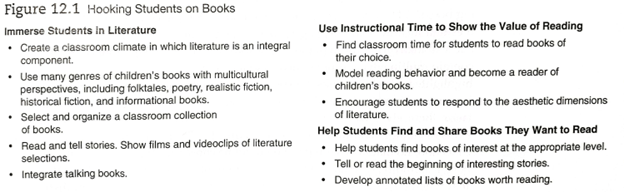
Selecting a Classroom Collection of Books – Teachers must choose books and classroom activities to surround children with print and nonprint materials. They need to include both literature and informational text in their classroom collections as well. Literature books typically include a variety of genres such as stories, dramas, and poetry while informational texts include nonfiction, historical, scientific, and technical readings. Books need to inform, have the appropriate complexity, and be of high interest. Other materials include books, articles, websites, videos, and newspapers as well as many different electronic texts like e-books. E-books should focus on literacy experiences rather than distractions such as movies and games. The stories, illustrations, content appeal, and motivation to develop imagination and abilities are just a few reasons for choosing these books. The sources of these books should come from different sources too. They include the teacher’s personal collection, the school library, the public library, and paperback book clubs. Titles should also be changed frequently to keep interests high as well.
How to Choose Classroom Literature –
- Read and enjoy children’s books yourself.
- Read children’s books with a sense of involvement: must read books thoroughly to share honest opinion of books.
- Read a variety of book types.
- Read books for a wide variety of ability levels.
- Share how your students respond to particular books with other teachers.
- Start by reading several books by reading good quality: Newbery and Caldecott winners.
- Search the Internet.
Determining Good Literature – A teacher’s first priority is to choose books that students will like and will read. They must also be knowledgeable of and enthusiastic about children’s and adolescents’ literature and informational text, as well as consideration of students’ diverse backgrounds, academic abilities, and interests. Here are 5 criteria to use when building a balanced collection of books:
- Collection needs to contain modern, realistic literature, but also traditional literature.
- Collections needs to contain books that realistically present different ethnic and minority groups and nontraditional families as well as mainstream Americans.
- Collection needs to contain books with different types of themes and books of varying difficulty.
- Collection needs to include nonfiction.
- Collection of books needs to include e-books.
Multicultural Literature – Multicultural books help us celebrate our distinctive differences and understand our common humanity. Culturally diverse books portray what is unique to an individual culture and universal to all cultures. Multicultural books help us understand and appreciate differences among people, and they also show how people are connected to one another through human needs, desires, and emotions. These books help us celebrate our distinctive differences and understand our common humanity.
For those who think to themselves, why multicultural literature? Here are five reasons for multicultural literature in the classroom:
1. All children need to experience multicultural books.
2. Children perceive that members of their cultural group make contributions to the world.
3. Children love hearing and reading stories about children like them.
4. Multicultural literature offers hope and encouragement to children who face the types of dilemmas and experiences depicted in some of the books they read.
5. Children who read culturally diverse books encounter authors who use language in inventive and memorable ways.
When it comes to the criteria for selecting multicultural literature, here are 5 things to consider:
1. Cultural accuracy
2. Richness in cultural details
3. Authentic dialogue and relationships
4. In-depth treatment of cultural issues
5. Inclusion of members of minority group for a purpose.
Designing a Classroom Library – Access to books in classroom libraries affects students’ reading. Students will read 50% more books in classrooms with libraries than those who don’t have such access. Classroom libraries should have a wide range of books of various reading levels and include books on topics that will be studied in subject areas. The physical features of a classroom library are also something to pay close attention to. Here are some physical features and suggestions for a library that can increase children’s voluntary use of the library:
- The library should be visible.
- Be a quiet place for 5-6 students to sit comfortably.
- Have 5-6 books per child in the library.
- Contain multiple copies of favorite books.
- Include a variety of genres and reading levels.
- Keep the library is organized.
Listening to Literature – Through hearing stories and poems, students develop a positive disposition toward books. Cumulative experiences with hearing stories and poems are likely to improve reading comprehension and vocabulary development. Being read aloud helps students develop literacy and language skills and interest in reading, as well as provides opportunities for social interactions.
Reading Aloud – When reading aloud, teachers should consider the complexity of the ideas, development of characters, language, and visuals integrated throughout the book. They should also consider the age, background, and interests of the students. Teachers need to prepare for story time by first being familiar with the story’s sequence of events, mood, subject, vocabulary, and concepts, and they must also decide on how to introduce the story. Here are some things to consider when preparing for a read aloud:
- Setting the mood: This could be part of the routine and maybe one could have the read aloud at the same time each day.
- Introducing the Story: This is to set the purpose and provide support as the students listen to the book. One way to introduce the story could also be to ask a question or the students could predict what will happen.
- Activities after Reading Aloud: Students should be encouraged to share their feelings as a whole class, small group, or with a peer. They should also summarize what was read and answer any questions the teacher or students may have.
- Allowing others to Present Literature: Teacher should allow guest speakers, soldiers, people in the community, and parents to come present literature in the classroom.
*Teachers should also strike a balance between formal and informal approaches.
Read Aloud – Generally a group event in which literature is read orally.
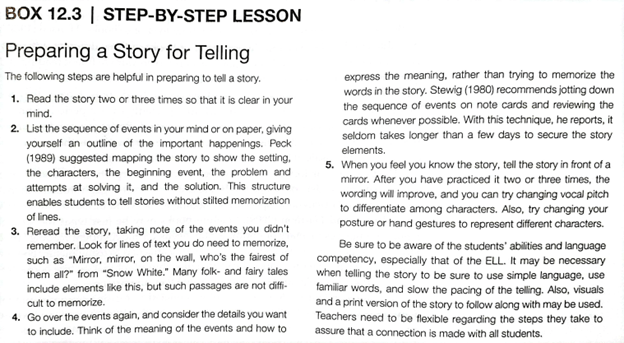
Storytelling – The act of telling a story orally without the use of a text. Storytelling provides students the opportunity to learn about oral tradition of literature, enhance speaking and listening skills, and develop an interest in personal expression. Here are three reasons for including story telling in the curriculum:
1. Few students have participated in this activity.
2. Opportunity for the teacher to involve the children in the storytelling.
3. After watching the teacher tell a story, the students also want to story tell.
Below is a step-by-step lesson for preparing a story for telling:
Helping Students Choose Just Right Books – There are several ways for teachers to help students choose the right books and students should be able to select books they can enjoy and from which they can get personally important information. In order to do this, teachers can tell exciting anecdotes about authors, provide previews of interesting stories, show videos about stories, suggest titles of stories that match students’ interests, encourage author searches on the internet, share leveled book listings, or compile teacher-or student-annotated book lists. Teachers also need to know their student’s interests as well as be well versed in children’s and adolescents’ literature and informational texts.
Here are a few videos to learn more about helping children select books:
Selecting Good Fit Books – https://www.youtube.com/watch?v=rwtHGh0PVHo
Student reading to determine a good fit book with five finger check – https://www.youtube.com/watch?v=6cW3E9xOMvA
PICK – https://www.youtube.com/watch?v=p-Gj0-h5JV0
Core Books – A collection of books at a grade level which are to be read by every student at that grade level. *Or, a collection of books that forms the nucleus of a school reading program at each grade level; usually selected by a curriculum committee. These core books are taught within the framework of whole class study across disciplines and students have little or no choice in selecting the books.
Literature Units – Lessons organized around book collections featuring unifying elements such as genre, author, or conceptual theme. The teacher chooses the theme and gets a collection of books around that theme (genre, author, conceptual theme). The students, however, have options as to what books to choose from the collection and what activities they might pursue. Literature units are also known as thematic instruction or integrated instruction.*Thematic Instruction – Another name for literature units.*Integrated Instruction – Another name for literature units. Literature Circles – Discussions or study groups based on a collaborative strategy involving self-selection of books for reading; each group consists of students who independently selected the same book. In literature circles, students choose the book they want to read out of a selection and groups are formed. Typical groups are 3-4 elementary students and 4-5 middle school students. Then roles are assigned to the students. These roles include discussion leader/director, literary luminary or passage monitor, connector, and illustrator or word wizard. Students read the text (in class or on their own) and discuss what they have read in the literature circle. Roles in Literature Circles – the roles utilized in literature circles vary depending on the purpose of the circle, the reading, and the students. Generally, there will be a leader who leads the discussions, a student who monitors the text to assure that the discussion relates to the specific sections of the text, and a student who tries to connect the discussion to real life experiences and other literature. Finally, the illustrator creates a visual representing the group’s responses. Reading Workshop – An organizational framework which allows readers to demonstrate their use of reading strategies by responding to books and sharing meaning with others. There are also several components to a reading workshop:Minilessons: The teacher demonstrates a reading strategy through explicit teaching. The topic of the lesson comes from the teacher’s observations of what the students need. Status-of-the-Class Report: Students check-in and let the teacher know what they will be working on during the readers workshop. Sustained Silent Reading: Everyone is reading silently. Individual Reading Conferences: A student meets with the teacher to discuss what they are reading. Group Sharing Time: Students share what they are reading about and make recommendations to other students.Below are two videos going over reading workshops: Rick’s Reading Workshop Overview – https://www.youtube.com/watch?v=TSfJBAhFNXA Reader’s Workshop Mini Lesson – https://www.youtube.com/watch?v=qVClhemUhjY&t=8s
Responses to Literature – Teachers must design strategies for encouraging readers to respond to texts. They also need to lead students in classroom experiences in which they analyze their personal reactions to what they have read. Every reading event or transaction involves a reader and a text. In any reading event, the reader adopts one of two stances: the efferent stance or the aesthetic stance. With an efferent stance, attention is focused on accumulating what is to be carried away from the reading. Readers using this stance may be seeking information. In an aesthetic stance, however, readers shift their attention inward to center on what is being created during the reading. Reading is driven by personal feelings, ideas, and attitudes that are stirred up by the text. Also, in most reading situations, there is both an efferent and an aesthetic response to the text.
Read-Response Theory – A theory that proclaims that the reader is crucial to the construction of the literary experience. Readers must be given the opportunity to respond to what they are reading to have a deeper understanding of what they read. In this theory, the reader actively creates meaning by relating to his or her knowledge as well as past experiences. The reader is thinking about, predicting, and verifying those predictions while actively creating meaning.
*Other responses to literature include book-talks, free response, and literature journals.
***Other notes from the weekly readings:
Surrounding Children with Text
An important aspect of bringing children and text together to create a community of readers and writers is to create a learning environment that is print rich and provides a wide variety of literature.
Surrounding your students with a variety of texts and a variety of ways to engage with texts can be challenging, but here are a few starting points.
Begin a Classroom Collection of Books
Begin by collecting a variety of books, including a wide range of reading levels, now while you are still completing your degree. By doing this, you will
Here is a great video on how to build your classroom library: https://youtu.be/oxASP-p0H08.
Listening to Text:
Class read alouds are important at any grade level. In order for students to benefit the most from listening to text read aloud, teachers should:
Prepare to read aloud. Practice in front of the mirror or with others. Make sure you use character voices if needed and expression.
Set the mood. Build some anticipation about the story. Make sure students are comfortable where they are situated. Can they find their own space to listen to the story?
Introduce the story. Give some teasers about what the story might be about. Review the cover and discuss some of the illustrations to intrigue students and build interest.
Encourage students to respond to text. While reading take time to pause after significant events in the story, or at the end of each chapter and discuss what students are feeling about it. What do they think might happen next? Did their previous predictions come true?
Another way to have students listen to texts is to listen to audiobooks. Of course, you can purchase these, but that can get expensive. You can create your own for FREE by using the free audio editor Audacity. You can download it for free using this link https://www.audacityteam.org/download/. Here is a link to record your own audiobooks with Audacity: https://youtu.be/KmsfqRxFSI8
Storytelling
Storytelling is more than just reading a story. There is a long historical tradition of oral storytelling in many cultures, and telling stories should be encouraged and shared in the classroom. There are many tools for sharing stories and the classroom should have many of these available to children.
Flannel/Feltboards are great for engaging students in storytelling and story making.
Tell and Draw Stories – these are stories that you draw as you tell them. One of the most well-known is the story BINGO.
This blog has quite a few different storytelling methods and is a good place to start if you are unfamiliar with these http://meusenotes.blogspot.com/p/draw-and-tell-stories.html
Helping Children Select Books
Have students use the ‘Goldilocks Strategy’ to choose a text to read. This strategy helps students choose the text that is just right for them, it is not too hard, not too easy, it is just right.
Selecting Multicultural Literature
Schools are more culturally diverse now than ever before, and through the inclusion of multicultural literature in the class library fiction collection, teacher can ensure they provide their students with texts that represent the culturally diverse classrooms and home environments in this country, and those across the globe. With recent global events, it has become increasingly important that students do not become ethnocentric. Exposure to a variety of multicultural literature can assist in breaking down cultural barriers.
Likewise, multicultural literature can also assist students with their identity formation (Hseu & Hetzel, 2000). Identity formation is important in the social development of all children, as it gives them a sense of belonging and acceptance in society. Inclusion of multicultural literature in library collections confirms that the beliefs and experiences of minority students are valued (Steiner, 1998). When students see themselves reflected in the pages of literature, they are more likely to engage with a text. Familiar concepts in multicultural literature help to build security, familiarity, and confidence, which can lead to an improvement in student learning (Agosto, 2007).
There are several criteria though for selecting multicultural literature that is appropriate and does not stereotype cultures. When considering texts to include in your library ask yourself the following questions:
- Cultural accuracy – Are issues and problems authentic and do they reflect the values and beliefs of the culture being portrayed?
- Richness in cultural details – Do readers gain a sense of the culture they are reading about?
- Authentic dialogue and relationships – Is the dialogue indicative of how people in the culture really speak, and are relationships portrayed honestly and realistically?
- In-depth treatment of cultural issues – Are issues given a realistic portrayal and explored in depth so that readers may be able to formulate informed thoughts on them?
- Inclusion of members of a minority group for a purpose – Are the lives of the characters rooted in the culture, no matter how minor their role in the story?
References
Agosto, D. E. (2007). Building a multicultural school library: issues and challenges. Teacher Librarian, 34(3), 27-31.
Hseu, M., & Hetzel, J. (2000). Bridging the Cultural Divide Through Multicultural Children’s Literature. http://buddies.org/articles/Literature.html
Steiner, S. F. (1998). Who Belongs Here? Portraying American identity in children’s picture books. Multicultural Review, 7(2), 20-27.
Organizing for Text-Based Instruction
Organizing patterns for text-based instruction vary from structured whole class studies of core books to independent reading of self-selected books in literature units and literature circles.
- Core Books – A collection of books that form the nucleus of a school reading program at each grade level; usually selected by a curriculum committee.
- Literature Units – Lessons organized around book collections featuring unifying elements such as genre, author, or conceptual theme.
- Literature Circles – Discussions or study groups based on a collaborative strategy involving self-selection of books for reading; each group consists of students who independently selected the same book.
- Media Literacy – The capacity to access, analyze, evaluate, and communicate messages in a variety of forms.
Literature Circle Roles
Within the literature circle students take on a variety of roles. While students may maintain the same role throughout the duration of their literature circle time, particularly in the early elementary grades, as they become more familiar and competent at the process, they can organically switch roles in the moment as the need arises.
Some common literature circle roles include:
- Discussion Director Thinks of good discussion questions, convenes meeting, solicits contributions from others.
- Passage Master Takes the readers back to memorable, important sections of the text and reads them aloud.
- Connector Takes everyone from the text world out into the real world, where the reader’s experiences connect with the literature.
- Illustrator Provides a graphic, nonlinguistic response to the text.
- Summarizer Gives a statement of the gist, key points, and highlights of the day’s reading.
- Vocabulary Enricher Marks down puzzling, interesting, or unfamiliar words.
Encouraging Response to Literature
Louise Rosenblatt (1982) was one of the earliest proponents of the reader-response theory. She believes that the reader actively creates meaning by relating to his or her knowledge as well as past experiences. The reader is thinking about, predicting, and verifying those predictions while actively creating meaning. Ways to encourage this are:
- Sparking Discussion with Book-Talks
- Engaging in Free Response
- Exploring Response Options in Literature Journals
Classroom Application – The biggest take away for me this week in regards to reading and classroom literature application would be about selecting hey classrooms collection of books. Teachers should not just fill classroom libraries with as many books as they can so that they’re overflowing with books, but they also shouldn’t fill them with random books as well. Books should be chosen for the classroom library with a purpose. Whether that purpose be a certain learning unit or something else educational related, these classroom libraries should include books with a variety of reading levels, types of books, and contain multicultural themes. Both the teacher and the students should also enjoy these books. Our classrooms are becoming more and more diverse, and children love hearing and reading stories about children like themselves. I also think it’s still important that students still read many of the old great classics, but only if it’s purposeful. We shouldn’t read The Old Man and the Sea, The Great Gatsby, and Where the Red Fern Grows just because all other previous generations of students read them. We should be reading them because the stories have a great lesson or brilliant descriptive writing. Students won’t want to read an old boring book just because a teacher said so. They should be intrigued by storylines, plots, and great characters. Taking charge of building an effective classroom library is no quick and easy task. Teachers should be making notes about which books work and which books don’t for their future classrooms.
Video Notes
The video “How to Organize Your Classroom from Instructor Magazine” brings us to two elementary schools to see how real and effective teachers organize their classrooms. It offers insight on how to create an effective and organized classroom while also making it comfortable for students to help with their learning. Some of the tips from the video include decluttering the classroom, utilizing storage solutions, creating designated spaces for things, and making the classroom accessible for students. It also mentions having students be a part of the process to create a sense of community in the classroom as well. Overall, great brief video full of tips and tricks.
The brief video “How to choose a good-fit book” gives teachers and children advice on how to select appropriate books. Students need to pick books that aren’t too difficult or too easy as well. The video describes using the “Five Finger Rule” to help choose a good-fit book as well as providing examples of different genres and topics that children might be interested in.
Similar to the previous video, this video describes how to pick a “just right book”. It mentions the five finger rule again while also detailing how and why students should pick books that they are interested in to keep them engaged and motivated to keep reading.
The video “1 Rick’s Reading Workshop Overview” shows us a fantastic teacher doing an effective lesson. In this video Rick details and describes the many aspects of his reading workshop and the importance of creating a positive and engaging reading environment. One key detail Rick describes is the importance of letting students choose their own books. His lesson starts off with a reading skill mini lesson before moving on to independent reading time. Rick then works with several students during small group instruction time and provides many strategies to help support student learning. Another great video overall that had many good ideas.
The video “Rick’s Reading Workshop Mini Lesson” is another great video with Rick doing a mini-lesson during his reading workshop. This mini-lesson teaches students about characters and character development. Rick asks the students many questions during this mini-lesson to get the students to think about the characters and to examine the characters actions, thoughts, and feelings. Asking questions encourages student participation and helps the students stay engaged. Providing the students with explicit instruction can also help further develop their reading skills and is critically important for student learning. Great video overall from an effective classroom teacher.
 Travis Davis ENGED 275