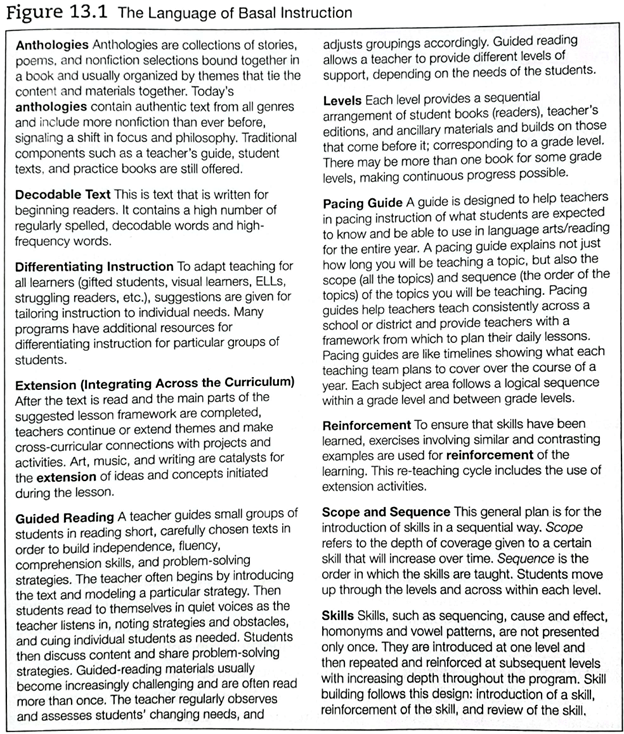
Components of a Basal – Basal reading programs are popular materials used for reading instruction and are commercially published materials that are well-designed to offer a more thorough and explicit instruction than many teachers can provide on their own. A basal program also offers greater continuity from class to class and grade level to grade level, providing both vertical and horizontal articulation. Progress monitoring, differentiated instruction, technology integration, and suggestions for working with English language learners are hot topics in current basal reading programs. Below is a figure detailing the key terms and definitions of the language used in basal instruction:
Student Books – Emergent literacy programs are often organized thematically, include a variety of supported materials, and capitalize on children’s curiosity about print to get them excited about reading and making predictions. Some of these materials include anthologies, trade books, e-books, and leveled books. Older students use hard cover anthologies (a bound collection of reading selections such as stories, poems, and informational text) and then small, leveled readers for each student. Stories are also chosen to illustrate and develop specific skills, which are taught in a predetermined sequence.
Leveled Readers – Leveled books are student books that are included in the program and used during guided reading. Children are matched with text at, below, or above grade level to help mean the needs of each student.
Teacher’s Editions – Teacher’s editions provide an instructional guide and in-service support. There are three important features of teacher editions: the scope and sequence chart, a reduced version of the student text, and suggested lesson plans. Because of the abundance of information and teaching options/directions, the size of a typical teacher’s edition for one unit is the same size as former editions for the whole year. Because of the amount of information and options, it may be overwhelming for novice teachers. However, others have found that they have become discriminating consumers and realize they do not need to slavishly follow the teacher’s manual.
Workbooks – Workbook content can include practice in spelling, phonics, and decoding skills in the primary grades and comprehension or study skills in the intermediate grades. There are also new opportunities for open-ended, personal, and creative responses too. A wide range of practice books such as phonics, vocabulary, writing, CCSS, and handbooks for ELLs are included with basal reading programs. Many workbooks are completely online now and can be uploaded into a teacher’s electronic dropbox. The key question for today’s teachers is: “What do I choose from the many available resources to differentiate for each child?”
Assessments – Basal reading programs include a comprehensive set of assessments to assess students’ strengths and needs, determine ability levels, pinpoint foundational skill gaps, and challenge advanced learners. These assessments also include screenings, progress monitoring, benchmark tests, and unit tests, and they are offered in both print form and online. The important thing for assessments is for teachers to carefully select what assessments they need and for what purpose.
Technology and Online Learning – Basal readers have gone digital and can offer opportunities to personalize and differentiate learning to meet the needs of individual students. Online versions of nearly everything that is printed along with practice activities, flash cards, writing assignments, and other support materials now accompany print materials within these programs. Many also offer online quizzes and online management tools for teachers such as customizable skill instruction, online lesson planning, and even online coaching. The largest contribution technology has made as been the immediate, real-time assessments and data reporting systems now part of most programs.
Intervention – Basal programs provide options such practice books, diagnostic assessments, games, and online interactive resources to reteach skills to students who need intervention. Leveled books in a series allow students to read on, above, or below grade level. Small group instruction suggestions are also provided with these programs.
*(From the Power Point) Components Which Are Part of Every Basal Series –
- Emergent Literacy: Big books or storybooks are used to introduce children to shared reading.
- Beginning Reading: sight words introduced, high-frequency words, decodable readers
- Strategy Lessons: Strategies are suggested for individual and group lessons to teach vocabulary, phonics, structural analysis, and use of context.
- Comprehension Strand: prereading comprehension strategies, during and post reading comprehensions strategies and activities are listed.
- Language Arts: integrating reading, writing, listening, and speaking at each grade level, learning centers, writing activities, writer’s workshop. Components for English Language Learners.
- Management: gives goals and objectives, teaching plan, assessments
- Assessment: informal and formal assessments options
- Differentiation: ideas of how to support students who struggle with content as well as how to challenge students
Lesson Framework of a Lesson in a Basal – Most teacher’s editions of basal readers have lessons for whole group, small group, and independent activities. A typical lesson follows a before, during, and after reading framework for teaching a selection over a number of days.
- Before Reading – Time to motivate students and activate/build background knowledge. The teacher attempts to build interest in reading, set purposes, and introduce new concepts and vocabulary.
- During Reading – The teacher guides students through the text, usually in small groups. Text selections can either be read section by–section or in its entirety. Following silent reading, students may be asked to read aloud or orally read specific parts to answer questions. The guided reading phase of the lesson focuses on comprehension through questioning.
- After Reading – A time for the teacher to determine whether students understand main concepts. During this time the teacher can clarify, reinforce, and extend concepts. Activities from various practice books might be used to reinforce skills in the broad areas of word analysis and recognition, vocabulary, comprehension, and study skill. Skill development, comprehension questions, and practice activities centered on direct instruction of reading skills arranged according to scope and sequence can occur as well.
Modifying Basal Lessons – Commercial reading programs provide a starting point for making sound instructional decisions. However, teachers must be judicious about selecting materials to use for the core reading program and the plethora of supplemental materials to accompany it. Modifications to these programs must
also be to accommodate our students. Modifications of basal reading lessons allow teachers to rely on their own strengths as well as those of the students. These teachers must also decide where to place instructional emphasis as well. Modifying lessons also personalizes reading instruction for teachers and students. Teachers must adapt to meet the needs of their students.
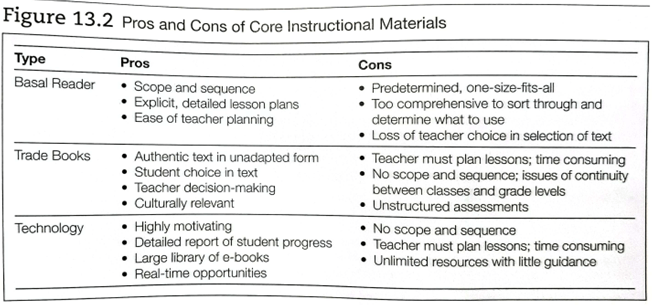
Below is a figure displaying some of the pros and cons of core instructional materials teachers may use:
Evaluating Reading Materials for Instruction – First off, the decisions that go into selecting core materials should be of supreme importance to a district. Districts cannot trust or rely on basal and curriculum publishing companies to adopt a particular program. Because of how important core programs are to any school, it is critical to put a great deal of time and thought into selecting a set of materials. Publishing companies and vendors are responsible for developing quality products, but the ultimate burden falls on educators to thoroughly evaluate the deluge of instructional materials flooding the market. Here are some questions and steps for educators to consider before deciding whether to consider new programs:
- What is the overall philosophy of the program? How is reading discussed in the teacher’s guide?
- What kind of learning environment does the program recommend? Is it child-centered? Teacher-centered? Literature-centered? Skills-based? Scientific?
- Describe the emergent literacy program in detail. How does it provide for communication between school and home?
- Describe the instructional program in detail. How are lessons structured to teach phonemic awareness, word identification, vocabulary, reading fluency, comprehension, and writing?
- Describe the literature of the program. Are the selections in unabridged form? Are different genres included? Is there a strong presences of nonfiction text? How culturally diverse is the literature?
- How well does the program integrate across the curriculum? In what ways is assessment connected to daily instruction? What opportunities are there for connections between the various language arts?
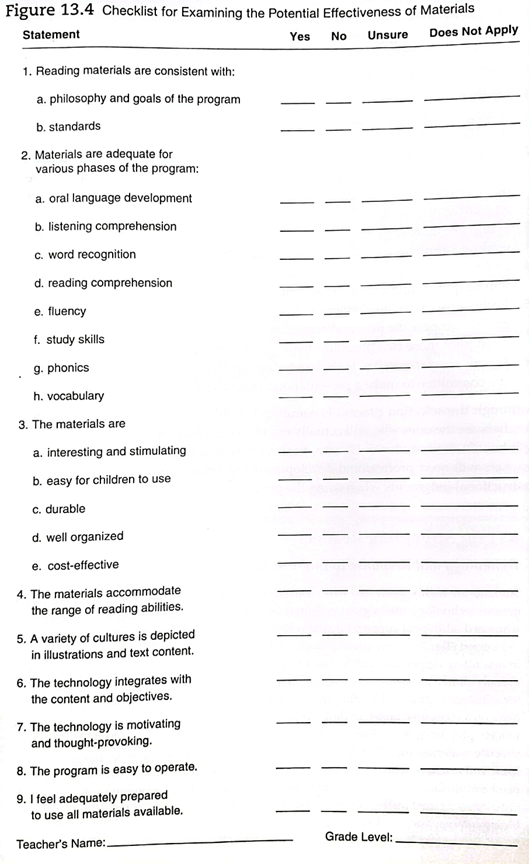
Here is a sample checklist for examining the potential effectiveness of materials for a current basal program or other curriculum resources:
Below is another procedure and guidelines for selecting a core reading program that goes above and beyond the basic checklists that allows districts to make informed decisions about textbook adaptations:
- Form a textbook adoption committee. The committee should be diverse and reflect the demographics of that particular district. Decide who on the committee will be responsible for the ultimate decision and who will just have input during the process.
- Set objectives. Before even looking at texts, the committee should review board policies, state laws, and district guidelines. They should then compile a set of expectations, paying particular attention to those recommendations that are common to all sources reviewed.
- Study effective reading instruction. By reading and discussing the same research on reading instruction, the committee will have a like-minded focus.
- Order core reading programs to review. Select a few programs to review period publishers will be quite willing to make presentations on their programs.
- Evaluate the core reading programs. Spend time reading each grade level of each program. Compare the pros and cons of each program, and narrow the list to just two. Then pilot these two programs for a month or two.
- Present recommendations to the Board of Education. If appropriate, select members of the committee to make a presentation to the school board.
*It is noted that teachers are the ones who will actually use the materials to make critical decisions that will benefit their students. They will also need professional development and training on how to make informed instructional judgements when using the programs.
Classroom Application – Although much of this week’s chapter information regarded basal reading programs and other instructional materials teachers and districts use, there were some useful parts to reflect on. One of my key take-aways was actually something to consider as both a parent and educator and has to do with what sort of materials is the classroom teacher using to supplement their basal reading program or other reading program and why? The same questions can and should be considered for new and incoming teachers to an already existing reading program. A teacher should not just take over a classroom and simply reuse all of the “old” teacher’s materials, reading programs, and curriculums. They should be using the guideline questioning and checklist to evaluate the existing programs effectiveness. Some materials may be incomplete or outdated while others may simply be ineffective. Questions like, “What kind of learning environment does the program recommend? Is it child-centered? How are lessons structured? Are there different genres being used and included throughout the year?” should be asked. The checklist example from figure 13.4 shows an effective way to reflect on current materials and can help teachers add more effective materials or take away ineffective materials easily. While teachers may not have much say when it comes to existing basal programs and curriculums in their school, they do have the ability to modify them by adding more effective and interesting materials. I will definitely be keeping a copy of the “Checklist for Examining the Potential Effectiveness of Materials” to evaluate my future classroom’s materials as well as modifying it to examine other subjects and materials.
*Other notes from this week’s Chapter 13 pages:
Reading Materials
There are three categories of instructional reading materials used in elementary classrooms:
- Core (Basal)
- Supplemental
- Intervention
Basal Programs Today
Basal programs are the most widely used materials for teaching reading, more often than not, these form the core reading program of a school. The basal programs are very comprehensive, attempting to satisfy every consumer, and therefore are a one size fits all model. The programs often contain stories by well-known authors, and in recent years they include more nonfiction than ever before. Within basal programs students are supported in developing their thinking, comprehension, and study skills, particularly as the teacher integrates these with other subjects, such as music, science, and social studies.
Key Features of Basal Instruction
There are key features across all basal instruction programs. These are:
Anthologies – Bound collections of stories and poems in reading programs.
Decodable text – Text which is written for beginning readers. It contains a high number of regularly spelled decodable words and high-frequency words.
Differentiating instruction – Teaching adapted for all learners to meet individual needs.
Extensions – Using activities such as art, music, and writing as catalysts to extend ideas and concepts initiated during a formal lesson.
Guided reading – A teaching approach designed to help individual readers build a system for processing increasingly challenging texts over time.
Levels – Books that are categorized into stages of difficulty in order to select text based on ability.
Pacing guides – A guide designed to help teachers in pacing instruction of what students are expected to know and be able to use in language arts/reading for the entire year.
Reinforcement – Exercises involving similar and contrasting examples that are used to reinforce learning.
Scope and sequence – General plan in basal reading programs for the introduction of skills in sequential or vertical arrangement.
Skills – Skills, such as sequencing, cause and effect, homonyms, and vowel patterns.
Steps for selecting a core program
- Create a committee
- Set goals
- Learn about effective reading instruction
- Create or select an evaluation tool
- Order materials to review
- Study the programs
- Make recommendations
Supplemental Materials
A review of school wide data may reveal that the school’s core reading program does not provide adequate instruction in one or two components essential to meeting the needs of the majority of students. If this is the case, schools should select a supplemental program to strengthen instruction and provide more practice to students on those particular skills. For example, if the core does not provide enough fluency practice in reading connected text, a supplemental program that focuses on fluency should be implemented for all students.
Analysis of student data may reveal that certain students are performing low on specific essential components of reading ability. In order to help these student’s catch up to their peers, they must be given targeted support in those specific essential components (such as word identification or fluency). A supplemental program should be implemented with that subset of students to provide more explicit instruction and practice opportunities, so that these students can make adequate progress to meet grade level standards.
Intervention
Teachers help struggling readers and writers by:
- Personalizing instruction
- Using appropriate instructional materials
- Growing professionally
- Collaborating with literacy coaches
Early intervention is critical to helping children who are struggling to read and write. Research over the past few decades has demonstrated that children that get off to a poor start in reading and writing rarely catch up. These continued findings are the impetus for ensuring that early intervention occurs. Often these interventions are family-focused programs to develop children’s awareness of literacy, parents’ literacy, and parenting skills. Early interventions to resolve reading and writing problems and accelerate literacy development for low-achieving Kindergarten to Third Grade students.
Reading Recovery
One highly effective intervention is the Reading Recovery program which is designed for low-achieving first graders, involving daily 30-minute sessions of one-to-one tutoring for 12 to 30 weeks. Instruction within the reading recovery program is provided to struggling students by specifically trained and supervised teachers.
Reading Recovery Lesson Components
- Rereading familiar books and independently reading the book introduced in the previous lesson.
- Learning decoding and comprehension strategies.
- Writing sentences.
- Reading a new book with teacher support.
Response to Intervention
Tier 1: Screening and Prevention
Tier 2: Early Intervention
Tier 3: Intensive Intervention
Inventions for Older Students
- High Quality Instruction
- Teachers provide instruction that meets the student’s needs.
- Instructional-Level Reading Materials
- Teachers select age-appropriate books at the student’s instructional level.
- More Time for Reading
- Teachers provide interesting books and time for students to read independently.
Making Instructional Decisions
Teachers who rely solely on their teacher’s manual are not following best practice. Teachers need to plan lessons with students in mind. Modifying lessons personalizes reading instruction.
Trade Books
Trade books better respect the linguistic, social, and cultural heritages of students. Trade books are more interesting and engaging which fosters interest in reading and a lifelong love of reading. When students self-select books to read, they are more likely to finish the text. Easier to use trade books to model a love of reading through reading aloud, book talking, engaging students and emphasizing the value of reading.
Technology-Based Materials
Technology based materials are great for meeting and supporting the diverse learning needs of students, and as such they make great supplementary instructional tools to the core reading program. Drawing upon supplementary materials such as internet websites, e-books, online games, online word processors and mobile device applications (apps); when integrated into the classroom seamlessly and thoughtfully, can improve student engagement and provide opportunities for students to develop ownership over their own learning.
The video linked below: “Using Technologies to Support Diverse Learning Needs” details where students and school staff in an Alberta K-6 school discuss the importance of providing students with the technology tools they need in order to be successful learners. https://youtu.be/RY4eR2Ntxtc
 Travis Davis ENGED 275