Data – Any information educators collect on individual students (or a group of students) over any period of time. Although we may in some cases be referring to general information (data), more often we are talking about specific test data, gathered throughout the school year, that help educators make decisions about how and what to teach.
Screening – Quick assessments given to all students. Screening assessments are a quick indicator of student skills and can reveal which students are predicted to meet grade-level benchmarks. Screening also helps educators identify which students need more closer monitoring.
Progress Monitoring – The tracking of students’ progress over a specific instructional time. The purpose is to closely monitor how the student is learning, to catch the students before they fail, and to change the instruction to a more effective method. Some examples include exit tickets, quizzes, and student work. *More detailed description below
Outcome Measures – Summative assessments given at the end of a specific instructional period to determine learning progress and achievement. Outcome measures provide information that is global in nature and focus on how well groups of students comprehend and apply knowledge. Some examples in the CAT test in California and the Forward Exam in Wisconsin. *More detailed description below.
Diagnostic – In-depth information about possible cause of a student’s difficulties learning. Tools and information used to pinpoint specific skills a student has or does not have. Information can then be used to develop a specific, targeted instructional intervention plan. Some examples include the Measures of Academic Progress (MAPs testing), a pre-test, and teacher observations.
Curriculum-Based Measures (CBM) – A method used to monitor what students have been learning. They usually have standardized instructions, a stopwatch or timer, a set of materials (examples include passages or lists referred to as probes), scoring procedures, and record forms or charts. CBM data allow for immediate adjustment in a student’s educational program when needed. They are considered a general outcome measure and provide information about how well students have learned the skills taught in their curriculum, such as unit tests or more standardized individually administered tests. CBMS are considered general outcome measures and can be utilized for identification and progress monitoring. Examples include DIBELS-8, Acadience Reading, Easy CBM, and teacher made materials like a monthly test of expected spelling words for the grade level academic year.
Formative – An assessment used to measure the assessment for learning and assesses performance during learning, usually occurs regularly throughout the instruction process, the results are used to inform instruction, and identifies areas for improvement. Examples include using thumb and hand signals for students to indicate whether or not they understand a specific topic or concept, exit tickets, class discussions, think-pair-share, and other observations a teacher may use to inform instruction.
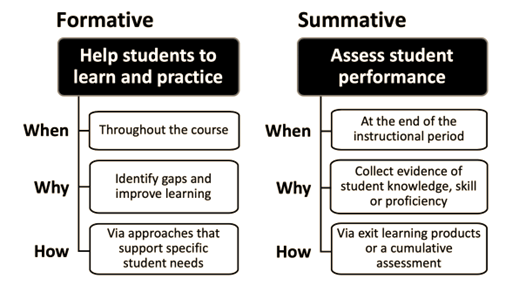
Summative – An assessment used to measure the assessment of learning, measures student achievement at the end of a period of learning (e.g. unit of study, end of semester, end of year); generalizes how well a student has performed and how much the student has learned overall. Statewide standards dash based achievement tests are summative assessments. Summative assessments occur at the end of the learning process, provide a final the evaluation of knowledge and skills, and can also involve high-stakes testing that often involves the ranking of students as well as providing students with a grade. Examples include chapter/unit tests, final portfolios and projects, essays and term papers and the ACT and SAT exams.
Standardized – standardized tests are assessments designed to be administered in a consistent manner to ensure that the conditions, questions, and scoring are uniform for all test takers. They aim to measure a student’s performance or knowledge in a specific area, often for the purpose of comparison or evaluation. They are created with the use of carefully selected sample of individuals who represent a larger group of individuals and allows comparisons of an individual score to that of a larger group. Everyone who takes the test answers the same questions and I scored in a consistent manner. Standardized tests must be administered following the standard procedures outlined in the text manual. Examples include the Scholastic Assessment Test or SAT, the Medical College Admission Test or MCAT, and the Woodcock-Johnson Tests.
Norm Referenced – Test that measures how well one student performs compared to other students at the same grade or age level who have already taken the test. Norm dash reference tests are standardized. Percentile standard scores, grade equivalent, and similar scores are used. Also referred to as normative assessments. Examples include the Woodcock-Johnson Tests of Achievement, Gray Oral Reading Test, percentile ranks, IQ Test, and the SAT.
Criterion Referenced – Tests that assess what students know and can do on a given task. Guides identification of skills to teach. Usually provide pass/fail mastery scores and occasionally have benchmark goals. Examples include Quick Phonics Screener, Words Their Way Spelling Inventory, an end of unit test, a pass/fail semester exam, and the ACT.
Curriculum Embedded – Assessments that use curriculum materials to measure student progress and achievement as well as what students are and have learned. This also involves monitoring the educational progress of students through direct assessment of academic skills. Examples include teacher made tests or test and assessments that come directly from the text book that often take the form of end of chapter tests.
Formal Assessment – Tests that are both valid and reliable and have been standardized. These are usually on a large scale and for the purpose of comparing one group’s performance to another. Examples include the SAT, ACT, IOWA, and Woodcock-Johnson Tests of Achievement.
*From the PP* – Reliable and valid. Students are given the same test, same amount of time, and same testing conditions. Scores are used to compare students to each other.
Informal Assessment – Assessments that evaluate children’s learning based on systematic observations by teachers of students performance reading tasks that are part of the daily classroom experience. They may also consist of interviews, questions, quizzes, and observations. Examples include classroom-based instructional reading assessments, teacher-made tests, and quizzes.
*From the PP* – Used during instruction to see if the student understands the instruction or not. The assessments are part of the student’s day. They may not know they are being assessed.
Observational Assessment – These are the assessments and recognized patterns teachers observe in the classroom in response to asking questions during instruction to gain insight into a student’s thinking. Sometimes it could be a simple thumbs up or thumbs down on how the students are feeling after instruction and whether or not they need to modify their instruction. These are often called “on the spot” observations and can include engaging activities such as asking to students to share what they learned with a partner or writing answers on a whiteboard for the teacher to review.
Reliability – This term refers to the extent to which assessments are accurate and consistent, that is, the general dependability of the test. *Can different teachers give a student the assessment with consistent and reliable results?
*From the PP* – The dependability of a test. Can the assessment be administered by different people at different times and get consistent results? If the results are consistent or dependable, the assessment is considered reliable.
Validity – An assessment is considered valid if it accurately measures what it is supposed to measure and predicts performance on similar assessments. A valid assessment can predict performance on a correlated assessment.
*From the PP* – Measures what it is supposed to measure. It should be able to predict the student’s performance. A running record would be valid and predict if a student will pass the grade-level reading test.
Four Types of Formal Assessments:
Universal Screening Assessments – Sometimes called benchmark assessments these screening assessments are usually given to all students at the beginning (BOY), middle (MOY), and near the end of the year (EOY). In primary grades, these screening tools typically measure phonological awareness, phonics, fluency, vocabulary, comprehension, and spelling progress. In fourth through sixth grades, the screenings assess comprehension, fluency, and writing.
These screenings reveal which students are predicted to meet grade-level expectations/benchmarks, and they also help educators identify which students need closer monitoring. *Universal Screening determines students who may be at risk for reading difficulties: they help educators answer the question, “Which of my students are at risk for reading difficulty?” Examples of Universal Screening Assessments include TPRI, AIMSweb, and Acadience Reading.
Progress Monitoring – Assessment designed to track a student’s progress over a specific instructional time period. They determine whether the student is making expected progress and if the instruction needs to be changed. The assessment measures how accurately and automatically the students perform the task, as well as tracking a student’s performance over a specific instruction time period. One of its purposes is to closely monitor how the student is learning, to catch the students before they fail. This also means changing instruction when necessary to a more effective and appropriate method. Assessment examples include AIMSweb, EasyCBM, DIBELS-8, Acadience Reading, and those done by university research centers, core or basal reading programs, and those done by school districts themselves.
These progress monitoring assessments are typically a timed 1-minute probe and a quick assessment of student skills. For students at risk, assessments are done every two weeks or every few weeks depending on the student’s needs, and they are done over a period of several weeks and months. Teachers will use progress monitoring data to: determine which level of intervention the student should receive, change the instruction materials being used, and increase the intensity of instruction (smaller groups, more frequent interventions). The assessments answer the question: “How much progress are my students making?” and “Are they making the expected progress, and do I need to make chances in my instruction?”
Diagnostic Assessments – Assessments that provide in-depth information about possible causes of student’s difficulties learning. These can sometimes be referred to as diagnostic screeners or surveys, and they identify specific skills the student needs to learn. These screeners are then used to develop a specific, targeted instructional intervention plan for the student in a small group. Some of the reading skills a teacher may need to assess more in-depth include: phonological/phoneme awareness, letter sounds orthographic knowledge, high-frequency words knowledge, decoding fluency, multiple cue efficiency, or oral language/listening comprehension. If and when students are not making the expected progress over time in Tier 2 or 3 interventions, more specialized individualized assessments may be needed. These are usually administered by school psychologists, special education teachers, occupational therapists, speech-language pathologists, interventionists, or other trained personnel. Examples include: Comprehensive Test of Phonological Processing, Test of Word Reading Efficiency, and Acadience Reading Diagnostic. These assessments answer the question, “Where do I need to focus intervention?”, and “What specific skills do the students need to learn?”
Outcome Evaluations – Assessments that provide outcome data for a group of students. These groups of students can include an entire class, a school, a district, and even the nation. Outcome evaluations and outcome measures are called summative assessments because they are given at the end of a specific instructional period to determine learning progress and achievement. They provide information and focus on how well groups of students comprehend and apply knowledge. Many of these assessments are mandated by federal and state governments and are aligned with a state’s standards and determine the skills and knowledge students learned in the past year. These results are then compared across the state or nation to determine effectiveness as well as determining teacher accountability. Examples of these assessments include TNReady, MCAS, CMAS, and Acadience Reading. These assessments answer the question, “Have my students learned the material that has been taught?”
Classroom Application
When it comes to classroom application there was a lot to unpack in this short chapter. One of the things I am nervous about for when I become a teacher is that I will have all of these observations and assessments but won’t know what to do with them all. While I am more familiar with making informal observations about students and progress monitoring, I am not as familiar with all of the specific diagnostic assessments used today. I have done several running records and similar assessments with students, but I do not have any experience with the Comprehensive Test of Phonological Processing, and I am not sure how to diagnose specific skills or deficits students are lacking in. On the positive side I do have a lot of practice and experience with using hand gestures for thumbs up thumbs down thumbs middle for understanding in the middle of a lesson as well as using exit tickets to inform future instructional plans. I am also excited to be able to create fun and competitive learning games and assessments for students. I have been on the participant side of many education learning games and assessments such as Jeopardy and Kahoot, but I have not gotten to create my own yet. I think it will be excited to try to find new ways to educate and assess my future students.
Video Notes:
https://youtu.be/4p5286T_kn0 – Be a Mr. Jensen – This short video details the time a young student at 10 years old kept getting in trouble for tapping on his desk and being disruptive. When all of the other teachers scolded him or sent him to the office (which was no help either), one teacher pulled him aside after class and changed his life. That teacher saw the student’s potential for drumming and gave him his first pair of drumsticks. The teacher told the student directly that he isn’t a problem and gave him an outlet for his “fidgeting” and this student went on to become a very successful musician.
Sight words vs high frequency words – This video describes the difference between sight words and high frequency words. High frequency words are words that we frequently see when reading and speaking. They can be divided into 2 categories: regular and irregular. Sight words are words that students know by sight. Sight words are words we don’t have to read by sounding out. Words we know more and more as we learn and read more and more.
https://youtu.be/zTkQjH-_97c – Assessments in Education – The video starts with the speaker describing the differences between formative assessments are using during the teaching process and a quick check for understanding. Summative assessments measure long term academic goals and can often be used for grading. The video goes on to describe the many different types of assessments with examples for each type of assessment. The video also goes over behavioral assessments and emotional assessments and screenings.
https://youtu.be/_WDfT46nijA – Formal vs Informal assessments – This brief video describes the many key points and differences between formal and informal assessment with many great details and examples for each one.
https://youtu.be/JI-YgK-l4Sg – Formative vs Summative vs Diagnostic – Same guy from previous assessment videos describes the key details and differences between these three assessments. First, he very clearly explains why we should implement each assessment. Then he describes when we should implement each assessment as to whether it be before, during, or after a learning lesson. He then goes on to detail some examples of each assessment and how we should use each assessment like planning for future lessons and making groupings.
https://youtu.be/O5hJNpO0JPE – Criterion-referenced vs Norm-referenced assessments – He mentions the goal for norm referenced assessments is to rank students based on test achievement and criterion referenced is to measure the skills and knowledge a student has mastered. He then goes on to describe other key differences between the two in this great brief video.
https://youtu.be/6ndJygJixqY – Validity, reliability, authenticity, and cultural bias – In this video the speaker defines each other the words before explaining and detailing examples in the classroom. She does a fantastic job explaining each one of the words thoroughly and effectively. The many definitions she used are real life examples and situations many of us can relate to. Overall, a great simple video explaining things.
 Travis Davis ENGED 275