Summary Of What I’ve Learned About Running Records From Reading A-Z
Stages of Development – There are 4 main stages of development within the Reading A-Z program that students will progress through. The four levels are Beginning Readers (Levels aa-C), Developing Readers (Levels D-J), Effective Readers (Levels K-P), and Automatic Readers (Levels Q-Z2). Reading A-Z provides a three-part assessment process and these are conducted throughout the reading and intervention process. These assessments are to help place students with appropriately leveled texts. The first part of the assessment process is to have students read Benchmark Passages or Benchmark Books (Levels aa-J) and to capture their reading behavior on Running Records. Part two is to have the students retell the text and to use the “Retelling Rubrics” to score their comprehension. Part three is to have the students take an oral or written Comprehension Quick Check Quiz. Each question’s answer will tell us what skill it assessed to help us identify comprehension skills for additional practice. This three-part process enables us to establish a baseline of our student’s level and to assign leveled books for future small group or individual instructional practice.
Running Records – One part of a three-part process to place students with instructionally appropriate level texts and determine whether or not students are ready to move up a level. These running records allow us to assess reading behavior as students read from developmentally appropriate texts and are most often used in the earlier stages of reading to monitor reading behavior and progress. Each “Benchmark Passage” and “Benchmark Book” comes with a customized Running Record
*Running Record – An assessment system for determining students’ development of oral reading fluency and word identification skills and strategies.
Recommended guidelines for when administering a running record:
- Sit next to the student to view the student’s text (it is preferable to use text materials that are part of the everyday program) and the reader’s observable reading behaviors.
- Record everything the student says and does on a blank sheet of paper (in place of a blank sheet of paper, you can use a duplicate copy of the pages the student will read).
- Make a record of the student reading three book selections (a sample reading of 100 to 200 words from each text is recommended, as is choosing readings form one easy, one instructional, and one difficult text).
- Mark a check for each word the student says correctly, matching the number of check s on a line of the paper with the number of words in a line of the text being read.
- Record every error (substitution, insertion, omission, repletion, mispronunciation, and prompt) and self-correction. Deviations from print are marked in much the same way as in other miscue analysis procedures. The sample coded running record passages in Figure 5.5 display a coding system for marking oral reading errors and self-corrections.
- Record all observable behaviors.
***(The above notes were taken from a previous blog posting from a chapter in the previous ENGED 370 Textbook and I figured they should also be noted somewhere.)***
Taking Running Records – Running records are most often done in the earlier stages of reading and taking a running record takes practice. There are several procedural steps one must do when performing a running record assessment as well and they are as follows:
- Select a Benchmark Passage or Benchmark Book (Levels aa-J) that approximates the student’s reading level. Explain that she/he will read out loud as you observe and record her/his reading skills.
- With the Running Record form in hand, sit next to the student so that you can see the text and the student’s finger and eye movements as she/he reads the text.
- As the student reads, mark each word on the running record form by using the appropriate Running Record Symbols and Marking Conventions shown below. Place a checkmark above each word that is read correctly.
- If the student reads incorrectly, record above the word what the student reads.
- If the student is reading too fast for you to record the running record, ask her/him to pause until you catch up.
- Monitor the student for Errors/Self Correction and attempt to identify causes of errors (phonics, morphology, guessing, etc.)
- Intervene as little as possible while the student is reading.
- If the student is stuck and unable to continue, wait 5 to 10 seconds, then tell her/him the word. If the student seems confused, provide an explanation to clear up the confusion and say, “Try again.”
Marking Running Records – Marking running records is one of the most important steps in the assessment process and several terms are used when marking a running record form. The following are terms one should become familiar with by reviewing their explanations below.
Errors (E) — Errors are tallied during the reading whenever a child does any of the following:
- Substitutes another word for a word in the text
- Omits a word
- Inserts a word
- Has to be told a word
- Mispronounces a word (not a result of dialect; creates a nonword)
Self-correction (SC) — Self-correction occurs when a child realizes her or his error and corrects it. When a child makes a self-correction, the previous substitution is not scored as an error.
Phonics — The reader uses phonics to decode the words being read. Phonics skills vary by age, grade, and instruction. Younger readers may not have experience with long vowels and may read all words with a short vowel sound. This should be noted so the teacher knows this child is ready for long vowel phonics lessons.
Morphology — Morphemes are the smallest units of words that have meaning and cannot be divided further. The most common morphemes are root words and affixes. A reader may use their knowledge of a word root and affixes to determine the pronunciation and meaning of the word read.
Guessing — Some readers use this skill when they are attempting to read very quickly or if they have developed a habit of skimming as they read. For instance, if the word is ran but the reader says ‘runned’, this would indicate the reader is not attending to the graphemes in the word but rather trying to make sense as they read. Or, the reader does not know the word and rather than attempt to decode makes a guess.
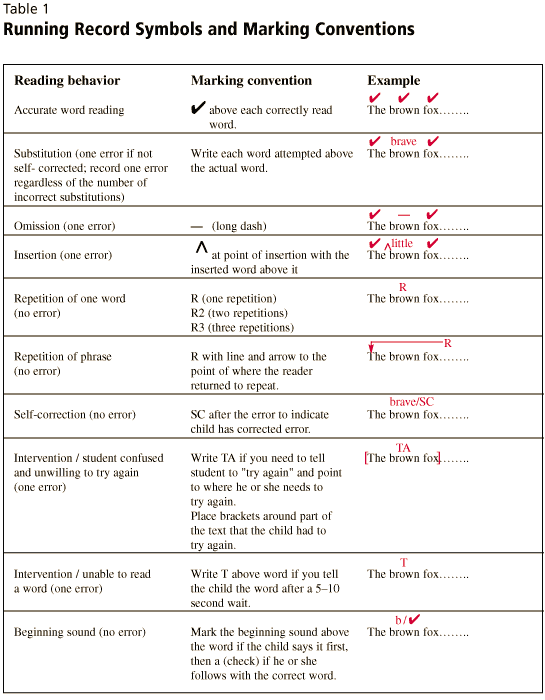
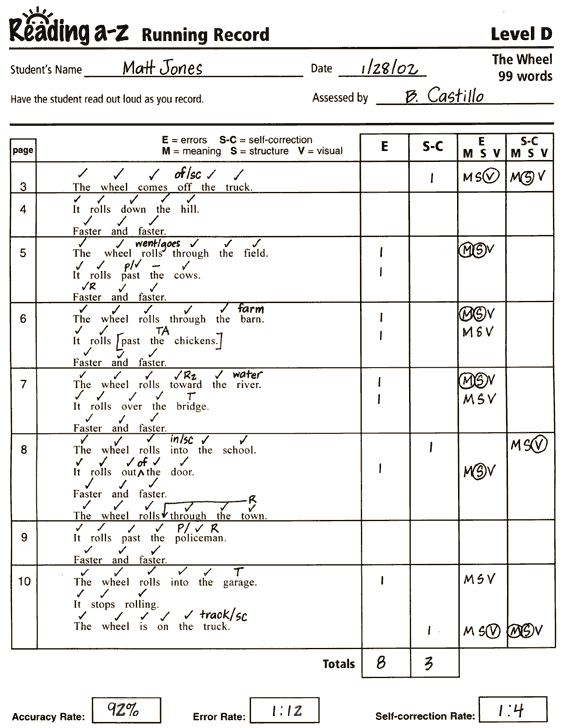
Marking a running record is also a two-step process. Step one involves marking the text on the running record form as the student reads from the Benchmark Passage or Benchmark Book. Once the student has read all the text on the running record form and you have recorded their reading behavior, you can complete Step two. Step two involves using the boxes to the right of the lines of text to gather information. Start with the first line and mark the number of errors in the “E” column. Then, tally the number of self-corrections in the “SC” column. When you’ve completed your review, total the number of errors and self-corrections at the bottom of the columns. Then, you use the Scoring and Analyzing a Running Record page to calculate the error, accuracy, and self-correction rates at the bottom of the page.
Below is an example of a scored running record:
Scoring Running Records – The information gathered while doing a running record is used for scoring and to determine error, accuracy, and self-correction rates. The calculated rates, along with qualitative information and the student’s comprehension of the text, are used to determine the student’s reading level.
Qualitative Analysis – Qualitative analysis is another aspect of assessing and comes from observations you make about the student’s reading behavior as you administer the running record. This may include the reader’s phonics, morphology, and guessing habits as well as fluency, intonation, and phrasing. If you need to prompt the reader, take note of how he or she responds. Use this additional information to better understand the student’s reading abilities.
Error Rate – Error rate is expressed as a ratio and is calculated by using the following formula: Total words / Total errors = Error rate. If a student read 99 total words and had 8 errors the student’s error rate would be 99/8 = 12.38. We then round to the nearest whole number and express the error rate as a ratio. The ratio is expressed as 1:12, and this means that for each error made, the student read approximately 12 words correctly.
Accuracy Rate – Accuracy rate is expressed as a percentage. You can calculate the accuracy rate using the following formula:
(Total words read – Total errors) / Total words read x 100 = Accuracy rate
Using the same numbers from before we would have: (99 – 8) / 99 x 100 = Accuracy rate, 91/99 x 100 = Accuracy rate, and .919 x 100 = 91.9%, or 92% with the numbers being rounded to the nearest whole number. You can use accuracy rate to determine whether the text read is easy enough for independent reading, appropriate to use without frustration during reading instruction, or too difficult for the reader.
A breakdown of these three categories in the Accuracy Rate Chart is as follows:
- Independent – Easy enough for independent reading – 95% – 100%
- Instructional – Instructional level for use in leveled reading session 90% – 94%
- Frustrational – Too difficult and will frustrate the reader 89% and below
Self-Correction Rate – Self-correction rate is expressed as a ratio and is calculated by using the following formula: (Number of errors + Number of self-corrections) / Number of self-corrections = Self-correction rate. An example of this would be if the student had 8 errors and 3 self-corrections. Its self-correction rate would be (8 + 3) / 3 or 11 / 3 = 3.666, or 4 when rounded to the nearest whole number. The self-correction rate is then expressed as 1:4. This means that the student corrects approximately 1 out of every 4 errors. If a student is self-correcting at a rate of 1:4 or less, this indicates that he or she is self-monitoring his or her reading.
*Other Notes from previous blog posts regarding running records:
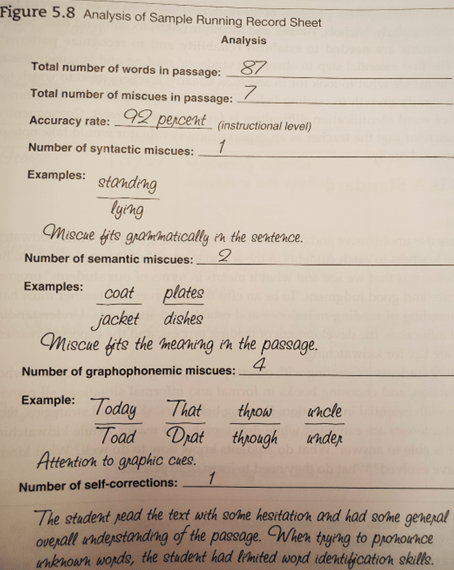
Analyzing Running Record – Analyzing running records allows teachers to understand the strengths and weaknesses of the student as well as their patterns of miscues. It also helps teachers understand how the reader uses and coordinates graphophonemic, syntactic, and semantic information from the text. Teachers must also consider the pattern of responses in order to analyze errors and self-corrections.
The figure below shows an example of an Analysis of a Running Record Sheet:
Another assessment tool used when assessing students is a Words Per Minute assessment. Words Per Minute – How many words the student can correctly read in one minute. This is an assessment in which readers read aloud for 1 minute from materials and the teacher marks the words the student reads incorrectly during the assessment. This assessment also tracks changes in reading rates and accuracy over time and assesses the appropriateness of the text’s difficulty.
Miscues – Oral reading errors. The terms error and miscue describe the same phenomenon – a deviation or difference between what a reader says and the word on the page. More positive way to describe evidence as opposed to error and also provides room for elaborate on the error.
Miscue Analysis – An informal assessment of oral reading errors to determine the extent to which readers use and coordinate graphic-sound, syntactic, and semantic information. These errors can be analyzed quantitatively or qualitatively.
Miscue Analysis uses four crucial questions:
- Is the meaning changed?
- Are the miscues nonwords or partial words?
- Are the miscues similar to the text words in structure and sound?
- Did the reader self-correct?
Summaries of the Videos
In this video, a teacher conducting a Running Record assessment with a 6 year old kindergarten boy. The student starts by reading a book called “At the Farm” while the teacher encourages him to read and provides assistance when needed. During the reading the child reads and sounds out words about various animals and their young. After the reading, the teacher asks the student several questions to assess his comprehension of the story. They also discuss the differences between adult and baby animals while going over the questions. Great brief video showing what to do during a running record and read aloud.
In this video, a teacher named Mary Lou in the Almond-Bancroft School District is shown using the Fountas & Pinnell Running Record in the classroom with a student named Hunter. They are going to be reading a short story called “Animal Instincts” to do a running records assessment. Hunter reads aloud while Mary Lou records the words he reads correctly or incorrectly. About halfway through the read, she directs Hunter to read the rest of the story on his own quietly and tells him that when he is done reading, she will be asking him some questions about what they read. When he is done reading, she asks him comprehension questions about the story, such as to tell him something about the concept of instincts and specific examples of instincts in dogs and cats. They then discuss parts of the book while answering questions like how instincts help animals. Hunter also demonstrates his understanding of the story by connecting the information from the glossary to the text. This brief video contained a tremendous amount of learning and assessing and is a great example of what to do after reading a text. The video ends with a brief sketching activity where Hunter sketches a dog showing its instinctive behaviors. Mary Lou also mentions that she will be testing Hunter at a higher level in the future because he did such a good job.
 Travis Davis ENGED 275