Phonological Awareness – *Textbook Definition (TD): A global awareness of large chunks of speech, such as syllables, onset, and rime, at the phoneme level. Typically includes the ability to manipulate (blend or segment) at different levels of the speech-sound system. Phonological awareness also includes rhyming and alliteration, the number of words in a sentence, syllables within words, onset and rime, and phonemic awareness. It is simple about listening to the sounds without seeing letters.
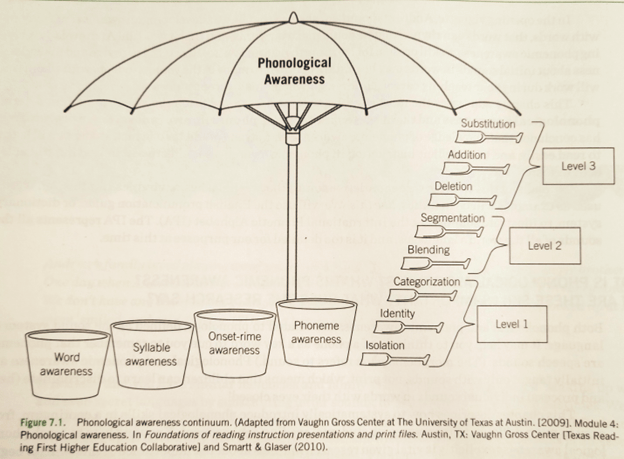
Phonemic Awareness – *TD: Awareness of the individual sounds that make up words and the ability to manipulate those sounds in words. It is also the ability to think about, combine, or segment individual sounds in speech and is the most challenging skills of phonological awareness.
*Phonological Awareness is the broader awareness of sound and hearing sounds. The word itself has the word phone in it, which means sound. Any sound is phonological awareness and can be and is developed through rhyming, tongue twisters, and hearing syllables.
*Phonemic Awareness is a specific skill in a smaller category of phonological awareness and only working with the smallest units of sound (phonemes). This skill involves developing an awareness of sounds in words and is developed through isolating sounds, segmenting, blending sounds, and manipulating sounds. This discrete set of skills helps children understand that the word dog can be separated, or segmented, into three individual sounds, /d/ /o/ /g/, and that, inversely, these three sounds can be combined, or blended, into a single word, dog.
Here is a website with some Phonemic Awareness games: http://www.howcast.com/videos/460491-how-to-play-phonemic-awareness-games-reading-lessons/
Phonemes – The smallest unit of sound that distinguishes the meaning of spoken words.
*Phonics – An understanding of letter–sound relationships. It is the matching of sounds to letters and text, making the connection between sounds and spoken language and how you represent those sounds.
**Throughout the book and this blog, letter sounds are denoted between slashes, or virgules, like this: /d/ or /ă/.
Onset – The beginning consonant(s) of a one-syllable word or the part of a syllable before a vowel, such as /b/ in the word bat.
Rime – The vowel and all that comes after or the part of a syllable that begins with the vowel and includes what follows such as /at/ for the word bat.
*For the word dog the onset would be the beginning sound /d/, and the rime would be what follows beginning with the vowel sound /og/.
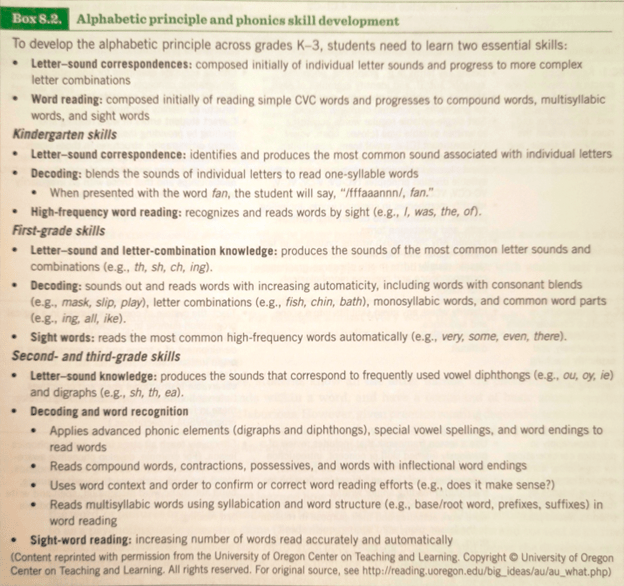
Alphabetic Principle – Understanding that written language is a code in which written letters (graphemes) represent units in spoken language (phonemes). It includes the understanding that squiggles on a page represent a sound and the squiggles have names. Students also learn that words are read from left to right (concept of print) and that every letter or letter pattern (grapheme) represents a sound (phoneme). Students learn that the sounds of spoken words are ordered in a specific, temporal way and that there are spaces between each word.
The figure below shows the development of alphabetic principles and phonics skills:
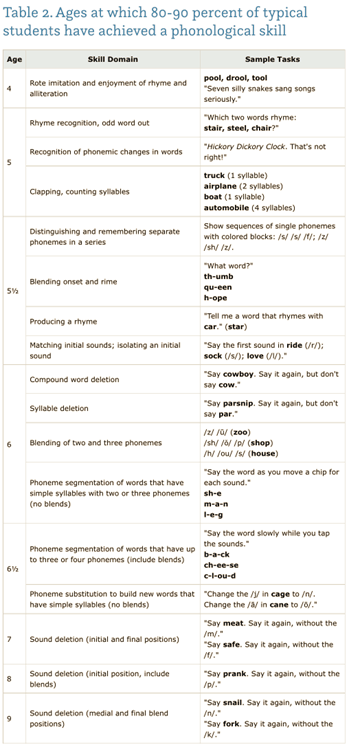
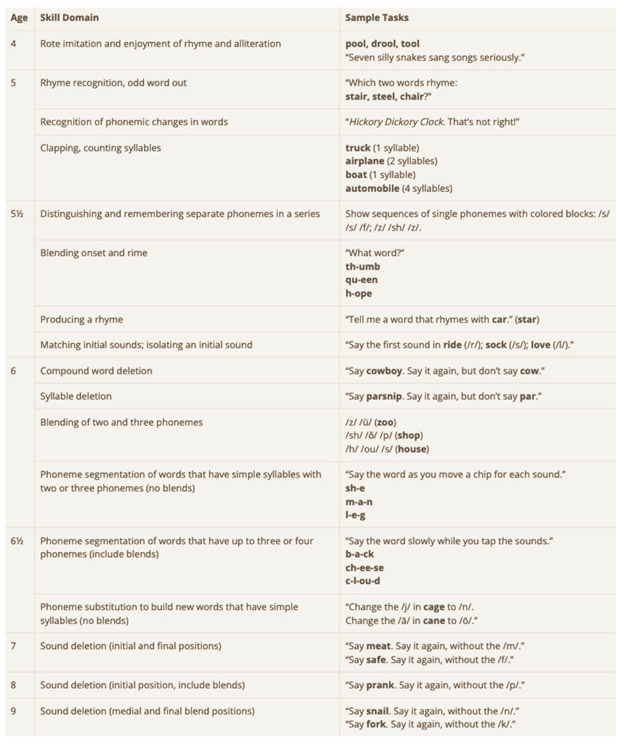
Phonological Awareness Skills and The Age They Develop –
By age 3 – Children are typically aware that words rhyme and can also be aware of when words begin with the same letter/sound called alliteration (Peter piper picked a pepper…).
By age 4 – The rhyming continues, and students may be able to fill in the blank with a rhyming word or fill in the blank when someone reading pauses at the end of a line (I see a red horse looking at _____). They can also sing or recite nursey rhymes that incorporate rhyming as well.
By Age 5 – Near the end of kindergarten children should have mastered phonemic awareness and be able to blend and segment the sounds in one-syllable words using onset-rime.
By age 6 – By the end of first grade students should be able to segment spoken single-syllable words into their complete sequence of individual sounds and be able to manipulate phonemes.
* It is also noted that if a student wasn’t read to by their family or early childhood teachers often that they will be behind when compared to other students. The students will then need explicit and systematic instruction of these concepts.
Systematic – Breaking lessons and activities into sequential steps that progress from simple to more complex. *TD: The definite method for a procedure, carried out by a step by step, routine process. Systematic instruction typically starts with teaching easier concepts to more complex concepts.
Explicit – Overtly teaching each step through teacher modeling and examples.
Six Guiding Principles to Make Activities Easier or More Difficult –
Instruction should be provided at a level so students will be challenged and not bored, but not too difficult so they become frustrated. Below are six guiding principles about what makes activities easier or more difficult.
- The size of the spoken sounds or words: The bigger the chunk of text, the easier it is to segment, blend, or delete. For example, it is easier to blend cow and boy to make cowboy than it is to blend the /c/ and /ow/ to make cow.
- The complexity of the linguistic skill required: Rhyming is easier than changing the medial sound. Manipulating phonemes is a hard task and it is easier for students to rhyme fun and sun than to change the medial vowels (as in changing cup to cap) or to delete sounds in blends as in slip to lip.
- The number of units in a word: It is easier to blend two-phonemes than five-phonemes. For example, the word at with /a/ and /t/ vs. the word scratch with /s/ /c/ /r/ /a/ and /tch/.
- The position of the sound within a word: It is easiest to hear the first sound in a word, next is the last sound, and most challenging is the medial sound, which is often a vowel (change cup to cap). Hearing the individual sounds within a blend, as in the /s/ /t/ /r/ in street, is more complex. What is easiest vs. most challenging to hear? (at vs. camp)
- Blend and segment continuous sounds before stop sounds: Continuous sounds may be held or hummed (like the /mmm/ or /sss/ sounds) whereas a stop sound may not (like a /t/ or /c/). It’s easier to blend /mmm/ /aaa/ /nnn/ in man than /t/ /o/ /p/ in top (top has stop sounds).
- Make the sounds, words, and process more concrete: Working with sounds requires a child to remember the sounds and may be taxing on their short-term memory. Using concrete objects instead of having the students try to remember reduces that memory load and pairs a kinesthetic component with the verbal output. Having children choose between two objects is easier than having them provide examples on their own.
Five Features of Effective Instruction –
- Explicit instruction with modeling
- Systematic instruction with scaffolding
- Multiple opportunities for students to respond and practice
- Ongoing progress monitoring
- Immediate corrective feedback
Classroom Application – The biggest takeaway from this week’s chapter has to do directly with how students learn about phonological awareness. Knowing what students should be learning or could be learning about and practicing with phonological awareness is vital to their reading and learning to read. One classroom application for this would be to help identify students who may be lacking certain skills for their age or grade regarding phonological awareness. Knowing and understanding what a “normally progressing” first or second grade student should be able to do can help us identify a student who may need extra help or interventions.
Video Notes
https://www.youtube.com/watch?v=McJldIFIpC8 – In the video, the teacher explains the distinctions between phonological awareness, phonemic awareness, and phonics. The teacher mentions the challenges of learning English because of its 26 letters and 44 sounds. There isn’t a one-to-one correspondence between letters and sounds too. The teacher goes over each definition and explains several examples. The teacher also stresses the importance of making phonological and phonemic awareness activities fun for students while putting much emphasis on auditory skills. She demonstrates and explains several examples again before concluding with a quick summary of the differences between phonological awareness, phonemic awareness, and phonics.
*From the Description: This video shares basic information about some terminology surrounding the teaching of emergent and beginning reading. It focuses on the definitions and distinctions between phonological awareness, phonemic awareness, and phonics. In a nutshell: Phonological awareness is the broader awareness of sound and is auditory. Phonemic awareness is the awareness of the smallest units of sound in a word and the ability to segment, blend, isolate, and manipulate those smallest individual units of sound. It is auditory. Phonics is the relationship between phonemes and graphemes. It is learning the rules and patterns of the letter-sound relationship.
https://www.youtube.com/watch?v=M_vLX8mxO4I – What is Phonological Awareness? This short video discusses phonological awareness. She describes how we listen to words and sentences, and it only involves listening and not seeing words. She also discusses how sentences and words can be taken apart into words and syllables before discussing taking apart sounds within a word as well.
https://www.youtube.com/watch?v=eHjRogrFZ28 – In this video, the teacher introduces the concepts of explicit and implicit writing with the goal focusing on, “Supporting your thinking using textual evidence.” She mentions that there are 3 main vocabulary words she will go over. The first, explicit writing, refers to information that is directly stated, clear, and obvious. Implicit writing involves information that is not directly stated and clues are given. This then requires readers to draw inferences based on clues provided by the author. These inferences are the act or process of using clues or evidence to draw a conclusion. The teacher emphasizes the importance of the “thinking voice” that readers should have while interacting with the text. She then shows an example of both implicit and explicit writing while demonstrating how a student should use their thinking voice. She next mentions that, “Your job = show your thinking voice.” After that, the teacher tells us that successful readers will go beyond explicit ideas, dig deeper using the author’s clues to draw inferences on implicit information, and to use the author’s clues to support their thinking voice as evidence. Finally, the students are assigned a practice task involving reading a short excerpt, determining if the writing is explicit or implicit, and drawing inferences using evidence to support their thinking.
https://www.youtube.com/watch?v=xb8hJSG_YYU – Onset and Rime Picture Cards. This video demonstrates how the onset of a word is the first part of the word before the vowel and the rime is the part after. There are pictures that represent a word that are cut in half and the student is to identify the onset and the rime for the words. With the word car, its onset is the “kuh” for the letter c sound and the rime is the “ar” part. For the word bat with separates to “buh” and “at” the student says “bah” and “at” the first time before she intervenes and works with the student to identify them correctly.
https://www.youtube.com/watch?v=HvX8oAdZ2t8 – In the video, the speaker explains how readers can recognize phonemes in words by identifying the individual sounds you hear in them. It begins by going over an example using the word “pig.” The speaker demonstrates that the word has three individual phonemes (sounds) of /p/, /i/, and /g/. The speaker also mentions that the number of phonemes in a word isn’t always the same as the number of letters. He then explains this using the word “seat” and shows us that it has four letters, but only three phonemes. Another example the speaker goes over is the word “chick.” This word has five letters but only three phonemes: /ch/, /i/, and /k/. The speaker explains the steps for recognizing phonemes in a word. He says that first you must listen to the word. Then you can identify the individual sounds or phonemes within it. The video ends with him repeating what the video went over and that recognizing phonemes in words is done by listening for and identifying the individual sounds present in each word.
https://www.youtube.com/watch?v=yxl4NIVOyFw – Phonemic Awareness: Phonemic Substitution. This video discusses breaking words down into their smallest sounds (phonemes) and swapping some of those sounds out for other sounds to create new words. She separates several CVC words into their smallest sounds which often end up being the letter sounds themselves. Then she shows how to swap out a sound from either the beginning, middle, or end of the word to identify a new word with the phoneme (sound) substitution. Great video on a way to use phoneme substitution to work with students.
 Travis Davis ENGED 275