Phonics – The tool readers use to pronounce words by associating sounds (phonemes) with letters (graphemes). This process involves mediated word identification because readers must devote conscious attention to “unlocking” the alphabetic code. Phonics is decoding words and spelling them.
*Phonics (Extended Version) – The relationship between phonology (which is the sounds in speech) and orthography (the spelling patterns of written language). Its emphasis is on spelling patterns and not individual letters because there isn’t a one-to-one correspondence between phonemes and graphemes in English. Some also describe phonics as the predictable relationships between phonemes and graphemes. The relationship between a sound and the letter(s) representing it is also called the phoneme-grapheme correspondence. Etymology, which is the study of the origin of words, also influences the pronunciation of letters and words.
Phoneme – Sounds – Phonemes are the smallest units of speech and are marked in our textbook using diagonal lines (e.g., /d/).
Phonemes can either be consonants or vowels; phonemes can also include consonant blends of 2 or 3 consonants which appear next to each other in words and their individual sounds blend together as in grass or spring and they can also be consonant digraphs of two letters that come together to make one sound as in chair or shell. Phoneme – each sound.
Grapheme – Letters – Graphemes are the letters of the alphabet. In our textbook, they are marked and shown using italics (ck). Grapheme – letters in print.
Phoneme-Grapheme Correspondence – Matching the sound to the correct letter. Phoneme-Grapheme Mapping is the one-to-one relationship between oral speech sounds (phonemes) and the letter or letters (graphemes) that represent those sounds in print. The common term, letter sounds, is misleading because it does not include letter clusters such as ch, sh, aw, oy, igh, and so forth where specific letter clusters represent one single speech sound. Also referred to as phoneme-grapheme association, phoneme-grapheme correspondence, letter-sound correspondence.
Graphophonemic – Letter-sound relationships – The Alphabetic Principle suggests that there should be a one-to-one correspondence between phonemes and graphemes, so that each sound is consistently represented by one letter. However, the English language isn’t a perfect phonetic language, and there are over 500 ways to represent 44 phonemes using single letters or combination of letters. This principle is about knowing that letters have a name and that they make a sound or sounds.
Decoding – Sounding out a word. The ability to apply your knowledge of letter-sound relationships, including knowledge of letter patterns, to correctly pronounce written words. Understanding these relationships gives children the ability to recognize familiar words quickly and to figure out words they haven’t seen before. Although children may sometimes figure out some of these relationships on their own, most children benefit from explicit instruction in this area. Phonics is one approach to reading instruction that teaches students the principles of letter-sound relationships, how to sound out words, and exceptions to the principles.
Encoding – Using sounds to spell words.
Phases of Word Reading and Summary of Each:
Visual Nonalphabetic Phrase –
- Students should know: reading environmental print and pictures to help them read a story
- Grade level: beginning of kindergarten, but could be younger
- Instruction: create environmental print (students are familiar with) bulletin boards and books
Partial Alphabetic Phase –
Students should know: letter names, individual sounds, guess words based on the first letter
Age: kindergarten-first grade (depends on where they live)
Instruction: Introducing letters, sounds, and blending cvc words
Full Graphophonemic Phase –
Students should know: all letter names, able to sound out words with 3-4 phonemes, basic spelling patterns
Age: kindergarten-second grade
Instruction: reading, spelling, blending, decodable books
Consolidated Graphosyllabic Phase –
Students should know: how to read with automaticity and comprehend what they read, increase in vocabulary, read more, and identify more sight words without sounding them out
Age: first-second grade
Instruction: READ and comprehension questions, sight words explicitly taught, vocabulary, and writing
Graphomorphemic Phase –
Students should know: read with automaticity, rarely need to decode words, strategies used to decode unfamiliar words, know various spelling patterns,
Age: first-third grade
Instruction: spelling patterns, read, and write
Phonological Awareness to Phonics Continuum:
- Phonological and Phonemic Awareness
- Naming letters (upper and lowercase)
- Producing sounds that letter represents
- The alphabetic principle
- Single-consonant phoneme-grapheme patterns
- All short vowel sound-spellings
- Consonant digraphs: ch, th, sh, ng
- Consonant trigraphs: tch, dge
- Vowel teams: ai, igh, ow
- Common irregular spelled words: said, of, one
Sight Words – All words that are read with automaticity. Words may have common and uncommon phonetic patterns (regular words and irregular words).
Irregular Words – A word that does not follow typical letter-sound correspondences, usually found in the vowel sounds(s), such as there, cough, and said.
High-Frequency Words – Words that appear often in printed material. These sight words make up a large percentage of written words and are grammatically necessary. Many of these are often called function words because they help a sentence function but do not give it meaning.
Nonsense Words – Words that aren’t quite “real” words but can still be read phonetically for teachers to assess student’s abilities.
Diagnostic Assessment – Assessments used to pinpoint specific areas of weakness; provide in-depth information to clarify students’ skills and instructional needs.
Progress Monitoring – Diagnosing reading and writing problems and monitoring the progress of each student. Progress monitoring is usually completed in a regular, preplanned schedule to evaluate the rate of progress as well as helping to measure student performance and improvement or responsiveness to instruction.
Guidelines For Teaching Beginning Phonics –
Teach most common phoneme-grapheme correspondences first (s, m, t, f, b, r)
2. Begin with phoneme-grapheme that can be combined to make words
3. Being with continuant sounds or letters like m, n, or s
4. Teach vowels
5. Use Multisensory techniques
6. Stretch the sounds out in the words.
7. Separate sounds that sound alike and letters that look alike don’t
teach b and d together. Should be taught at least 3 weeks apart.
8. Introduce only a small number of phoneme-graphemes each week.
9. Provide multiple opportunities for students to practice.
10. Use a consistent routine and direct, systematic instruction.
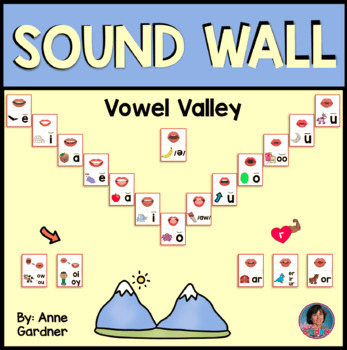
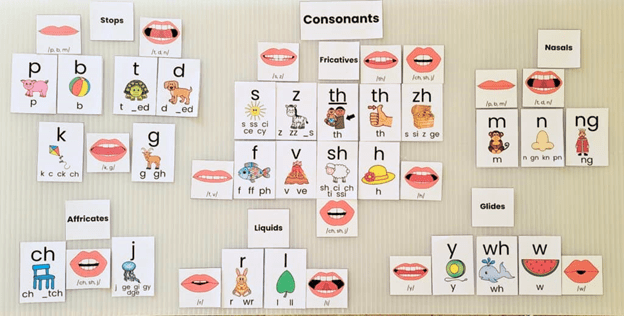
Sounds Walls – Similar to a word wall, but with sounds and letter sounds. The idea is to switch the teaching letters in print to:
- Teaching phonological awareness
- Teaching phonemic awareness
- Teacher letter names
- Making connections between sounds and the most common way to spell those sounds.
Here are some examples of a sound wall:
Orthographic Mapping – The process readers use to store words for instant retrieval.
***Knowledge of likely spelling patterns. Readers will use their abilities to group common letter patterns into syllables. They also us their knowledge of likely and unlikely letter sequences when encountering multisyllabic words. Skillful readers will chunk words into syllables automatically when perceiving letters while devoting less attention to encoding, putting less energy into identifying words.
Simple Regular Words – Words that consistently follow a regular, predicted pattern, and the letter sounds are the most common and easiest to decode.
High-Frequency Irregular Words – Words where the spelling doesn’t follow a predictable spelling pattern.
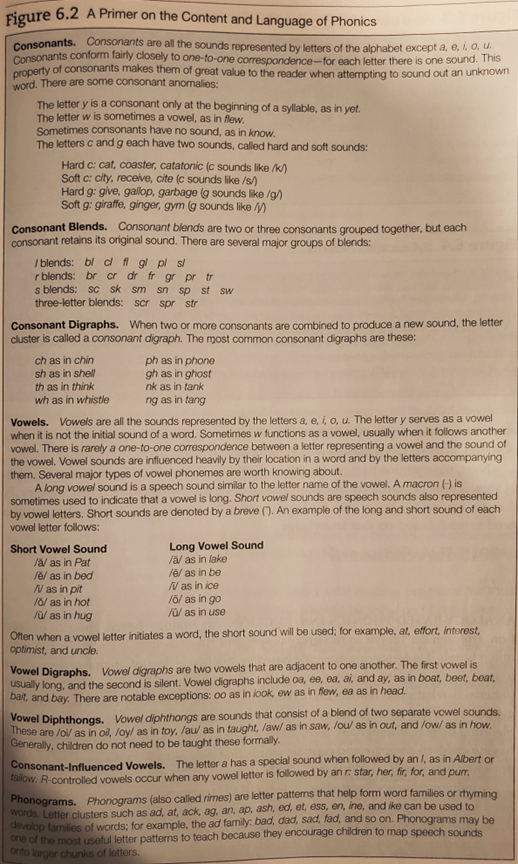
Consonant Digraphs – When two or more consonants are combined to produce a new sound, the letter cluster is called a consonant digraph. The most common consonant digraphs are these: ch as in chin ph as in phone sh as in shell gh as in ghost th as in think nk as in tank wh as in whistle ng as in tang
*Two adjacent consonants that make one sound.
Vowel Digraphs – Two vowels that are adjacent to one another. The first vowel is usually long and the second is silent. Vowel digraphs include oa, ee, ai, and ay as in boat, beet, beat, bait and bay. There are also notable instructions: oo as in look, ew as in flew, and ea as in head.
Long Vowels With Silent E – A vowel-consonant-e, or VCE, pattern. The final e is silent and the vowel is long.
Vowel Teams – Two or more vowels representing one vowel sound, often found in the middle of a word.
Diphthongs – Vowel Diphthongs – Sounds that consist of a blend of two separate vowel sounds. These are /oi/ as in oil, /oy/ as in toy, /au/ as in taught, /aw/ as in saw, /ou/ as in out, and /ow/ as in how. Generally, children do not need to be taught these formally.
Silent Consonants Need To Be Learned – Two consonants where only one is heard and the other is silent. Examples of common silent consonant combinations include kn (knee) and wr (write).
R-Controlled Vowels – When the letter r follows a vowel and the sound of the vowel is affected. Although there are two letters in these vowel combinations, they represent only one sound. Examples include er, ir, ur, or, and ar as in herd, fur, dirt, car, and for.
Soft C and Soft G – These sounds are due to the French influence in our language and account for the different sounds for the letters c and g. Typically, the letter c represents /k/ and the letter g represents /g/, the hard sounds. However, when the letter c or g is followed by e, I, or, y, the letter sounds c like /s/ and the g sounds like /j/. Examples include the words city, central, and cyber and gem, giant, and stingy to discern the patterns.
*Also, if the c or g is followed by a, o, u, or a consonant, the sounds /k/ and /g/ are often referred to as hard sounds, as in carat, color, cut, and clarity and gate, gold gut, and group.
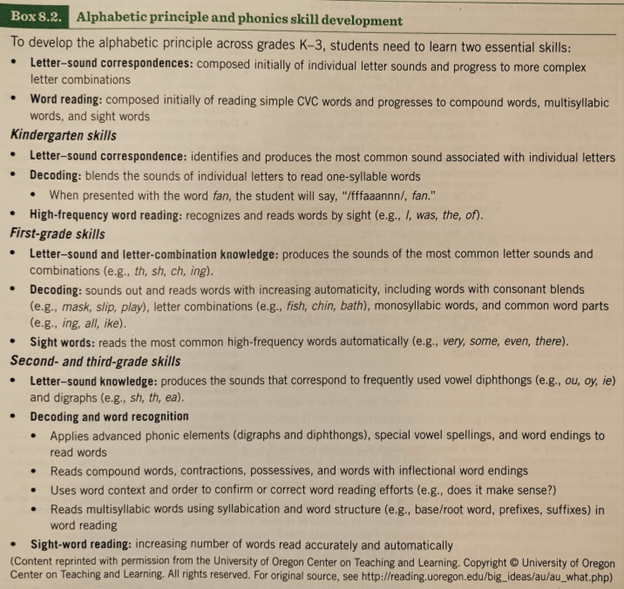
Classroom Application – There was a tremendous amount of information in this week’s chapter and videos. One of the biggest take aways for me personally is knowing and understanding how students develop their alphabetic principles and phonics skills. Knowing how these skills develop will help to better intervene with those who need it and what sort of activities I can do to help them. It will also help to know the many different developmental phases and awareness continuums to know what to teach my students and when to teach it. Knowing more about these phases and such will also better help me identify those lacking skills and those who should be given more academically challenging work. Overall, lots of great information in the chapter and great brief videos on what several of this week’s terms mean.
Video notes:
https://youtu.be/NkA994wNIZU – DIBELS Grade 1 Example – In this video, a teacher does a DIBELS assessment with a student. The assessment begins with the teacher instructing the student to point to the letters on the page and to name them. The student then points to and names the letters as he reads. Next, the teacher instructs the student to say the individual sounds in words as she reads them. After practicing with several “real” words, the teacher tells the student they are now going to work with “make-believe” words. She asks the student to read the words while emphasizing that the student should read the whole word or provide any sounds they do know if they can’t read the entire word. After the student successfully reads through the list and the teacher tells the student that he did an excellent job during the assessment.
https://youtu.be/tBb92p_6how – What is Phonics? –
In this video, a reading specialist discusses the importance of phonics in reading instruction. She first defines phonics and then explains its two parts being alphabet knowledge and phonemic awareness. She also says that they are basically a connection between sounds and spoken language and how you represent them in written language. She then goes into a more specific definition of phonics in regard to the method of reading instruction. She mentions that children need to be explicitly taught spelling rules and orthographic patterns because English is a 90% phonetical language. She advocates for phonics instruction for students to be able to have the tools available to them to read and decode unfamiliar words as opposed to guessing the word based on the initial letter and context clues. Great brief video about why phonics instruction is important.
https://www.youtube.com/watch?v=K4XEDJIugxM – Letter-Sounds
In this video, a teacher is working with students on letter-sound relationships. They start by focusing on the letter ‘p.’ The teacher introduces the letter ‘p’, its corresponding sound, and how pig is used as a mnemonic device to help them remember it. She then emphasizes the sound “puh” and associates it with the polite pig who loves pizza and pie and always says please. She then moves on to a review of previously learned letter sounds with the students. After the review, the teacher explains to the students that they can use these letter sounds to write simple words. The students then do a sounding out and writing activity using the words on the board and through sounds on individual whiteboards. This is a fantastic example of an interactive and engaging lesson to reinforce letter-sound associations.
https://www.youtube.com/watch?v=-EJpDFmbaMI – Curious About Orthographic Mapping?
In this video, the speaker introduces the concept of orthographic mapping and its definition. The speaker emphasizes the importance of sight words in reading mentioning that word recognition and sight word reading happens in milliseconds. This all means that it is essential for readers to recognize most words by sight. The speaker then moves on to explain how sight word knowledge is more about phonemic awareness skills than visual memory. She then goes on to explain how sight word recognition is developed in three main areas of sound/symbol correspondence, word study, and a proficiency in phonemic awareness. The speaker moves on to mention that manipulation is the most important phonemic awareness skills and that these skills rely on segmentation, deletion or substitution, and blending with the key to orthographic mapping is doing it automatically. She also mentions that phonemic awareness instruction can be helpful at any age. She finally suggests several next steps an educator can take to help as well as provided resources.
 Travis Davis ENGED 275