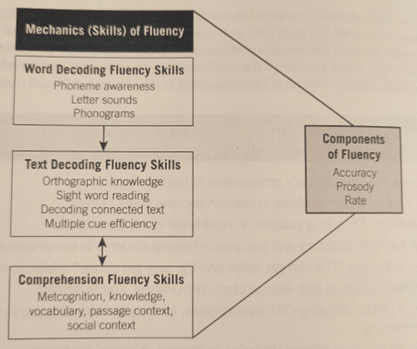
Fluency – The ability to read accurately at a rate that mirrors speech, with expression and comprehension. Fluency is reading with reasonable accuracy, appropriate rate, and suitable expression.
*If students aren’t fluent in their reading, they can’t comprehend. Their brain is too busy decoding to comprehend. This is why it’s so important that students are reading at their independent reading level.
Three Components of Fluency Defined –
1. Accuracy – Reading the words correctly with at least 95% accuracy. For the reader to understand what is being read, the text must be read with a certain level of accuracy, reading the words correctly as they appear in the text.
2. Rate – The speed the student reads the text. *It is often mistakenly used as a synonym for fluency. Students should do their “best reading” as opposed to “reading as fast as they can”.
3. Expression – Reading with prosody. Expression refers to the pitch, tone, volume, emphasis, and rhythm in speech or oral reading. The ability to read with appropriate expression is an important aspect of fluency.
Prosody – One of three necessary components or characteristics of a fluent reader. Prosody is the ability to read with appropriate expression; includes the pitch, tone, volume, emphasis, and rhythm in speech or oral reading.
Other Notes About Accuracy and Rate –
- Accuracy plays the most important role in comprehension in kindergarten and early first grade.
- Once students are reading, typically middle of first grade, the accuracy and the rate of their reading is strongly tied to their overall reading skill including comprehension.
- Once a student’s reading level is around the 6th-grade level factors other than fluency such as vocabulary and background knowledge become more important in the overall reading process
*Comprehension is impaired or limited by reading too fast, too slowly, or inaccurately and is facilitated by reading at an appropriate rate for the task with reasonable accuracy. In other words, fluent reading assists comprehension.
Curriculum Based Measures (CBMs) – An assessment method used to monitor what students have been learning usually consists of standardized instructions, use of a stopwatch or timer, a set of passages, scoring procedures, and record forms or charts. CBMs are often used to progress monitoring since they are well suited for repeated use and allow for immediate adjustments in a student’s educational program as needed. CBMs are considered a general outcome measure (GOM).
Oral Reading Fluency (Orf) – A CBM assessment requiring the use of standardized procedures that involve having a student read aloud from unpracticed passages or lists of letters, letter sounds, or words for 1 minute while an examiner identifies errors. A student reads aloud a passage they have never seen before while younger students read a list of letters or sounds for one minute. The scorer then determines the student’s Words Correct Per Minute (WCPM or the number of letters or sounds correct).
Words Correct Per Minute (WCPM) – This is the number of words a student correctly reads in one minute. The score can then be compared either to an established benchmark that indicates proficiency or to a specific goal set for that student.
*Additional diagnostic assessments of specific foundational reading skills, including phonemic awareness and phonics/decoding, should be administered to all students below benchmark to determine what skills to target in an intervention.
*It’s important we don’t only use the ORF assessment to determine if a student is above or below grade level reading. There are many other facts, but it could raise a flag to dig deeper into a student’s reading ability.
Students at a 6th-grade reading level should be given a close assessment-read silently with certain words removed. Students select the appropriate words, so it makes sense.
Students who are in Tier 1 should be assessed 3-4 times a year.
Students who are Tier 2 or 3 should be assessed weekly or bi-weekly.
Students improve their fluency when reading aloud. Silent or independent reading doesn’t improve a student’s fluency. Why?
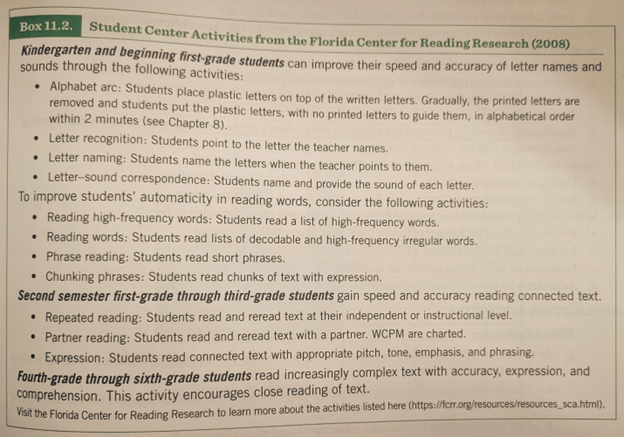
Repeated readings are a great fluency intervention when provided with teacher feedback and modeling.
Cueing students to attend to their accuracy and rate while reading can increase a student’s fluency. A teacher should ask, “Does that make sense?”.
Structured Partner Reading – A teaching activity that involves the teacher paring appropriate partners, assigning the text for them to read, and providing a process to use when reading, listening, and providing partner feedback. More fluent students should be matched with less fluent students, but they shouldn’t be vastly discrepant, and students who are struggling greatly and drastically less fluent should be paired with the teacher or another adult. These partners also take turns reading aloud and provide each other feedback including pointing out errors and supporting correct pronunciation and decoding of words.
Repeated Readings – Repeated and Monitored Oral Readings – Instructional activity in which students read and reread a text a number of times or until a certain level of fluency is reached. It has been shown to improve reading fluency and overall reading achievement; four re readings are usually sufficient for most students. Students can also practice reading orally with tutors, peers, audio recordings, open or in other settings. These repeated readings remain the gold standard of fluency interventions, and it is more effective when teachers provide feedback or have the student read along with a model as part of repeated reading than independent repeated reading.
Round Robin Reading – A teaching activity/method where students take turns reading aloud from unpracticed text often in a whole-class, large-group setting. Only one student is reading at a time while the others are typically losing interest and not paying attention. This method is one that is commonly implemented to try to encourage reading but is one that is less effective.
Sustained Silent Reading (SSR) and Drop Everything And Read (Dear) – A teaching activity/method where students are required to read silently in self-selected texts for a designated period of time, sometimes up to 20 or 30 minutes or more daily. However, students often choose books that are either too easy or much too difficult for them, so they are not improving their reading skills.
*Although some students may benefit from these activities, neither round robin reading, nor SSR/DEAR provide the amount of practice that at-risk or struggling readers will need to develop their fluency. Both activities also limit the amount of modeling and opportunities for specific feedback provided by the teacher, which is critical for effective instruction.
Choral Reading – A teaching method/activity where all students participate and read a text aloud in unison along with the teacher.
Cloze Reading – A teaching method/activity that involves having the teacher read text aloud while students follow along silently in their own copies of the text or from a shared text posted on a whiteboard or posted for all to see. From time to time, the teacher randomly pauses before reading a word, and the students read that omitted word aloud in unison.
Reader’s Theater – A popular and effective approach to encourage students to reread passages to become more fluent readers. Students are assigned parts in a short play and practice their lines to prepare for a performance reading the script. When doing this, students learn to read with expression and accuracy.
Tier 1 Fluency Instruction – Students in Tier 1 are making progress in reading and teachers should provide practice opportunities and increase the complexity of the text students read. Students will develop adequate fluency levels by simply engaging in reading and especially so if they also hear models of fluent reading and receive feedback about their reading accuracy, rate, and expression.
Effective ways to encourage reading and build fluency: Choral reading, cloze reading, structured partner reading, readers theater.
Less effective ways to encourage reading: Round robin reading, silent sustained reading (SSR), and drop everything and read (DEAR).
Tier 2 Or 3 Fluency Instruction –
One effective activity for students who need more targeted intervention is a strategy known as Read Naturally (RN). Students are first assessed to determine their appropriate level of text in which to receive instruction. They are then placed in a text level that is at or close to their frustration level (less than 90% accuracy). Then:
1. The student completes a 60-second cold read of a self-selected passage. They are then given a score which will be used as an indicator of their unpracticed WCPM and can be motivated to practice by increasing this score.
2. The student marks words that cause them to “stop, stumble, or skip” and they record their WCPM.
3. The student then rereads the passage aloud with a skilled reader. They will reread the passage three times to ensure the student knows all of the words. The purpose of this step is to help the student learn how to identify and correctly pronounce all the words in the passage and to provide a model of appropriate expression.
4. Once the student knows all the words, they engage in repeated rereads for 60 seconds until the student reaches the ORF goal. This step usually takes 3-10 times and helps build the student’s reading rate while maintaining accuracy.
5. Finally, the teacher now listens to the student read the well-practiced passage for 60 seconds. If the student makes no more than three errors, reads with appropriate expression, and reaches their goal, they are allowed to record the practiced WCPM score on a graph alongside the original cold-read score.
6. This process is then repeated with the next passage. The RN strategy also incorporates prediction, retell, and comprehension questions to hold students accountable for comprehending the content of the passages.
Cold Read – Reading a text that a student has not read before.
Classroom Application Easily the biggest take away from this week’s chapter for me personally has to be the understanding that round-robin and sustained silent reading activities are ineffective ways to increase fluency and comprehension. Everything the authors described about the reasons why it’s ineffective and which methods and activities are more effective made total sense to me. As a future classroom teacher, whether it be in reading instruction or another subject, knowing and understanding what instructional methods and activities are more effective than others is critical for student success. It is clear that increasing the amount of practice opportunities and the complexity of the texts are great ways to effectively instruct students. I also have a better understanding of the reasons for the Tier 2 intervention strategy Read Naturally, and I believe that this strategy might work in many science and social studies lessons as well. Great information is this week’s chapter.
Video Notes
https://youtu.be/eVjDsNcPU2E – Reading Fluency with Chloe, Second Grader: This video is a great demonstration of fluency instruction and activities as well as great definitions of fluency. She describes that fluency includes accuracy, rate, and expression. Some of the things the video discusses is how to address errors in accuracy and why we should address them, how to use charts and scores for encouragement, what repeated readings are and why we do them with students, and how rate actually has a lot to do with comprehension. Great video with lots of examples and useful tips.
https://youtu.be/o_-z8d0sRUA – Choral Reading: This video discusses what choral reading is and how it deals with comprehension. It then goes on to detail some guidelines for a choral reading activity/program. A teacher must start by choosing a book that is at an appropriate reading level, contains dialogue or rhythm, and is relatively short. Next the video discusses how we should model fluent reading for the students but have them follow along in the text and why we do this. The video goes on to explain that we should take time to point out and discuss important elements in the text before rereading the text aloud and in unison with the students. Great short video discussing choral reading and how to effectively use it in the classroom.
https://youtu.be/vMVB-RUKXKM – An Explicit Fluency Lesson with a Prosody Element Focus: This video starts with an explanation about what fluency is, what it sounds like, and why it’s important. Then the teacher demonstrates and models what good fluency and prosody sounds like and looks like. The class and the teacher then read together aloud before the students “whisper read” the text quietly by themselves. She then models reading fluently the next part of the text before the students and teacher read fluently aloud together again. The students then read the text on their own before rereading the whole passage.
https://www.youtube.com/watch?v=NWl0hnb1crM&t=1s – K-3 Essential 3, Bullet 3: Small Group Fluency Instruction Sample Video: This video details many of the different fluency activity types like echo reading, repeated readings, and readers theater for small groups. The video describes and explains the differences between the activities and the benefits of doing them. It includes firsthand examples of the teacher doing an echo reading, repeated reading, and readers theater activity. The teacher describes how fluent readers read with expression and how to model expression reading with students. These firsthand examples are a great resource for others to observe how an effective teacher uses many different strategies with their readers.
https://youtu.be/5xXEWm-6bnE – Reading Multisyllable Words with Xavier, Third Grader: The video starts off with a few examples of how students “misread” words when reading and how to help them. The teacher and student begin by reading nonsense words to understand how to read multisyllable words. The teacher describes that they are going to ask themselves two questions for each word they are attempting to read: How many vowels? And are they together or apart? They then start with single syllable words to fully understand syllables and what they are before they move on to two or more syllables. They then work on breaking apart bigger multisyllable words by writing down each of the broken apart syllables. After practicing looking for the vowels and separating the syllables, the student begins to read longer and more difficult words. The teacher then goes on to explain how once a student understands the basics of reading multisyllable words they can move on to more difficult lessons about things like silent e’s and other word/letter patterns. Great example of a student’s potential with a letter bit of extra help.
*Here is one more great resource for fluency: https://www.readingrockets.org/article/top-10-resources-fluency
 Travis Davis ENGED 275