Polysemous Words – Words that have more than one meaning, such as rose the flower and rose the verb.
Morphemes – Prefixes, suffixes, and root words. The smallest meaningful unit of a word. For example, the word unhappy has two morphemes. The first is “un” meaning not and the second is “happy” meaning joyful.
*Other notes on the importance of teaching vocabulary:
- A student’s vocabulary knowledge in kindergarten predicts their ability to read with comprehension in high school.
- Students with restricted vocabulary in primary grades typically have poorer reading comprehension years later when compared to their peers with better knowledge of words.
- Vocabulary inequalities exist before the students even start school and the gap continues to grow across the school years. Students who know more words also read more words, which exposes them to even more words.
- Vocabulary needs to be explicitly and implicitly taught. There is no limit to words students can learn as long as the students have conceptual knowledge to understand the meaning of the words.
Skills Students Should Learn At Each Grade –
- Pre-K: Students develop oral language.
- Kindergarten: Students learn names of common concepts usually by looking at pictures.
- First Grade: Students rely less on pictures and more on words introduced in stories and informational text.
- Second Grade: Students begin to make inferences about the meaning of words and to identify words with multiple meanings.
- Third Grade: Students master more sophisticated skills such as categorizing words, using prefixes and suffixes to determine word meaning, and using more vocabulary words.
- Fourth Grade+: Students understand more polysemous words and morphemes, use reference tools, and use general academic and domain-specific words.
Ways To Assess Vocabulary –
*The goal is for students to learn words well enough to understand and use them throughout their lives and not just memorize definitions for a weekly test.
Using the Vocabulary Knowledge Scale – students rate words on a scale from 1 to 4 based on how well they know the word. It starts at “I have never heard of the word”, to “I have a deep understanding of this word”. If they have a higher understanding of the word, they need to explain what the word means and use it in a sentence. Students also monitor their growth and are proud when they have increased their knowledge. *It’s also important to remember that a deep understanding of vocabulary-even words and phrases already familiar with-continues to become more multifaceted throughout our lives and the depth of our experiences with those words increase.
*It is also important when assessing students to detect partial knowledge. Growth before and after a unit is highly motivating.
*Students can also be asked to write a sentence using one or two taught vocabulary words in a sentence. Students can also be assessed using oral language by responding to spoken sentences.
Choosing Words to Teach-Tiers and Morphology –
There isn’t specific research that shows there should be a certain number of words taught each week or what words to teach in a specific grade level.
Effective, meaningful vocabulary instruction includes context, a student-friendly definition, and engaging discussion.
Educational researchers have developed a flexible leveled 3-tiered system for vocabulary to help teachers choose words more effectively:
- Tier One words: Words most children know already.
- Tier Two words: Words students will see repeatedly in nearly every content area. These words include final, former, exhausted, demonstrate, analyze, distribute, emphasize, complete, generate, and frequently. These are academic and scholastic words. Many Tier Two words are often a synonym for Tier One words such as obtain (Tier Two) and get (Tier One).
- Tier Three words: Words that are specific to a particular content area or unit of study. These words include integer, tundra, hieroglyphics, and photosynthesis. Students need to have an in-depth understanding of these words only if it’s necessary for understanding the unit or passage. Otherwise, a quick explanation is sufficient.
Word Selection Based on Morphology – Families of morphological related words make up many of the words students will encounter and account for 58% of the most frequent words in English. A word in a morphological family should be taught along with its relatives. For example, the word form should be taught and discussed alongside its morphologically related family words formation, reform, reformation, and formulate.
Four-Part Vocabulary Plan – The components necessary to optimize vocabulary growth. It consists of four different but interconnected components and is written as “to do” statements for the teacher. As in, teachers should:
- Provide rich and varied language experiences:
- Create a language-rich, highly verbal learning atmosphere.
- Read aloud to the class.
- Offer opportunities to explore the language of poetry and drama.
- Encourage elaborate discussions and debates.
- Plan for topic-pertinent peer conversations. Promote listening, speaking, reading, and writing.
- Encourage students to read daily, from fiction and nonfiction.
- Help students find reading materials that align with their interests.
- Teach individual words:
- Select a few words to teach thoroughly.
- Teach the words with explicit and cognitively engaging methods.
- Provide students with two key essentials: a learner-friendly definition and context.
- Form associations, creating networks of related words.
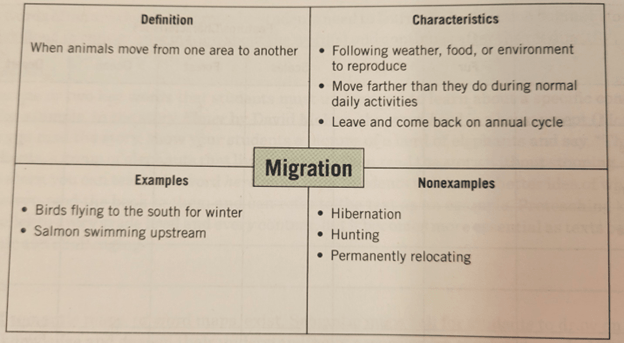
- Provide examples and nonexamples of the word meaning, such as “That music is remarkable, but this plain pencil is not remarkable.”
- Revisit the words over time in differing contexts, providing multiple and varied exposures.
- Teach word-learning strategies:
- Teach students how and when to use a dictionary and a thesaurus.
- Teach students how to infer the meaning of an unknown word by examining context clues as well as word parts (prefixes, suffixes, and roots).
- Foster word consciousness:
- Help students develop a love for language.
- Kindle interest and engagement with words.
- Helps students appreciate a word or phrase as uniquely useful.
- Create opportunities for students to recognize the power of words.
- Model curiosity with words, phrases, and word origins.
1. Provide Rich and Varied Language Experiences – Effective vocabulary instruction requires integration, repetition, and meaningful use.
Integration – Linking the new learning with something they already know or combining new concepts with ones the students already know. They should use synonyms and antonyms to connect related concepts.
Repetition – Providing multiple and varied exposure to the word in differing contexts. Students require 18-21 exposures to words when relying solely on reading to acquire them, but high-quality activities can reduce it to 2 or 3 exposures.
Meaningful Use – Using the word in varied applications or contexts. Teachers should draw associations, make connections, and compare and contrast words and concepts. The more the student thinks about the concept, the more they will likely understand the word and remember it.
Synonyms – A word that means exactly or nearly the same as another word or phrase in the same language.
Antonyms – A word opposite in meaning to another.
Word Consciousness – An awareness and appreciation of the power of language, as situated in context. We can develop this through modeling attention to the novelty and power of the language encountered in books and oral interactions. We can also show students how we notice whether a word or phrase is: new to us; a more sophisticated version of a known word or expression; scientific, old-fashioned or archaic, idiomatic figurative, whimsical, and so forth; very long, very short, difficult to pronounce, fun to say and so forth.
Cognates – Words from different languages that have similar spelling, pronunciation, and meaning. For example, the Spanish word insecto is a cognate for the English word insect. Cognates are more easily recognized in printed form than they are in speech. However, not all words that are spelled alike or sound alike share the same meaning.
* 3 Principles of effective vocabulary instruction:
- Multiple exposures
- With deep understanding
- Connected to what they know
Teaching Vocabulary Words to EL’s –
- Connecting academic vocabulary to an engaging text.
- Selecting a small set of academic vocabulary for in-depth instruction. These words should include words that are important to understanding the text, used frequently, used in other content areas, have multiple meanings, part of a morphological or conceptual family, and have a cognate or similar form in both English and the student’s native language.
- Using multiple modalities (writing, speaking, and listening) and concreate representations (pictures and graphic organizers) to explore words in depth.
- Teaching word-learning strategies (context clues and word parts) to help students independently figure out the meaning of words.
- Many of the above are the same for teaching vocabulary to native speakers.
* Other supports for EL’s include:
- Role-playing or acting out meanings of words.
- Modeling how to pronounce new words and giving feedback when they say the words.
- Teaching the conventions of English grammar and pronunciation.
Activities And Strategies for Teaching Vocabulary –
Read Aloud to the Class – Reading aloud is one of the best ways to expose students to new words.
Dialogic Reading – Talking about what you’re reading and asking questions while reading aloud and having a dialogue with the students.
Extending – Pre-k-2nd grade – Reading and rereading the same story multiple times during the week. Each day you teach a few more words from the story and on the 5th day the students are assessed on the vocabulary.
Paraphrasing – Embedding a simple translation of a word or concept to ensure the students understand the text. This differs from directly teaching new words in depth and can occur during the read-aloud without stopping or dwelling on the word. For example, a teacher may read a sentence and quickly interject by saying, “Once upon a time, a maiden (a young girl) lived in a tiny village (a very small town).”
Preteaching – Preteaching involves choosing one or two key words that the students must understand to learn about a specific concept in the text and briefly teaching them what those words mean. This can be done by showing them pictures, reading the definitions, using the word/s in example sentences, providing background information about the key terms, and many other ways. In simpler terms, before reading the story, a teacher teaches students a couple of vocabulary words. Preteaching key vocabulary applies to every grade level and every content, but it becomes more essential as texts become more academic and challenging.
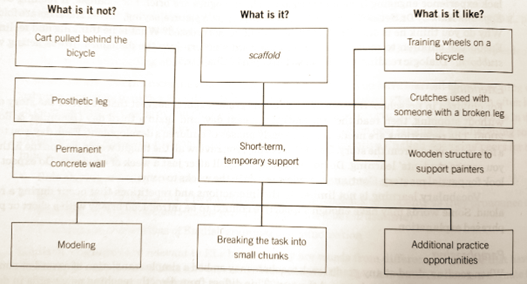
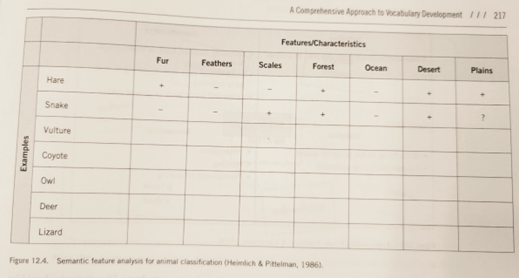
Semantic Maps or Word Maps – A learning activity/strategy where students draw on their background knowledge and deepen their understanding of a word or set of related words. Teachers can use semantic maps when teaching vocabulary by using concept maps, semantic feature analysis, Frayer Models, word associations, and word lines.
Here is an example of a concept map:
Here is an example of a Semantic Feature Analysis:
Here is an example of a Frayer Model:
Classroom Application
When it comes to being an effective classroom teacher, vocabulary instruction is critically important. A quick google search of vocabulary lessons and activities can easily show us just how many different vocabulary words there are and how many different ways we could be teaching them. However, it isn’t just about the number of vocabulary words we are teaching students, it’s about the way we teach and assess them. Readers can tolerate a few unknown words while reading so vocabulary instruction is critical for learning. When teachers select words appearing in actual text selections that will be read in class, comprehension can be enhanced significantly. I really liked that the textbook goes into detail about why teachers should be doing this, how we should be doing this, and how it can impact our students. We shouldn’t just introduce “big” vocabulary words for students to learn just because they are big, we should be introducing vocabulary words that are useful for the lesson’s activities and the unit’s learning objectives. These key words also need to be useful. Will the student need to know these terms in the immediate future or even continued future use? Words with multiple meanings are another important topic when choosing vocabulary words. Many words have multiple meanings and students, especially ELLs, must learn what these different meanings are, how and when to use them, and how to tell which meaning of the word the text is detailing by looking at the context. Choosing the right vocabulary words for students to learn about and understanding when and how those words are going to be taught can be an exhausting task. But by doing so, we are setting up our students to be more successful learners and readers.
Video Notes
https://youtu.be/DC0HNtvxuRg – Dr. Anita Archer – Vocabulary Instruction: This great vocabulary video starts off with the teacher going over some vocabulary terms. She goes over a term by defining it, discussing its synonyms and such, and goes over many great examples. She then uses the vocabulary term many times in sentences before having the students discuss their own sentences with a partner/group. She does this for every vocabulary term and the students get great firsthand experience and knowledge from thinking about how to use the word in a sentence and then actually using the term when talking with their partners. She even went over the differences with one word by discussing how some words can be an adjective, adverb, and noun. Great example of a vocabulary lesson with firsthand discussions and learning.
https://youtu.be/WgQYvj2U4Kw – Close Reading – Vocab Focus – Grade 1: Great video showing an effective vocabulary instruction starting off with an introduction to vocabulary terms the students will see in the text they are going to read together. The teacher then told the students to circle any unknown words they come across when they then read together. The teacher knew that there would be a few unknown words, and this was one way to go over some of the unknown terms. He then had the students discuss what they think the terms mean and the main ideas of the story. He then asked if other classmates agreed or disagreed on things and filled in the gaps of the definitions when they weren’t quite right. He then had the students reread the story before going over the vocabulary terms again. Great lesson and example with tremendous student participation.
https://youtu.be/p9DPKgBrJQE – Tier Two Vocabulary Instruction: When going over vocabulary terms, the teacher has the students first discuss what they think the word means by sharing the first thing that comes to their mind about the word. He mentions only teaching one or two of these tier two words so the students can really hone in on the definitions and use the words more often than simply reading about them once or twice. He has the students discuss and share the word in sentences and even teaches the students the sign language for the word. He also discusses playing games with the students on Fridays and this is a great way to informally assess the student’s knowledge of the weeks lessons as well. The students in the video were very engaged and even had fun learning. Another incredible example of an effective teacher.
 Travis Davis ENGED 275