Comprehension – A combination of extracting meaning from an author’s words while also interpreting the meaning of those words. Comprehension is the understanding of the author’s words and interpreting the meaning of those words. Comprehension is the purpose of reading. We wouldn’t just read a list of words in a book. Comprehension also doesn’t just happen. It has to be explicitly taught to students. As our textbook states, “The general rule is, teach children many strategies, teach them early, reteach them often, and connect assessment with reteaching.”
Students have to understand what they read, but not just when reading a story. Comprehension is required to be successful in math, science, social studies, and other subjects. Comprehension instruction must also occur at the onset of reading instruction and occur over the years.
Key Comprehension Strategies to Teach K-3 –
Below is an outlined list of skills students should learn and what teachers should be working on:
Kindergarten: Retell stories including the plot (beginning, middle, and end), identify the main character, and setting, and retell the main events. Make self-to-text connections, and text-to-text connections, create mental images, and make predictions.
1st and 2nd Grade: Make inferences and provide evidence from the text. Retellings should be sequenced correctly and include the problem solution.
3rd Grade: Monitor and adjust their use of strategies to improve their comprehension of more complex texts. Summarize the plot’s main events and describe the characters, their relationships, and the changes they undergo. Explain cause-and-effect and identify details that support the main idea.
*Longer Version – Kindergarten: Students in kindergarten can learn to retell stories including information from the beginning, middle, and end of the text. Students should be able to identify the main character(s) and the setting and retell the main event. At this age, students begin to make connections to their personal experiences and across texts, create mental images, and form logical predictions to support their listening comprehension.
As students enter Grades 1 and 2, expectations build on the foundational skills identified in pre-K and kindergarten. Students in these grades should be able to make inferences and provide evidence from the text to support their thinking. Student retellings are expected to be sequenced appropriately and include the problem-and-solution aspect of a story or topic of informational text.
**Even Pre-K students should be taught reading comprehension skills. They are also able to demonstrate reading comprehension skills. These students should be able to reenact a story using puppets, through dramatic play, or by a simple oral retelling. They should also be able to identify their favorite part of the story and should be able to ask and answer questions about the text.
Assessing Comprehension – There are various ways to assess comprehension, but each assessment will provide only a piece of a student’s comprehension ability. Teachers must put these pieces together to so they can begin to understand a student’s strengths and weaknesses in comprehension.
Benchmark Assessments – Assessments that provide information to help teachers see if a student struggles to answer specific kinds of questions. These assessments and information are useful in helping to see general weaknesses in reading comprehension and to help us know where to focus our instruction.
Informal Assessments – The most frequent type of assessment and is typically embedded within reading instruction. These assessments often involved planned prompts and questions before, during, and after reading. These questions provide insight into how students are using various reading strategies. Informal assessments may also involve tasks that require students to share their thinking by speaking or by writing. The assessments also need to match the learning goals and instruction. The teacher should be informally assessing students constantly to ensure the students are progressing.
*Assessments also help the teacher know which comprehension skills require additional or more intensive instruction. Instruction must be adjusted and differentiated to meet the needs of each and every student. We need to help students know what to do, when to do it, and when it works.
*Explicit, systematic routines for comprehension instruction are also critically important. When working with K-3 students, comprehension strategies should be taught with one strategy at a time for a few weeks. This allows for the “I do, we do, you do” model. When teaching a strategy, the teacher should refer back to previously learned strategies and teach the students good readers to use comprehension strategies in combination. The books we use to teach the strategy are very important too. There should be several examples of the strategy.
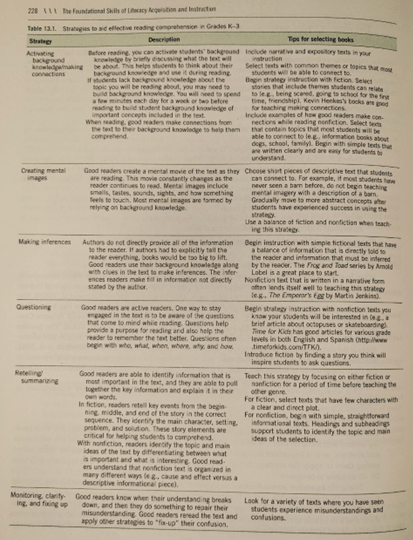
Strategies To Help Effective Reading Instruction in Grades K-3 – Some strategies to help effective reading comprehension in grades K-3 involve Activating Background Knowledge/Making Connections, Creating Mental Images, Making Inferences, Questioning, Retelling/Summarizing, Monitoring, clarifying, and fixing up. Below is a table describing each strategy as well as tips for selecting books.
8 Steps of Comprehension Instruction –
1. Anchor Experience – Introduce the strategy through an anchor experience, not using a text, that shows how it is used in everyday life. The goal is to help students see how they use the strategy in their everyday life so that they can use that knowledge when comprehending text.
2. Explicit Instruction– Use explicit instruction for what the strategy is and how it supports comprehension. The phrase explicit instruction means that you clearly explain to students, in language they understand, what it is you are going to do and why you are going to do it. The authors also note that the explicitness with which teachers teach comprehension strategies makes a difference in learner outcomes, especially for low-achieving students.
3. Touchstones – Use of a visual or kinesthetic touchstone for students to use as a reminder for the strategy. These touchstones remind students of the strategy that is most helpful.
4. Planned Thoughtful Teacher Questions – Plan before, during, and after reading questions that deepen thinking around comprehension and encourage the use of the strategy. Questioning is the predominant way teachers address reading comprehension with students and is a necessary part of comprehension instruction.
5. Teacher Modeling – Model using the strategy with text by thinking aloud while reading a portion of the text. This involves taking the time to model and show students what you mean when you tell them to do something because you can’t assume the students understand something.
6. Whole-Group Guided Practice – During modeling, plan opportunities to stop and prompt all students to apply the strategy with support. Corrective feedback during these guided practices must be timely to be effective. All students must be held accountable during these guided practices as well.
7. Small-Group Instruction with Guided Practice – Plan small groups for targeted reteaching of a strategy and scaffolding practice. This small-group instructional time can also be used to provide more opportunities for student practice as well.
8. Accountability for Independent Use – Provide opportunities for using the strategy during independent reading time. A literacy log or reading reflection journal is a great way to make sure students are using their independent reading time effectively while holding them accountable. This accountability also helps students stay on task and helps determine who is using the strategy effectively as well as who might need additional instruction.
*Below are some tips to use when doing a think-aloud:
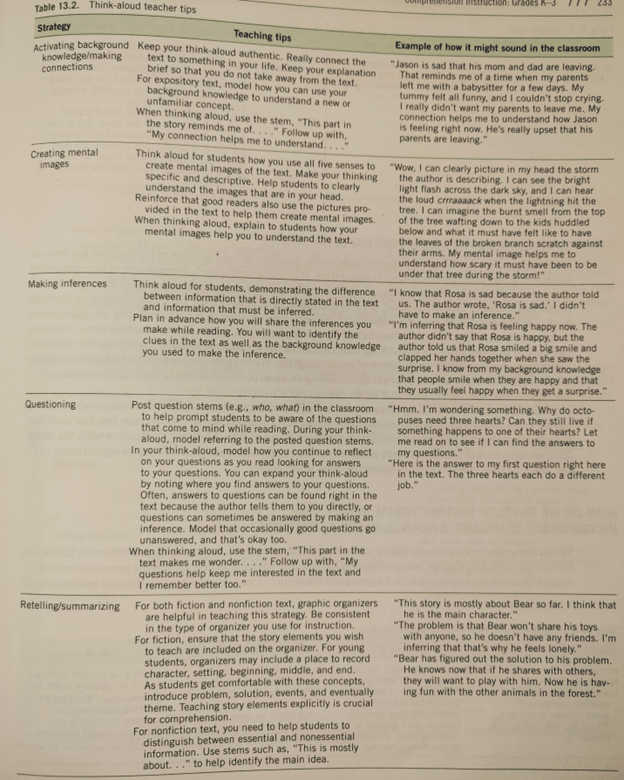
Classroom Application – This week’s chapter was full of information about comprehension and strategies to be more effective. One key take-away for me was the table on tips for teachings when doing a think-aloud. While many teachers have very thorough curriculums that tell them exactly what to say, when to say it, and how to say it, they don’t always have the reasons for why they are supposed to say it. This table had some great practical tips for teachers to think about before doing a think-aloud with their students. Some of these tips were for the teacher to actually think about activating background knowledge and making connections. It tells us to keep our thinking authentic and to keep our explanations brief, so we don’t take anything away from the text. Another good tip was to try to use the think-aloud to create mental images. Making our thinking specific and descriptive helps students clearly understand these mental images. The useful and descriptive table even had real life examples of how it might sound in the classroom, and it was great to see those examples to have a better understanding of the concept. I know from experience that it can be a little weird to do a think-aloud at first, but the more practice we get using it the more effective it will be.
Video Notes
https://youtu.be/Sd1FlXxpVIw – Before, During and After Questions: Promoting Reading Comprehension and Critical Thinking: This video demonstrates a teacher going over questions students have before, during, and after the reading of a book. She prompts them that they are to use the phrase, “I wonder about…” when asking their questions. She has them discuss with a friend before having them write down questions. After discussing some of the questions during the read aloud, the teacher moves them on to writing questions they have for after the book is read. She then goes over the questions they had during the reading to see if any of the questions they had were answered and then goes over the questions they had after the reading. A great example of an easy lesson activity for asking questions before, during, and after reading.
https://youtu.be/s4A85oOjZW0 – Teaching Reading and Comprehension to English Learners, Grades K-5: This video discusses different techniques for teaching reading and improving comprehension. The strategies are designed for most mainstream classroom teachers. It mentions that vocabulary is the foundation for instruction. It then discusses and asks teachers to think about what key words are most important for students to know which will help them learn the most. Next it mentions that teachers should provide opportunities to say words aloud. The video also shows us that students will often learn from each other when discussing vocabulary and other subjects rather than just from the teacher’s teachings. They can often explain it in a different way for each other to understand better. It also suggests improving engagement and comprehension with partner reading. It briefly discussed how engaging students in writing and reading together can lead to more success in students. Next, the video discusses the use of collaborative strategies to give all students a chance to succeed. Finally, the video discusses the strategies a principal’s teachers used with their students and the impacts it had. She mentions that the students had a higher level of engagement, the teachers had a more rigorous instruction, and the teachers can easily share things like successful strategies with other teachers.
https://youtu.be/84VyogMSuv0 – Close Reading: An Instructional Strategy for Conquering Complex Text: This great video goes through the instructional strategy of a close reading process in a classroom. The teacher first reads the complex text once without interruption, so the students are acquainted with the text. She then goes over the learning target/s to engage support and hold students accountable for their learning. After discussing a few key terms, she then asks the students why they read the text over and over again and follows up their answers with the explanation of why. “Teachers can encourage students to be metacognitive about the things that close readers do.” was a great tid bit that for teachers to remember to explain things to their students and to help them think about the way they’re thinking about and reading the text. She has done such a great job during the year that the students are able to underline and circle the key details and words as well as write the gist of the passages that were previously scaffolded lessons. She does a back-to-back partner sharing and text check that is followed by a “whip around” where the teacher checks for understanding by having the students share the students key details they found with the students at their table. Student talk is the key take away here and that they can help each other more than we expect. An incredible lesson activity done by a veteran teacher.
https://youtu.be/oNBv1sVDiBI – Informational Text Whole Group Reading Lesson: This video involves a whole group kindergarten class using schema maps and informational text during an interactive read aloud. During this great lesson and read aloud, the students are active participants and there are numerous opportunities for learning through conversation and discussion. The lesson starts off with the teacher asking about schema and its definition. After defining it, he then moves on to the lesson topic and asks the students about what type of schema they already have for weather. They then talk about and list all the things they know about weather before they begin the read aloud. As they begin to read the book, they go over things like what nonfiction vs fiction is, what the title is, who the author and illustrator are, and more. The read aloud was full of great teaching moments using open ended questions and discussion as well as citing the text for answers. They talk about what words they know and don’t know as well as explaining certain details more thoroughly.
Reading Rockets Comprehension Notes
Sentence Unpacking for Meaning – Grade 5: This video and description details how we can rewrite complex sentences as a series of simple sentences. This 8-minute-long video took 7 minutes to rewrite one very long sentence into 6 different “simple” sentences. The teacher and the students looked through and discussed all of the different parts of the sentence to break down what it truly meant. They discussed things like pronouns and who the pronouns represented, prepositional phrases, and how words can imply other meanings than their original definitions. Great video on a brief lesson about sentence unpacking and how it can help out students fully understand and comprehend complex sentences.
Metaphor, Simile, Personification, and Hyperbole|Figurative Language Lesson: The video starts off with a great definition for figurative language and why it’s used. Young students and ELLs reading figurative language can easily become confused about what the meaning of a sentence is trying to say and it’s important for them to understand these definitions and examples. It also helps students’ writing sound better as well. The video had wonderful visuals and was full of incredible examples with many modern references. These references as examples actually taught me more about personification and a better understanding of similes and metaphors.
How to Use Text Dependent Questions in Close Reading: There are numerous reasons as to why we ask students questions during and after readings, but we don’t always think about the fact that answering these questions can help students understand the text better. Using text to support these answers or even to prove these answers is crucial for student learning and comprehension. While we want our students to be able to find and cite text evidence for the basic type of questions, we also need to teach them how to collect and use the information from the text as evidence to make their own argument and to state their own position or opinion. This is when text evidence becomes important because the students are now using it in their own writing and own presentations. Having students expand and explain their answers and writings using the text is a great skill for students to learn.
 Travis Davis ENGED 275