Be yourself; Everyone else is already taken.
— Oscar Wilde.
This is the first post on my new blog. I’m just getting this new blog going, so stay tuned for more. Subscribe below to get notified when I post new updates.
Be yourself; Everyone else is already taken.
— Oscar Wilde.
This is the first post on my new blog. I’m just getting this new blog going, so stay tuned for more. Subscribe below to get notified when I post new updates.
Comprehension – A combination of extracting meaning from an author’s words while also interpreting the meaning of those words. Comprehension is the understanding of the author’s words and interpreting the meaning of those words. Comprehension is the purpose of reading. We wouldn’t just read a list of words in a book. Comprehension also doesn’t just happen. It has to be explicitly taught to students. As our textbook states, “The general rule is, teach children many strategies, teach them early, reteach them often, and connect assessment with reteaching.”
Students have to understand what they read, but not just when reading a story. Comprehension is required to be successful in math, science, social studies, and other subjects. Comprehension instruction must also occur at the onset of reading instruction and occur over the years.
Key Comprehension Strategies to Teach K-3 –
Below is an outlined list of skills students should learn and what teachers should be working on:
Kindergarten: Retell stories including the plot (beginning, middle, and end), identify the main character, and setting, and retell the main events. Make self-to-text connections, and text-to-text connections, create mental images, and make predictions.
1st and 2nd Grade: Make inferences and provide evidence from the text. Retellings should be sequenced correctly and include the problem solution.
3rd Grade: Monitor and adjust their use of strategies to improve their comprehension of more complex texts. Summarize the plot’s main events and describe the characters, their relationships, and the changes they undergo. Explain cause-and-effect and identify details that support the main idea.
*Longer Version – Kindergarten: Students in kindergarten can learn to retell stories including information from the beginning, middle, and end of the text. Students should be able to identify the main character(s) and the setting and retell the main event. At this age, students begin to make connections to their personal experiences and across texts, create mental images, and form logical predictions to support their listening comprehension.
As students enter Grades 1 and 2, expectations build on the foundational skills identified in pre-K and kindergarten. Students in these grades should be able to make inferences and provide evidence from the text to support their thinking. Student retellings are expected to be sequenced appropriately and include the problem-and-solution aspect of a story or topic of informational text.
**Even Pre-K students should be taught reading comprehension skills. They are also able to demonstrate reading comprehension skills. These students should be able to reenact a story using puppets, through dramatic play, or by a simple oral retelling. They should also be able to identify their favorite part of the story and should be able to ask and answer questions about the text.
Assessing Comprehension – There are various ways to assess comprehension, but each assessment will provide only a piece of a student’s comprehension ability. Teachers must put these pieces together to so they can begin to understand a student’s strengths and weaknesses in comprehension.
Benchmark Assessments – Assessments that provide information to help teachers see if a student struggles to answer specific kinds of questions. These assessments and information are useful in helping to see general weaknesses in reading comprehension and to help us know where to focus our instruction.
Informal Assessments – The most frequent type of assessment and is typically embedded within reading instruction. These assessments often involved planned prompts and questions before, during, and after reading. These questions provide insight into how students are using various reading strategies. Informal assessments may also involve tasks that require students to share their thinking by speaking or by writing. The assessments also need to match the learning goals and instruction. The teacher should be informally assessing students constantly to ensure the students are progressing.
*Assessments also help the teacher know which comprehension skills require additional or more intensive instruction. Instruction must be adjusted and differentiated to meet the needs of each and every student. We need to help students know what to do, when to do it, and when it works.
*Explicit, systematic routines for comprehension instruction are also critically important. When working with K-3 students, comprehension strategies should be taught with one strategy at a time for a few weeks. This allows for the “I do, we do, you do” model. When teaching a strategy, the teacher should refer back to previously learned strategies and teach the students good readers to use comprehension strategies in combination. The books we use to teach the strategy are very important too. There should be several examples of the strategy.
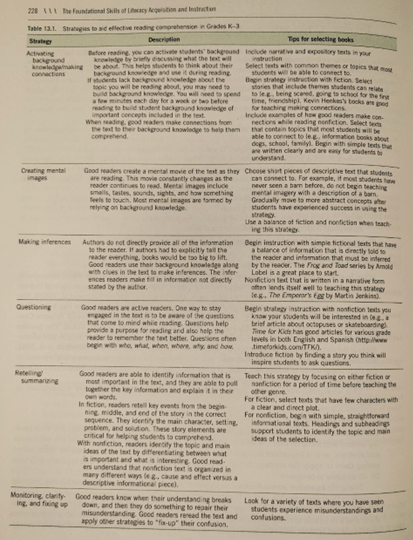
Strategies To Help Effective Reading Instruction in Grades K-3 – Some strategies to help effective reading comprehension in grades K-3 involve Activating Background Knowledge/Making Connections, Creating Mental Images, Making Inferences, Questioning, Retelling/Summarizing, Monitoring, clarifying, and fixing up. Below is a table describing each strategy as well as tips for selecting books.
8 Steps of Comprehension Instruction –
1. Anchor Experience – Introduce the strategy through an anchor experience, not using a text, that shows how it is used in everyday life. The goal is to help students see how they use the strategy in their everyday life so that they can use that knowledge when comprehending text.
2. Explicit Instruction– Use explicit instruction for what the strategy is and how it supports comprehension. The phrase explicit instruction means that you clearly explain to students, in language they understand, what it is you are going to do and why you are going to do it. The authors also note that the explicitness with which teachers teach comprehension strategies makes a difference in learner outcomes, especially for low-achieving students.
3. Touchstones – Use of a visual or kinesthetic touchstone for students to use as a reminder for the strategy. These touchstones remind students of the strategy that is most helpful.
4. Planned Thoughtful Teacher Questions – Plan before, during, and after reading questions that deepen thinking around comprehension and encourage the use of the strategy. Questioning is the predominant way teachers address reading comprehension with students and is a necessary part of comprehension instruction.
5. Teacher Modeling – Model using the strategy with text by thinking aloud while reading a portion of the text. This involves taking the time to model and show students what you mean when you tell them to do something because you can’t assume the students understand something.
6. Whole-Group Guided Practice – During modeling, plan opportunities to stop and prompt all students to apply the strategy with support. Corrective feedback during these guided practices must be timely to be effective. All students must be held accountable during these guided practices as well.
7. Small-Group Instruction with Guided Practice – Plan small groups for targeted reteaching of a strategy and scaffolding practice. This small-group instructional time can also be used to provide more opportunities for student practice as well.
8. Accountability for Independent Use – Provide opportunities for using the strategy during independent reading time. A literacy log or reading reflection journal is a great way to make sure students are using their independent reading time effectively while holding them accountable. This accountability also helps students stay on task and helps determine who is using the strategy effectively as well as who might need additional instruction.
*Below are some tips to use when doing a think-aloud:
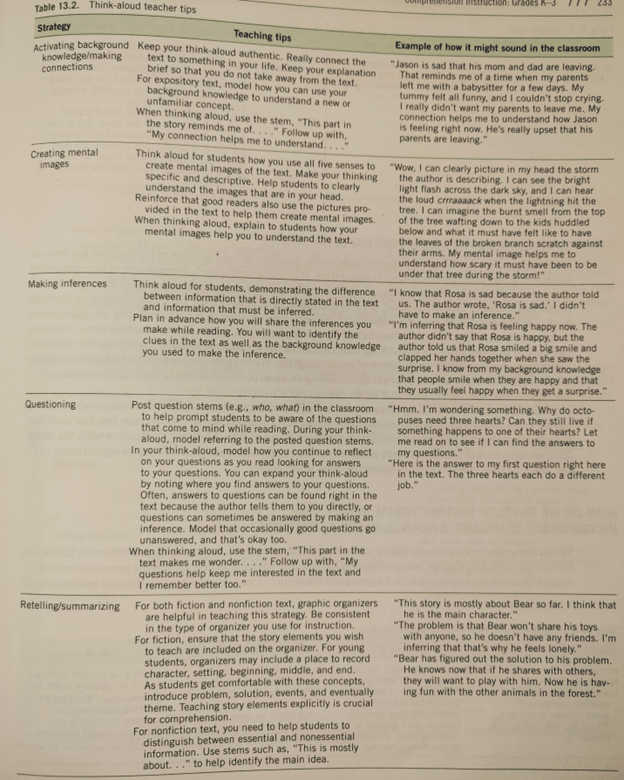
Classroom Application – This week’s chapter was full of information about comprehension and strategies to be more effective. One key take-away for me was the table on tips for teachings when doing a think-aloud. While many teachers have very thorough curriculums that tell them exactly what to say, when to say it, and how to say it, they don’t always have the reasons for why they are supposed to say it. This table had some great practical tips for teachers to think about before doing a think-aloud with their students. Some of these tips were for the teacher to actually think about activating background knowledge and making connections. It tells us to keep our thinking authentic and to keep our explanations brief, so we don’t take anything away from the text. Another good tip was to try to use the think-aloud to create mental images. Making our thinking specific and descriptive helps students clearly understand these mental images. The useful and descriptive table even had real life examples of how it might sound in the classroom, and it was great to see those examples to have a better understanding of the concept. I know from experience that it can be a little weird to do a think-aloud at first, but the more practice we get using it the more effective it will be.
Video Notes
https://youtu.be/Sd1FlXxpVIw – Before, During and After Questions: Promoting Reading Comprehension and Critical Thinking: This video demonstrates a teacher going over questions students have before, during, and after the reading of a book. She prompts them that they are to use the phrase, “I wonder about…” when asking their questions. She has them discuss with a friend before having them write down questions. After discussing some of the questions during the read aloud, the teacher moves them on to writing questions they have for after the book is read. She then goes over the questions they had during the reading to see if any of the questions they had were answered and then goes over the questions they had after the reading. A great example of an easy lesson activity for asking questions before, during, and after reading.
https://youtu.be/s4A85oOjZW0 – Teaching Reading and Comprehension to English Learners, Grades K-5: This video discusses different techniques for teaching reading and improving comprehension. The strategies are designed for most mainstream classroom teachers. It mentions that vocabulary is the foundation for instruction. It then discusses and asks teachers to think about what key words are most important for students to know which will help them learn the most. Next it mentions that teachers should provide opportunities to say words aloud. The video also shows us that students will often learn from each other when discussing vocabulary and other subjects rather than just from the teacher’s teachings. They can often explain it in a different way for each other to understand better. It also suggests improving engagement and comprehension with partner reading. It briefly discussed how engaging students in writing and reading together can lead to more success in students. Next, the video discusses the use of collaborative strategies to give all students a chance to succeed. Finally, the video discusses the strategies a principal’s teachers used with their students and the impacts it had. She mentions that the students had a higher level of engagement, the teachers had a more rigorous instruction, and the teachers can easily share things like successful strategies with other teachers.
https://youtu.be/84VyogMSuv0 – Close Reading: An Instructional Strategy for Conquering Complex Text: This great video goes through the instructional strategy of a close reading process in a classroom. The teacher first reads the complex text once without interruption, so the students are acquainted with the text. She then goes over the learning target/s to engage support and hold students accountable for their learning. After discussing a few key terms, she then asks the students why they read the text over and over again and follows up their answers with the explanation of why. “Teachers can encourage students to be metacognitive about the things that close readers do.” was a great tid bit that for teachers to remember to explain things to their students and to help them think about the way they’re thinking about and reading the text. She has done such a great job during the year that the students are able to underline and circle the key details and words as well as write the gist of the passages that were previously scaffolded lessons. She does a back-to-back partner sharing and text check that is followed by a “whip around” where the teacher checks for understanding by having the students share the students key details they found with the students at their table. Student talk is the key take away here and that they can help each other more than we expect. An incredible lesson activity done by a veteran teacher.
https://youtu.be/oNBv1sVDiBI – Informational Text Whole Group Reading Lesson: This video involves a whole group kindergarten class using schema maps and informational text during an interactive read aloud. During this great lesson and read aloud, the students are active participants and there are numerous opportunities for learning through conversation and discussion. The lesson starts off with the teacher asking about schema and its definition. After defining it, he then moves on to the lesson topic and asks the students about what type of schema they already have for weather. They then talk about and list all the things they know about weather before they begin the read aloud. As they begin to read the book, they go over things like what nonfiction vs fiction is, what the title is, who the author and illustrator are, and more. The read aloud was full of great teaching moments using open ended questions and discussion as well as citing the text for answers. They talk about what words they know and don’t know as well as explaining certain details more thoroughly.
Reading Rockets Comprehension Notes
Sentence Unpacking for Meaning – Grade 5: This video and description details how we can rewrite complex sentences as a series of simple sentences. This 8-minute-long video took 7 minutes to rewrite one very long sentence into 6 different “simple” sentences. The teacher and the students looked through and discussed all of the different parts of the sentence to break down what it truly meant. They discussed things like pronouns and who the pronouns represented, prepositional phrases, and how words can imply other meanings than their original definitions. Great video on a brief lesson about sentence unpacking and how it can help out students fully understand and comprehend complex sentences.
Metaphor, Simile, Personification, and Hyperbole|Figurative Language Lesson: The video starts off with a great definition for figurative language and why it’s used. Young students and ELLs reading figurative language can easily become confused about what the meaning of a sentence is trying to say and it’s important for them to understand these definitions and examples. It also helps students’ writing sound better as well. The video had wonderful visuals and was full of incredible examples with many modern references. These references as examples actually taught me more about personification and a better understanding of similes and metaphors.
How to Use Text Dependent Questions in Close Reading: There are numerous reasons as to why we ask students questions during and after readings, but we don’t always think about the fact that answering these questions can help students understand the text better. Using text to support these answers or even to prove these answers is crucial for student learning and comprehension. While we want our students to be able to find and cite text evidence for the basic type of questions, we also need to teach them how to collect and use the information from the text as evidence to make their own argument and to state their own position or opinion. This is when text evidence becomes important because the students are now using it in their own writing and own presentations. Having students expand and explain their answers and writings using the text is a great skill for students to learn.
Polysemous Words – Words that have more than one meaning, such as rose the flower and rose the verb.
Morphemes – Prefixes, suffixes, and root words. The smallest meaningful unit of a word. For example, the word unhappy has two morphemes. The first is “un” meaning not and the second is “happy” meaning joyful.
*Other notes on the importance of teaching vocabulary:
Skills Students Should Learn At Each Grade –
Ways To Assess Vocabulary –
*The goal is for students to learn words well enough to understand and use them throughout their lives and not just memorize definitions for a weekly test.
Using the Vocabulary Knowledge Scale – students rate words on a scale from 1 to 4 based on how well they know the word. It starts at “I have never heard of the word”, to “I have a deep understanding of this word”. If they have a higher understanding of the word, they need to explain what the word means and use it in a sentence. Students also monitor their growth and are proud when they have increased their knowledge. *It’s also important to remember that a deep understanding of vocabulary-even words and phrases already familiar with-continues to become more multifaceted throughout our lives and the depth of our experiences with those words increase.
*It is also important when assessing students to detect partial knowledge. Growth before and after a unit is highly motivating.
*Students can also be asked to write a sentence using one or two taught vocabulary words in a sentence. Students can also be assessed using oral language by responding to spoken sentences.
Choosing Words to Teach-Tiers and Morphology –
There isn’t specific research that shows there should be a certain number of words taught each week or what words to teach in a specific grade level.
Effective, meaningful vocabulary instruction includes context, a student-friendly definition, and engaging discussion.
Educational researchers have developed a flexible leveled 3-tiered system for vocabulary to help teachers choose words more effectively:
Word Selection Based on Morphology – Families of morphological related words make up many of the words students will encounter and account for 58% of the most frequent words in English. A word in a morphological family should be taught along with its relatives. For example, the word form should be taught and discussed alongside its morphologically related family words formation, reform, reformation, and formulate.
Four-Part Vocabulary Plan – The components necessary to optimize vocabulary growth. It consists of four different but interconnected components and is written as “to do” statements for the teacher. As in, teachers should:
1. Provide Rich and Varied Language Experiences – Effective vocabulary instruction requires integration, repetition, and meaningful use.
Integration – Linking the new learning with something they already know or combining new concepts with ones the students already know. They should use synonyms and antonyms to connect related concepts.
Repetition – Providing multiple and varied exposure to the word in differing contexts. Students require 18-21 exposures to words when relying solely on reading to acquire them, but high-quality activities can reduce it to 2 or 3 exposures.
Meaningful Use – Using the word in varied applications or contexts. Teachers should draw associations, make connections, and compare and contrast words and concepts. The more the student thinks about the concept, the more they will likely understand the word and remember it.
Synonyms – A word that means exactly or nearly the same as another word or phrase in the same language.
Antonyms – A word opposite in meaning to another.
Word Consciousness – An awareness and appreciation of the power of language, as situated in context. We can develop this through modeling attention to the novelty and power of the language encountered in books and oral interactions. We can also show students how we notice whether a word or phrase is: new to us; a more sophisticated version of a known word or expression; scientific, old-fashioned or archaic, idiomatic figurative, whimsical, and so forth; very long, very short, difficult to pronounce, fun to say and so forth.
Cognates – Words from different languages that have similar spelling, pronunciation, and meaning. For example, the Spanish word insecto is a cognate for the English word insect. Cognates are more easily recognized in printed form than they are in speech. However, not all words that are spelled alike or sound alike share the same meaning.
* 3 Principles of effective vocabulary instruction:
Teaching Vocabulary Words to EL’s –
* Other supports for EL’s include:
Activities And Strategies for Teaching Vocabulary –
Read Aloud to the Class – Reading aloud is one of the best ways to expose students to new words.
Dialogic Reading – Talking about what you’re reading and asking questions while reading aloud and having a dialogue with the students.
Extending – Pre-k-2nd grade – Reading and rereading the same story multiple times during the week. Each day you teach a few more words from the story and on the 5th day the students are assessed on the vocabulary.
Paraphrasing – Embedding a simple translation of a word or concept to ensure the students understand the text. This differs from directly teaching new words in depth and can occur during the read-aloud without stopping or dwelling on the word. For example, a teacher may read a sentence and quickly interject by saying, “Once upon a time, a maiden (a young girl) lived in a tiny village (a very small town).”
Preteaching – Preteaching involves choosing one or two key words that the students must understand to learn about a specific concept in the text and briefly teaching them what those words mean. This can be done by showing them pictures, reading the definitions, using the word/s in example sentences, providing background information about the key terms, and many other ways. In simpler terms, before reading the story, a teacher teaches students a couple of vocabulary words. Preteaching key vocabulary applies to every grade level and every content, but it becomes more essential as texts become more academic and challenging.
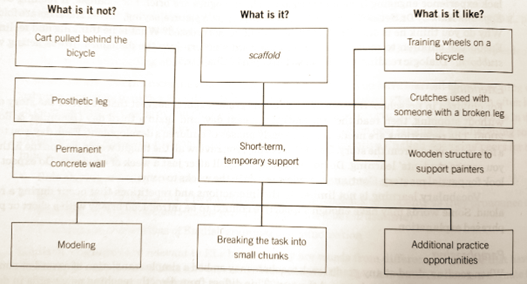
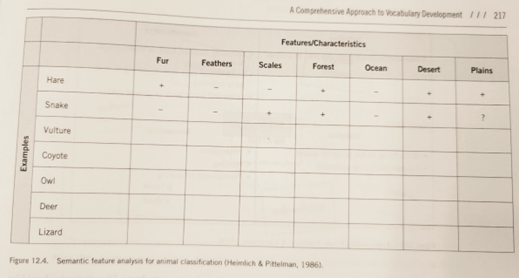
Semantic Maps or Word Maps – A learning activity/strategy where students draw on their background knowledge and deepen their understanding of a word or set of related words. Teachers can use semantic maps when teaching vocabulary by using concept maps, semantic feature analysis, Frayer Models, word associations, and word lines.
Here is an example of a concept map:
Here is an example of a Semantic Feature Analysis:
Here is an example of a Frayer Model:
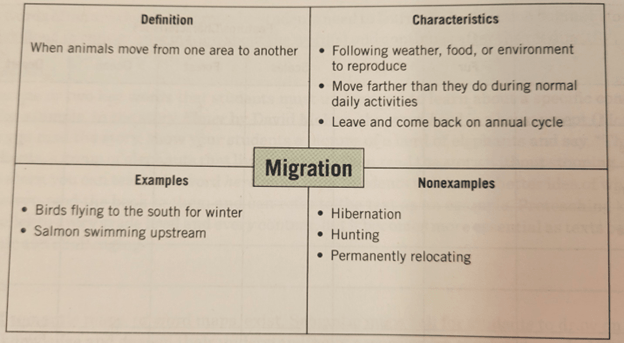
Classroom Application
When it comes to being an effective classroom teacher, vocabulary instruction is critically important. A quick google search of vocabulary lessons and activities can easily show us just how many different vocabulary words there are and how many different ways we could be teaching them. However, it isn’t just about the number of vocabulary words we are teaching students, it’s about the way we teach and assess them. Readers can tolerate a few unknown words while reading so vocabulary instruction is critical for learning. When teachers select words appearing in actual text selections that will be read in class, comprehension can be enhanced significantly. I really liked that the textbook goes into detail about why teachers should be doing this, how we should be doing this, and how it can impact our students. We shouldn’t just introduce “big” vocabulary words for students to learn just because they are big, we should be introducing vocabulary words that are useful for the lesson’s activities and the unit’s learning objectives. These key words also need to be useful. Will the student need to know these terms in the immediate future or even continued future use? Words with multiple meanings are another important topic when choosing vocabulary words. Many words have multiple meanings and students, especially ELLs, must learn what these different meanings are, how and when to use them, and how to tell which meaning of the word the text is detailing by looking at the context. Choosing the right vocabulary words for students to learn about and understanding when and how those words are going to be taught can be an exhausting task. But by doing so, we are setting up our students to be more successful learners and readers.
Video Notes
https://youtu.be/DC0HNtvxuRg – Dr. Anita Archer – Vocabulary Instruction: This great vocabulary video starts off with the teacher going over some vocabulary terms. She goes over a term by defining it, discussing its synonyms and such, and goes over many great examples. She then uses the vocabulary term many times in sentences before having the students discuss their own sentences with a partner/group. She does this for every vocabulary term and the students get great firsthand experience and knowledge from thinking about how to use the word in a sentence and then actually using the term when talking with their partners. She even went over the differences with one word by discussing how some words can be an adjective, adverb, and noun. Great example of a vocabulary lesson with firsthand discussions and learning.
https://youtu.be/WgQYvj2U4Kw – Close Reading – Vocab Focus – Grade 1: Great video showing an effective vocabulary instruction starting off with an introduction to vocabulary terms the students will see in the text they are going to read together. The teacher then told the students to circle any unknown words they come across when they then read together. The teacher knew that there would be a few unknown words, and this was one way to go over some of the unknown terms. He then had the students discuss what they think the terms mean and the main ideas of the story. He then asked if other classmates agreed or disagreed on things and filled in the gaps of the definitions when they weren’t quite right. He then had the students reread the story before going over the vocabulary terms again. Great lesson and example with tremendous student participation.
https://youtu.be/p9DPKgBrJQE – Tier Two Vocabulary Instruction: When going over vocabulary terms, the teacher has the students first discuss what they think the word means by sharing the first thing that comes to their mind about the word. He mentions only teaching one or two of these tier two words so the students can really hone in on the definitions and use the words more often than simply reading about them once or twice. He has the students discuss and share the word in sentences and even teaches the students the sign language for the word. He also discusses playing games with the students on Fridays and this is a great way to informally assess the student’s knowledge of the weeks lessons as well. The students in the video were very engaged and even had fun learning. Another incredible example of an effective teacher.
Fluency – The ability to read accurately at a rate that mirrors speech, with expression and comprehension. Fluency is reading with reasonable accuracy, appropriate rate, and suitable expression.
*If students aren’t fluent in their reading, they can’t comprehend. Their brain is too busy decoding to comprehend. This is why it’s so important that students are reading at their independent reading level.
Three Components of Fluency Defined –
1. Accuracy – Reading the words correctly with at least 95% accuracy. For the reader to understand what is being read, the text must be read with a certain level of accuracy, reading the words correctly as they appear in the text.
2. Rate – The speed the student reads the text. *It is often mistakenly used as a synonym for fluency. Students should do their “best reading” as opposed to “reading as fast as they can”.
3. Expression – Reading with prosody. Expression refers to the pitch, tone, volume, emphasis, and rhythm in speech or oral reading. The ability to read with appropriate expression is an important aspect of fluency.
Prosody – One of three necessary components or characteristics of a fluent reader. Prosody is the ability to read with appropriate expression; includes the pitch, tone, volume, emphasis, and rhythm in speech or oral reading.
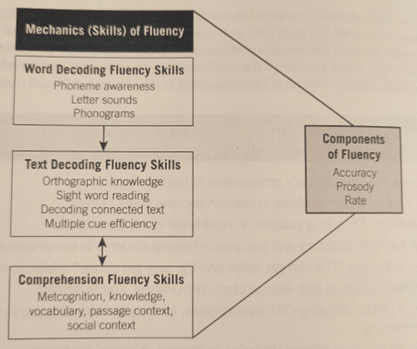
Other Notes About Accuracy and Rate –
*Comprehension is impaired or limited by reading too fast, too slowly, or inaccurately and is facilitated by reading at an appropriate rate for the task with reasonable accuracy. In other words, fluent reading assists comprehension.
Curriculum Based Measures (CBMs) – An assessment method used to monitor what students have been learning usually consists of standardized instructions, use of a stopwatch or timer, a set of passages, scoring procedures, and record forms or charts. CBMs are often used to progress monitoring since they are well suited for repeated use and allow for immediate adjustments in a student’s educational program as needed. CBMs are considered a general outcome measure (GOM).
Oral Reading Fluency (Orf) – A CBM assessment requiring the use of standardized procedures that involve having a student read aloud from unpracticed passages or lists of letters, letter sounds, or words for 1 minute while an examiner identifies errors. A student reads aloud a passage they have never seen before while younger students read a list of letters or sounds for one minute. The scorer then determines the student’s Words Correct Per Minute (WCPM or the number of letters or sounds correct).
Words Correct Per Minute (WCPM) – This is the number of words a student correctly reads in one minute. The score can then be compared either to an established benchmark that indicates proficiency or to a specific goal set for that student.
*Additional diagnostic assessments of specific foundational reading skills, including phonemic awareness and phonics/decoding, should be administered to all students below benchmark to determine what skills to target in an intervention.
*It’s important we don’t only use the ORF assessment to determine if a student is above or below grade level reading. There are many other facts, but it could raise a flag to dig deeper into a student’s reading ability.
Students at a 6th-grade reading level should be given a close assessment-read silently with certain words removed. Students select the appropriate words, so it makes sense.
Students who are in Tier 1 should be assessed 3-4 times a year.
Students who are Tier 2 or 3 should be assessed weekly or bi-weekly.
Students improve their fluency when reading aloud. Silent or independent reading doesn’t improve a student’s fluency. Why?
Repeated readings are a great fluency intervention when provided with teacher feedback and modeling.
Cueing students to attend to their accuracy and rate while reading can increase a student’s fluency. A teacher should ask, “Does that make sense?”.
Structured Partner Reading – A teaching activity that involves the teacher paring appropriate partners, assigning the text for them to read, and providing a process to use when reading, listening, and providing partner feedback. More fluent students should be matched with less fluent students, but they shouldn’t be vastly discrepant, and students who are struggling greatly and drastically less fluent should be paired with the teacher or another adult. These partners also take turns reading aloud and provide each other feedback including pointing out errors and supporting correct pronunciation and decoding of words.
Repeated Readings – Repeated and Monitored Oral Readings – Instructional activity in which students read and reread a text a number of times or until a certain level of fluency is reached. It has been shown to improve reading fluency and overall reading achievement; four re readings are usually sufficient for most students. Students can also practice reading orally with tutors, peers, audio recordings, open or in other settings. These repeated readings remain the gold standard of fluency interventions, and it is more effective when teachers provide feedback or have the student read along with a model as part of repeated reading than independent repeated reading.
Round Robin Reading – A teaching activity/method where students take turns reading aloud from unpracticed text often in a whole-class, large-group setting. Only one student is reading at a time while the others are typically losing interest and not paying attention. This method is one that is commonly implemented to try to encourage reading but is one that is less effective.
Sustained Silent Reading (SSR) and Drop Everything And Read (Dear) – A teaching activity/method where students are required to read silently in self-selected texts for a designated period of time, sometimes up to 20 or 30 minutes or more daily. However, students often choose books that are either too easy or much too difficult for them, so they are not improving their reading skills.
*Although some students may benefit from these activities, neither round robin reading, nor SSR/DEAR provide the amount of practice that at-risk or struggling readers will need to develop their fluency. Both activities also limit the amount of modeling and opportunities for specific feedback provided by the teacher, which is critical for effective instruction.
Choral Reading – A teaching method/activity where all students participate and read a text aloud in unison along with the teacher.
Cloze Reading – A teaching method/activity that involves having the teacher read text aloud while students follow along silently in their own copies of the text or from a shared text posted on a whiteboard or posted for all to see. From time to time, the teacher randomly pauses before reading a word, and the students read that omitted word aloud in unison.
Reader’s Theater – A popular and effective approach to encourage students to reread passages to become more fluent readers. Students are assigned parts in a short play and practice their lines to prepare for a performance reading the script. When doing this, students learn to read with expression and accuracy.
Tier 1 Fluency Instruction – Students in Tier 1 are making progress in reading and teachers should provide practice opportunities and increase the complexity of the text students read. Students will develop adequate fluency levels by simply engaging in reading and especially so if they also hear models of fluent reading and receive feedback about their reading accuracy, rate, and expression.
Effective ways to encourage reading and build fluency: Choral reading, cloze reading, structured partner reading, readers theater.
Less effective ways to encourage reading: Round robin reading, silent sustained reading (SSR), and drop everything and read (DEAR).
Tier 2 Or 3 Fluency Instruction –
One effective activity for students who need more targeted intervention is a strategy known as Read Naturally (RN). Students are first assessed to determine their appropriate level of text in which to receive instruction. They are then placed in a text level that is at or close to their frustration level (less than 90% accuracy). Then:
1. The student completes a 60-second cold read of a self-selected passage. They are then given a score which will be used as an indicator of their unpracticed WCPM and can be motivated to practice by increasing this score.
2. The student marks words that cause them to “stop, stumble, or skip” and they record their WCPM.
3. The student then rereads the passage aloud with a skilled reader. They will reread the passage three times to ensure the student knows all of the words. The purpose of this step is to help the student learn how to identify and correctly pronounce all the words in the passage and to provide a model of appropriate expression.
4. Once the student knows all the words, they engage in repeated rereads for 60 seconds until the student reaches the ORF goal. This step usually takes 3-10 times and helps build the student’s reading rate while maintaining accuracy.
5. Finally, the teacher now listens to the student read the well-practiced passage for 60 seconds. If the student makes no more than three errors, reads with appropriate expression, and reaches their goal, they are allowed to record the practiced WCPM score on a graph alongside the original cold-read score.
6. This process is then repeated with the next passage. The RN strategy also incorporates prediction, retell, and comprehension questions to hold students accountable for comprehending the content of the passages.
Cold Read – Reading a text that a student has not read before.
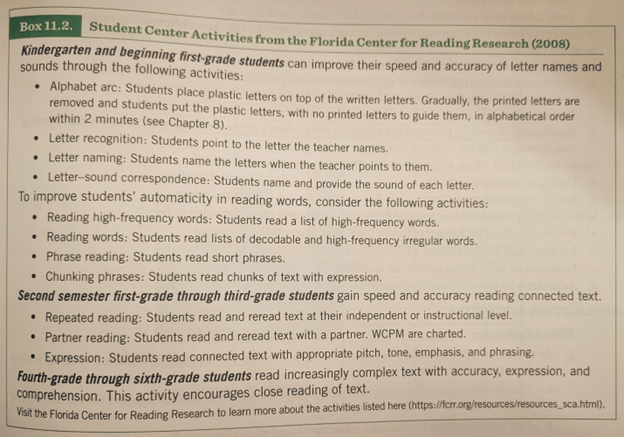
Classroom Application Easily the biggest take away from this week’s chapter for me personally has to be the understanding that round-robin and sustained silent reading activities are ineffective ways to increase fluency and comprehension. Everything the authors described about the reasons why it’s ineffective and which methods and activities are more effective made total sense to me. As a future classroom teacher, whether it be in reading instruction or another subject, knowing and understanding what instructional methods and activities are more effective than others is critical for student success. It is clear that increasing the amount of practice opportunities and the complexity of the texts are great ways to effectively instruct students. I also have a better understanding of the reasons for the Tier 2 intervention strategy Read Naturally, and I believe that this strategy might work in many science and social studies lessons as well. Great information is this week’s chapter.
Video Notes
https://youtu.be/eVjDsNcPU2E – Reading Fluency with Chloe, Second Grader: This video is a great demonstration of fluency instruction and activities as well as great definitions of fluency. She describes that fluency includes accuracy, rate, and expression. Some of the things the video discusses is how to address errors in accuracy and why we should address them, how to use charts and scores for encouragement, what repeated readings are and why we do them with students, and how rate actually has a lot to do with comprehension. Great video with lots of examples and useful tips.
https://youtu.be/o_-z8d0sRUA – Choral Reading: This video discusses what choral reading is and how it deals with comprehension. It then goes on to detail some guidelines for a choral reading activity/program. A teacher must start by choosing a book that is at an appropriate reading level, contains dialogue or rhythm, and is relatively short. Next the video discusses how we should model fluent reading for the students but have them follow along in the text and why we do this. The video goes on to explain that we should take time to point out and discuss important elements in the text before rereading the text aloud and in unison with the students. Great short video discussing choral reading and how to effectively use it in the classroom.
https://youtu.be/vMVB-RUKXKM – An Explicit Fluency Lesson with a Prosody Element Focus: This video starts with an explanation about what fluency is, what it sounds like, and why it’s important. Then the teacher demonstrates and models what good fluency and prosody sounds like and looks like. The class and the teacher then read together aloud before the students “whisper read” the text quietly by themselves. She then models reading fluently the next part of the text before the students and teacher read fluently aloud together again. The students then read the text on their own before rereading the whole passage.
https://www.youtube.com/watch?v=NWl0hnb1crM&t=1s – K-3 Essential 3, Bullet 3: Small Group Fluency Instruction Sample Video: This video details many of the different fluency activity types like echo reading, repeated readings, and readers theater for small groups. The video describes and explains the differences between the activities and the benefits of doing them. It includes firsthand examples of the teacher doing an echo reading, repeated reading, and readers theater activity. The teacher describes how fluent readers read with expression and how to model expression reading with students. These firsthand examples are a great resource for others to observe how an effective teacher uses many different strategies with their readers.
https://youtu.be/5xXEWm-6bnE – Reading Multisyllable Words with Xavier, Third Grader: The video starts off with a few examples of how students “misread” words when reading and how to help them. The teacher and student begin by reading nonsense words to understand how to read multisyllable words. The teacher describes that they are going to ask themselves two questions for each word they are attempting to read: How many vowels? And are they together or apart? They then start with single syllable words to fully understand syllables and what they are before they move on to two or more syllables. They then work on breaking apart bigger multisyllable words by writing down each of the broken apart syllables. After practicing looking for the vowels and separating the syllables, the student begins to read longer and more difficult words. The teacher then goes on to explain how once a student understands the basics of reading multisyllable words they can move on to more difficult lessons about things like silent e’s and other word/letter patterns. Great example of a student’s potential with a letter bit of extra help.
*Here is one more great resource for fluency: https://www.readingrockets.org/article/top-10-resources-fluency
Phonics – The tool readers use to pronounce words by associating sounds (phonemes) with letters (graphemes). This process involves mediated word identification because readers must devote conscious attention to “unlocking” the alphabetic code. Phonics is decoding words and spelling them.
*Phonics (Extended Version) – The relationship between phonology (which is the sounds in speech) and orthography (the spelling patterns of written language). Its emphasis is on spelling patterns and not individual letters because there isn’t a one-to-one correspondence between phonemes and graphemes in English. Some also describe phonics as the predictable relationships between phonemes and graphemes. The relationship between a sound and the letter(s) representing it is also called the phoneme-grapheme correspondence. Etymology, which is the study of the origin of words, also influences the pronunciation of letters and words.
Phoneme – Sounds – Phonemes are the smallest units of speech and are marked in our textbook using diagonal lines (e.g., /d/).
Phonemes can either be consonants or vowels; phonemes can also include consonant blends of 2 or 3 consonants which appear next to each other in words and their individual sounds blend together as in grass or spring and they can also be consonant digraphs of two letters that come together to make one sound as in chair or shell. Phoneme – each sound.
Grapheme – Letters – Graphemes are the letters of the alphabet. In our textbook, they are marked and shown using italics (ck). Grapheme – letters in print.
Phoneme-Grapheme Correspondence – Matching the sound to the correct letter. Phoneme-Grapheme Mapping is the one-to-one relationship between oral speech sounds (phonemes) and the letter or letters (graphemes) that represent those sounds in print. The common term, letter sounds, is misleading because it does not include letter clusters such as ch, sh, aw, oy, igh, and so forth where specific letter clusters represent one single speech sound. Also referred to as phoneme-grapheme association, phoneme-grapheme correspondence, letter-sound correspondence.
Graphophonemic – Letter-sound relationships – The Alphabetic Principle suggests that there should be a one-to-one correspondence between phonemes and graphemes, so that each sound is consistently represented by one letter. However, the English language isn’t a perfect phonetic language, and there are over 500 ways to represent 44 phonemes using single letters or combination of letters. This principle is about knowing that letters have a name and that they make a sound or sounds.
Decoding – Sounding out a word. The ability to apply your knowledge of letter-sound relationships, including knowledge of letter patterns, to correctly pronounce written words. Understanding these relationships gives children the ability to recognize familiar words quickly and to figure out words they haven’t seen before. Although children may sometimes figure out some of these relationships on their own, most children benefit from explicit instruction in this area. Phonics is one approach to reading instruction that teaches students the principles of letter-sound relationships, how to sound out words, and exceptions to the principles.
Encoding – Using sounds to spell words.
Phases of Word Reading and Summary of Each:
Visual Nonalphabetic Phrase –
Partial Alphabetic Phase –
Students should know: letter names, individual sounds, guess words based on the first letter
Age: kindergarten-first grade (depends on where they live)
Instruction: Introducing letters, sounds, and blending cvc words
Full Graphophonemic Phase –
Students should know: all letter names, able to sound out words with 3-4 phonemes, basic spelling patterns
Age: kindergarten-second grade
Instruction: reading, spelling, blending, decodable books
Consolidated Graphosyllabic Phase –
Students should know: how to read with automaticity and comprehend what they read, increase in vocabulary, read more, and identify more sight words without sounding them out
Age: first-second grade
Instruction: READ and comprehension questions, sight words explicitly taught, vocabulary, and writing
Graphomorphemic Phase –
Students should know: read with automaticity, rarely need to decode words, strategies used to decode unfamiliar words, know various spelling patterns,
Age: first-third grade
Instruction: spelling patterns, read, and write
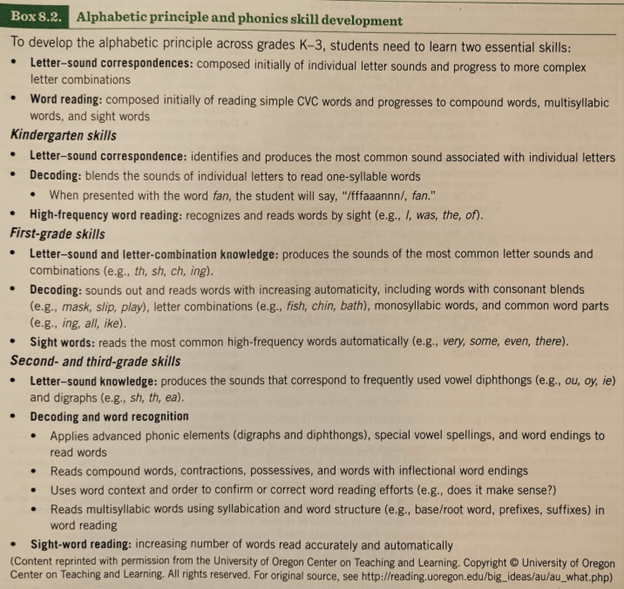
Phonological Awareness to Phonics Continuum:
Sight Words – All words that are read with automaticity. Words may have common and uncommon phonetic patterns (regular words and irregular words).
Irregular Words – A word that does not follow typical letter-sound correspondences, usually found in the vowel sounds(s), such as there, cough, and said.
High-Frequency Words – Words that appear often in printed material. These sight words make up a large percentage of written words and are grammatically necessary. Many of these are often called function words because they help a sentence function but do not give it meaning.
Nonsense Words – Words that aren’t quite “real” words but can still be read phonetically for teachers to assess student’s abilities.
Diagnostic Assessment – Assessments used to pinpoint specific areas of weakness; provide in-depth information to clarify students’ skills and instructional needs.
Progress Monitoring – Diagnosing reading and writing problems and monitoring the progress of each student. Progress monitoring is usually completed in a regular, preplanned schedule to evaluate the rate of progress as well as helping to measure student performance and improvement or responsiveness to instruction.
Guidelines For Teaching Beginning Phonics –
Teach most common phoneme-grapheme correspondences first (s, m, t, f, b, r)
2. Begin with phoneme-grapheme that can be combined to make words
3. Being with continuant sounds or letters like m, n, or s
4. Teach vowels
5. Use Multisensory techniques
6. Stretch the sounds out in the words.
7. Separate sounds that sound alike and letters that look alike don’t
teach b and d together. Should be taught at least 3 weeks apart.
8. Introduce only a small number of phoneme-graphemes each week.
9. Provide multiple opportunities for students to practice.
10. Use a consistent routine and direct, systematic instruction.
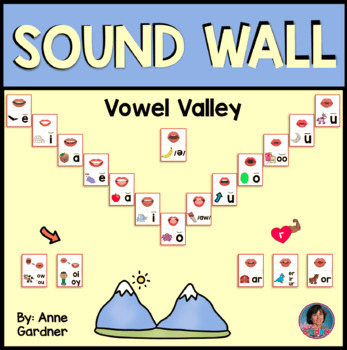
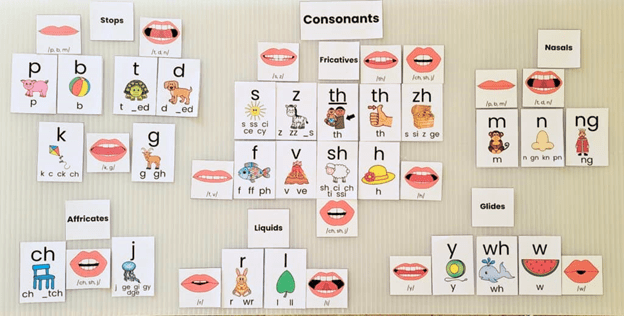
Sounds Walls – Similar to a word wall, but with sounds and letter sounds. The idea is to switch the teaching letters in print to:
Here are some examples of a sound wall:
Orthographic Mapping – The process readers use to store words for instant retrieval.
***Knowledge of likely spelling patterns. Readers will use their abilities to group common letter patterns into syllables. They also us their knowledge of likely and unlikely letter sequences when encountering multisyllabic words. Skillful readers will chunk words into syllables automatically when perceiving letters while devoting less attention to encoding, putting less energy into identifying words.
Simple Regular Words – Words that consistently follow a regular, predicted pattern, and the letter sounds are the most common and easiest to decode.
High-Frequency Irregular Words – Words where the spelling doesn’t follow a predictable spelling pattern.
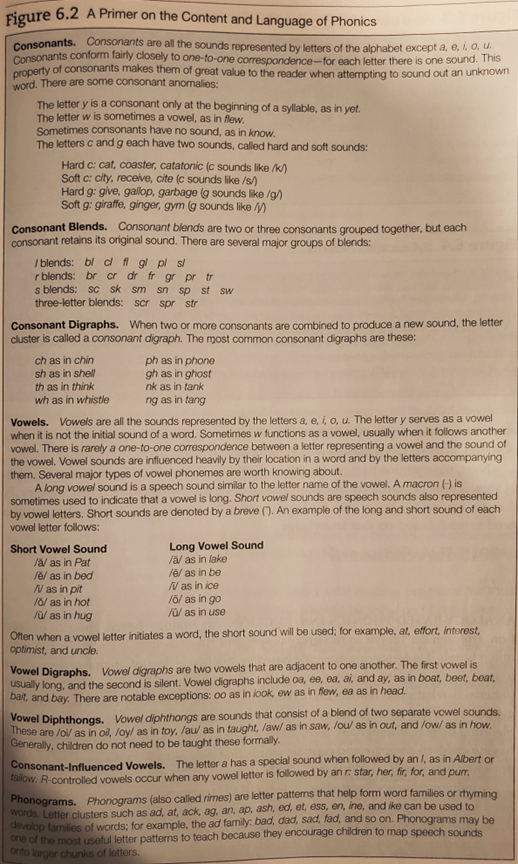
Consonant Digraphs – When two or more consonants are combined to produce a new sound, the letter cluster is called a consonant digraph. The most common consonant digraphs are these: ch as in chin ph as in phone sh as in shell gh as in ghost th as in think nk as in tank wh as in whistle ng as in tang
*Two adjacent consonants that make one sound.
Vowel Digraphs – Two vowels that are adjacent to one another. The first vowel is usually long and the second is silent. Vowel digraphs include oa, ee, ai, and ay as in boat, beet, beat, bait and bay. There are also notable instructions: oo as in look, ew as in flew, and ea as in head.
Long Vowels With Silent E – A vowel-consonant-e, or VCE, pattern. The final e is silent and the vowel is long.
Vowel Teams – Two or more vowels representing one vowel sound, often found in the middle of a word.
Diphthongs – Vowel Diphthongs – Sounds that consist of a blend of two separate vowel sounds. These are /oi/ as in oil, /oy/ as in toy, /au/ as in taught, /aw/ as in saw, /ou/ as in out, and /ow/ as in how. Generally, children do not need to be taught these formally.
Silent Consonants Need To Be Learned – Two consonants where only one is heard and the other is silent. Examples of common silent consonant combinations include kn (knee) and wr (write).
R-Controlled Vowels – When the letter r follows a vowel and the sound of the vowel is affected. Although there are two letters in these vowel combinations, they represent only one sound. Examples include er, ir, ur, or, and ar as in herd, fur, dirt, car, and for.
Soft C and Soft G – These sounds are due to the French influence in our language and account for the different sounds for the letters c and g. Typically, the letter c represents /k/ and the letter g represents /g/, the hard sounds. However, when the letter c or g is followed by e, I, or, y, the letter sounds c like /s/ and the g sounds like /j/. Examples include the words city, central, and cyber and gem, giant, and stingy to discern the patterns.
*Also, if the c or g is followed by a, o, u, or a consonant, the sounds /k/ and /g/ are often referred to as hard sounds, as in carat, color, cut, and clarity and gate, gold gut, and group.
Classroom Application – There was a tremendous amount of information in this week’s chapter and videos. One of the biggest take aways for me personally is knowing and understanding how students develop their alphabetic principles and phonics skills. Knowing how these skills develop will help to better intervene with those who need it and what sort of activities I can do to help them. It will also help to know the many different developmental phases and awareness continuums to know what to teach my students and when to teach it. Knowing more about these phases and such will also better help me identify those lacking skills and those who should be given more academically challenging work. Overall, lots of great information in the chapter and great brief videos on what several of this week’s terms mean.
Video notes:
https://youtu.be/NkA994wNIZU – DIBELS Grade 1 Example – In this video, a teacher does a DIBELS assessment with a student. The assessment begins with the teacher instructing the student to point to the letters on the page and to name them. The student then points to and names the letters as he reads. Next, the teacher instructs the student to say the individual sounds in words as she reads them. After practicing with several “real” words, the teacher tells the student they are now going to work with “make-believe” words. She asks the student to read the words while emphasizing that the student should read the whole word or provide any sounds they do know if they can’t read the entire word. After the student successfully reads through the list and the teacher tells the student that he did an excellent job during the assessment.
https://youtu.be/tBb92p_6how – What is Phonics? –
In this video, a reading specialist discusses the importance of phonics in reading instruction. She first defines phonics and then explains its two parts being alphabet knowledge and phonemic awareness. She also says that they are basically a connection between sounds and spoken language and how you represent them in written language. She then goes into a more specific definition of phonics in regard to the method of reading instruction. She mentions that children need to be explicitly taught spelling rules and orthographic patterns because English is a 90% phonetical language. She advocates for phonics instruction for students to be able to have the tools available to them to read and decode unfamiliar words as opposed to guessing the word based on the initial letter and context clues. Great brief video about why phonics instruction is important.
https://www.youtube.com/watch?v=K4XEDJIugxM – Letter-Sounds
In this video, a teacher is working with students on letter-sound relationships. They start by focusing on the letter ‘p.’ The teacher introduces the letter ‘p’, its corresponding sound, and how pig is used as a mnemonic device to help them remember it. She then emphasizes the sound “puh” and associates it with the polite pig who loves pizza and pie and always says please. She then moves on to a review of previously learned letter sounds with the students. After the review, the teacher explains to the students that they can use these letter sounds to write simple words. The students then do a sounding out and writing activity using the words on the board and through sounds on individual whiteboards. This is a fantastic example of an interactive and engaging lesson to reinforce letter-sound associations.
https://www.youtube.com/watch?v=-EJpDFmbaMI – Curious About Orthographic Mapping?
In this video, the speaker introduces the concept of orthographic mapping and its definition. The speaker emphasizes the importance of sight words in reading mentioning that word recognition and sight word reading happens in milliseconds. This all means that it is essential for readers to recognize most words by sight. The speaker then moves on to explain how sight word knowledge is more about phonemic awareness skills than visual memory. She then goes on to explain how sight word recognition is developed in three main areas of sound/symbol correspondence, word study, and a proficiency in phonemic awareness. The speaker moves on to mention that manipulation is the most important phonemic awareness skills and that these skills rely on segmentation, deletion or substitution, and blending with the key to orthographic mapping is doing it automatically. She also mentions that phonemic awareness instruction can be helpful at any age. She finally suggests several next steps an educator can take to help as well as provided resources.
Phonological Awareness – *Textbook Definition (TD): A global awareness of large chunks of speech, such as syllables, onset, and rime, at the phoneme level. Typically includes the ability to manipulate (blend or segment) at different levels of the speech-sound system. Phonological awareness also includes rhyming and alliteration, the number of words in a sentence, syllables within words, onset and rime, and phonemic awareness. It is simple about listening to the sounds without seeing letters.
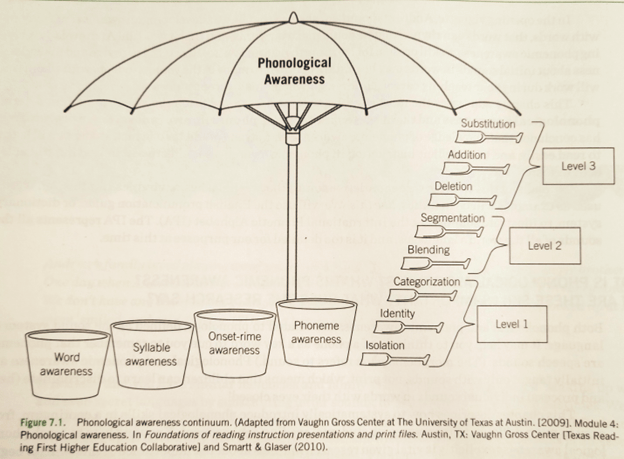
Phonemic Awareness – *TD: Awareness of the individual sounds that make up words and the ability to manipulate those sounds in words. It is also the ability to think about, combine, or segment individual sounds in speech and is the most challenging skills of phonological awareness.
*Phonological Awareness is the broader awareness of sound and hearing sounds. The word itself has the word phone in it, which means sound. Any sound is phonological awareness and can be and is developed through rhyming, tongue twisters, and hearing syllables.
*Phonemic Awareness is a specific skill in a smaller category of phonological awareness and only working with the smallest units of sound (phonemes). This skill involves developing an awareness of sounds in words and is developed through isolating sounds, segmenting, blending sounds, and manipulating sounds. This discrete set of skills helps children understand that the word dog can be separated, or segmented, into three individual sounds, /d/ /o/ /g/, and that, inversely, these three sounds can be combined, or blended, into a single word, dog.
Here is a website with some Phonemic Awareness games: http://www.howcast.com/videos/460491-how-to-play-phonemic-awareness-games-reading-lessons/
Phonemes – The smallest unit of sound that distinguishes the meaning of spoken words.
*Phonics – An understanding of letter–sound relationships. It is the matching of sounds to letters and text, making the connection between sounds and spoken language and how you represent those sounds.
**Throughout the book and this blog, letter sounds are denoted between slashes, or virgules, like this: /d/ or /ă/.
Onset – The beginning consonant(s) of a one-syllable word or the part of a syllable before a vowel, such as /b/ in the word bat.
Rime – The vowel and all that comes after or the part of a syllable that begins with the vowel and includes what follows such as /at/ for the word bat.
*For the word dog the onset would be the beginning sound /d/, and the rime would be what follows beginning with the vowel sound /og/.
Alphabetic Principle – Understanding that written language is a code in which written letters (graphemes) represent units in spoken language (phonemes). It includes the understanding that squiggles on a page represent a sound and the squiggles have names. Students also learn that words are read from left to right (concept of print) and that every letter or letter pattern (grapheme) represents a sound (phoneme). Students learn that the sounds of spoken words are ordered in a specific, temporal way and that there are spaces between each word.
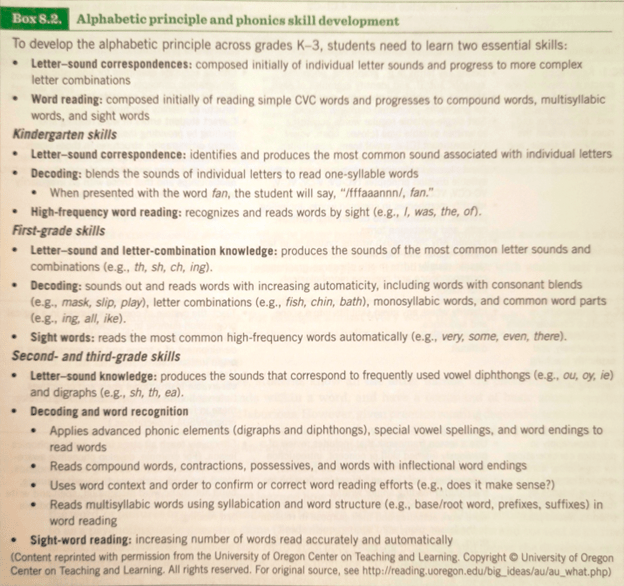
The figure below shows the development of alphabetic principles and phonics skills:
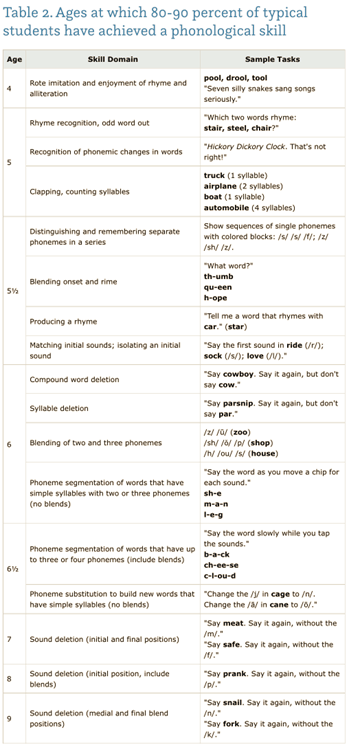
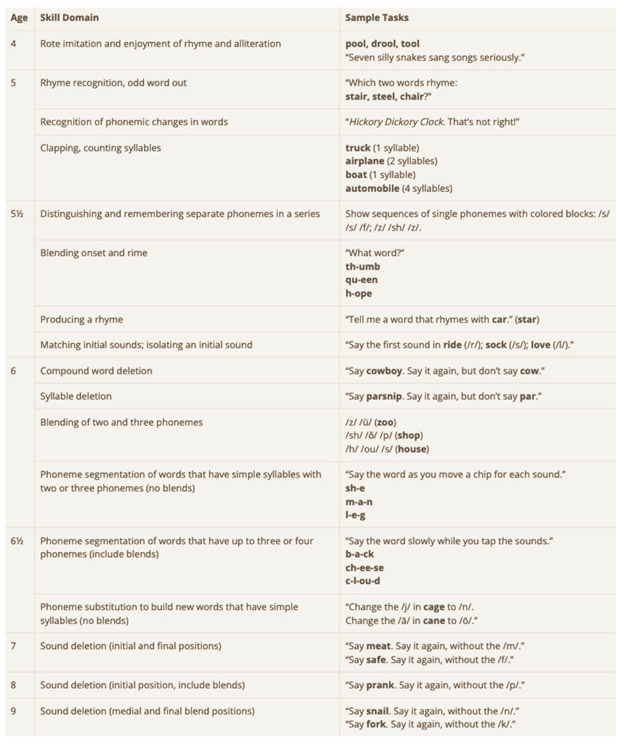
Phonological Awareness Skills and The Age They Develop –
By age 3 – Children are typically aware that words rhyme and can also be aware of when words begin with the same letter/sound called alliteration (Peter piper picked a pepper…).
By age 4 – The rhyming continues, and students may be able to fill in the blank with a rhyming word or fill in the blank when someone reading pauses at the end of a line (I see a red horse looking at _____). They can also sing or recite nursey rhymes that incorporate rhyming as well.
By Age 5 – Near the end of kindergarten children should have mastered phonemic awareness and be able to blend and segment the sounds in one-syllable words using onset-rime.
By age 6 – By the end of first grade students should be able to segment spoken single-syllable words into their complete sequence of individual sounds and be able to manipulate phonemes.
* It is also noted that if a student wasn’t read to by their family or early childhood teachers often that they will be behind when compared to other students. The students will then need explicit and systematic instruction of these concepts.
Systematic – Breaking lessons and activities into sequential steps that progress from simple to more complex. *TD: The definite method for a procedure, carried out by a step by step, routine process. Systematic instruction typically starts with teaching easier concepts to more complex concepts.
Explicit – Overtly teaching each step through teacher modeling and examples.
Six Guiding Principles to Make Activities Easier or More Difficult –
Instruction should be provided at a level so students will be challenged and not bored, but not too difficult so they become frustrated. Below are six guiding principles about what makes activities easier or more difficult.
Five Features of Effective Instruction –
Classroom Application – The biggest takeaway from this week’s chapter has to do directly with how students learn about phonological awareness. Knowing what students should be learning or could be learning about and practicing with phonological awareness is vital to their reading and learning to read. One classroom application for this would be to help identify students who may be lacking certain skills for their age or grade regarding phonological awareness. Knowing and understanding what a “normally progressing” first or second grade student should be able to do can help us identify a student who may need extra help or interventions.
Video Notes
https://www.youtube.com/watch?v=McJldIFIpC8 – In the video, the teacher explains the distinctions between phonological awareness, phonemic awareness, and phonics. The teacher mentions the challenges of learning English because of its 26 letters and 44 sounds. There isn’t a one-to-one correspondence between letters and sounds too. The teacher goes over each definition and explains several examples. The teacher also stresses the importance of making phonological and phonemic awareness activities fun for students while putting much emphasis on auditory skills. She demonstrates and explains several examples again before concluding with a quick summary of the differences between phonological awareness, phonemic awareness, and phonics.
*From the Description: This video shares basic information about some terminology surrounding the teaching of emergent and beginning reading. It focuses on the definitions and distinctions between phonological awareness, phonemic awareness, and phonics. In a nutshell: Phonological awareness is the broader awareness of sound and is auditory. Phonemic awareness is the awareness of the smallest units of sound in a word and the ability to segment, blend, isolate, and manipulate those smallest individual units of sound. It is auditory. Phonics is the relationship between phonemes and graphemes. It is learning the rules and patterns of the letter-sound relationship.
https://www.youtube.com/watch?v=M_vLX8mxO4I – What is Phonological Awareness? This short video discusses phonological awareness. She describes how we listen to words and sentences, and it only involves listening and not seeing words. She also discusses how sentences and words can be taken apart into words and syllables before discussing taking apart sounds within a word as well.
https://www.youtube.com/watch?v=eHjRogrFZ28 – In this video, the teacher introduces the concepts of explicit and implicit writing with the goal focusing on, “Supporting your thinking using textual evidence.” She mentions that there are 3 main vocabulary words she will go over. The first, explicit writing, refers to information that is directly stated, clear, and obvious. Implicit writing involves information that is not directly stated and clues are given. This then requires readers to draw inferences based on clues provided by the author. These inferences are the act or process of using clues or evidence to draw a conclusion. The teacher emphasizes the importance of the “thinking voice” that readers should have while interacting with the text. She then shows an example of both implicit and explicit writing while demonstrating how a student should use their thinking voice. She next mentions that, “Your job = show your thinking voice.” After that, the teacher tells us that successful readers will go beyond explicit ideas, dig deeper using the author’s clues to draw inferences on implicit information, and to use the author’s clues to support their thinking voice as evidence. Finally, the students are assigned a practice task involving reading a short excerpt, determining if the writing is explicit or implicit, and drawing inferences using evidence to support their thinking.
https://www.youtube.com/watch?v=xb8hJSG_YYU – Onset and Rime Picture Cards. This video demonstrates how the onset of a word is the first part of the word before the vowel and the rime is the part after. There are pictures that represent a word that are cut in half and the student is to identify the onset and the rime for the words. With the word car, its onset is the “kuh” for the letter c sound and the rime is the “ar” part. For the word bat with separates to “buh” and “at” the student says “bah” and “at” the first time before she intervenes and works with the student to identify them correctly.
https://www.youtube.com/watch?v=HvX8oAdZ2t8 – In the video, the speaker explains how readers can recognize phonemes in words by identifying the individual sounds you hear in them. It begins by going over an example using the word “pig.” The speaker demonstrates that the word has three individual phonemes (sounds) of /p/, /i/, and /g/. The speaker also mentions that the number of phonemes in a word isn’t always the same as the number of letters. He then explains this using the word “seat” and shows us that it has four letters, but only three phonemes. Another example the speaker goes over is the word “chick.” This word has five letters but only three phonemes: /ch/, /i/, and /k/. The speaker explains the steps for recognizing phonemes in a word. He says that first you must listen to the word. Then you can identify the individual sounds or phonemes within it. The video ends with him repeating what the video went over and that recognizing phonemes in words is done by listening for and identifying the individual sounds present in each word.
https://www.youtube.com/watch?v=yxl4NIVOyFw – Phonemic Awareness: Phonemic Substitution. This video discusses breaking words down into their smallest sounds (phonemes) and swapping some of those sounds out for other sounds to create new words. She separates several CVC words into their smallest sounds which often end up being the letter sounds themselves. Then she shows how to swap out a sound from either the beginning, middle, or end of the word to identify a new word with the phoneme (sound) substitution. Great video on a way to use phoneme substitution to work with students.
Summary Of What I’ve Learned About Running Records From Reading A-Z
Stages of Development – There are 4 main stages of development within the Reading A-Z program that students will progress through. The four levels are Beginning Readers (Levels aa-C), Developing Readers (Levels D-J), Effective Readers (Levels K-P), and Automatic Readers (Levels Q-Z2). Reading A-Z provides a three-part assessment process and these are conducted throughout the reading and intervention process. These assessments are to help place students with appropriately leveled texts. The first part of the assessment process is to have students read Benchmark Passages or Benchmark Books (Levels aa-J) and to capture their reading behavior on Running Records. Part two is to have the students retell the text and to use the “Retelling Rubrics” to score their comprehension. Part three is to have the students take an oral or written Comprehension Quick Check Quiz. Each question’s answer will tell us what skill it assessed to help us identify comprehension skills for additional practice. This three-part process enables us to establish a baseline of our student’s level and to assign leveled books for future small group or individual instructional practice.
Running Records – One part of a three-part process to place students with instructionally appropriate level texts and determine whether or not students are ready to move up a level. These running records allow us to assess reading behavior as students read from developmentally appropriate texts and are most often used in the earlier stages of reading to monitor reading behavior and progress. Each “Benchmark Passage” and “Benchmark Book” comes with a customized Running Record
*Running Record – An assessment system for determining students’ development of oral reading fluency and word identification skills and strategies.
Recommended guidelines for when administering a running record:
***(The above notes were taken from a previous blog posting from a chapter in the previous ENGED 370 Textbook and I figured they should also be noted somewhere.)***
Taking Running Records – Running records are most often done in the earlier stages of reading and taking a running record takes practice. There are several procedural steps one must do when performing a running record assessment as well and they are as follows:
Marking Running Records – Marking running records is one of the most important steps in the assessment process and several terms are used when marking a running record form. The following are terms one should become familiar with by reviewing their explanations below.
Errors (E) — Errors are tallied during the reading whenever a child does any of the following:
Self-correction (SC) — Self-correction occurs when a child realizes her or his error and corrects it. When a child makes a self-correction, the previous substitution is not scored as an error.
Phonics — The reader uses phonics to decode the words being read. Phonics skills vary by age, grade, and instruction. Younger readers may not have experience with long vowels and may read all words with a short vowel sound. This should be noted so the teacher knows this child is ready for long vowel phonics lessons.
Morphology — Morphemes are the smallest units of words that have meaning and cannot be divided further. The most common morphemes are root words and affixes. A reader may use their knowledge of a word root and affixes to determine the pronunciation and meaning of the word read.
Guessing — Some readers use this skill when they are attempting to read very quickly or if they have developed a habit of skimming as they read. For instance, if the word is ran but the reader says ‘runned’, this would indicate the reader is not attending to the graphemes in the word but rather trying to make sense as they read. Or, the reader does not know the word and rather than attempt to decode makes a guess.
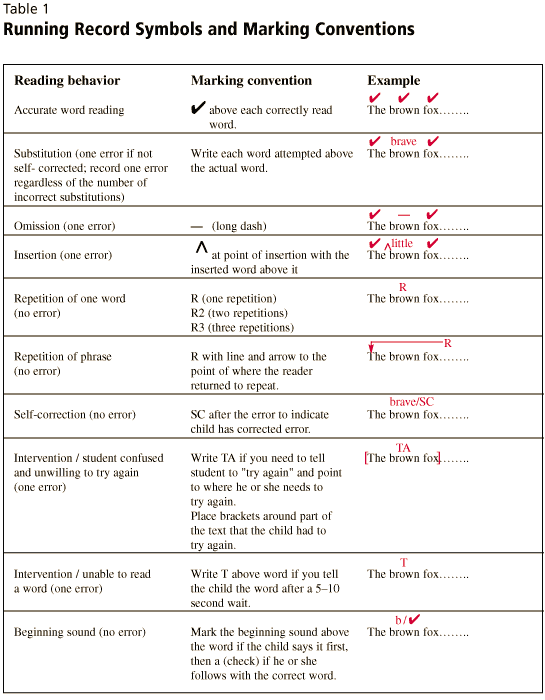
Marking a running record is also a two-step process. Step one involves marking the text on the running record form as the student reads from the Benchmark Passage or Benchmark Book. Once the student has read all the text on the running record form and you have recorded their reading behavior, you can complete Step two. Step two involves using the boxes to the right of the lines of text to gather information. Start with the first line and mark the number of errors in the “E” column. Then, tally the number of self-corrections in the “SC” column. When you’ve completed your review, total the number of errors and self-corrections at the bottom of the columns. Then, you use the Scoring and Analyzing a Running Record page to calculate the error, accuracy, and self-correction rates at the bottom of the page.
Below is an example of a scored running record:
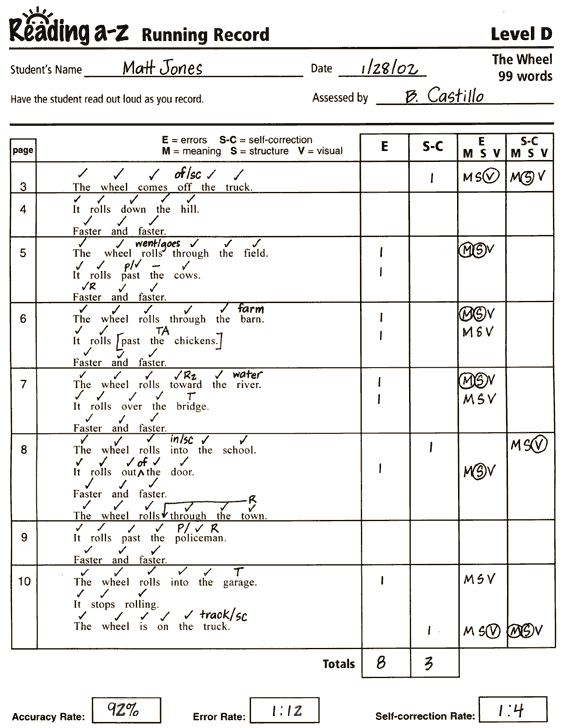
Scoring Running Records – The information gathered while doing a running record is used for scoring and to determine error, accuracy, and self-correction rates. The calculated rates, along with qualitative information and the student’s comprehension of the text, are used to determine the student’s reading level.
Qualitative Analysis – Qualitative analysis is another aspect of assessing and comes from observations you make about the student’s reading behavior as you administer the running record. This may include the reader’s phonics, morphology, and guessing habits as well as fluency, intonation, and phrasing. If you need to prompt the reader, take note of how he or she responds. Use this additional information to better understand the student’s reading abilities.
Error Rate – Error rate is expressed as a ratio and is calculated by using the following formula: Total words / Total errors = Error rate. If a student read 99 total words and had 8 errors the student’s error rate would be 99/8 = 12.38. We then round to the nearest whole number and express the error rate as a ratio. The ratio is expressed as 1:12, and this means that for each error made, the student read approximately 12 words correctly.
Accuracy Rate – Accuracy rate is expressed as a percentage. You can calculate the accuracy rate using the following formula:
(Total words read – Total errors) / Total words read x 100 = Accuracy rate
Using the same numbers from before we would have: (99 – 8) / 99 x 100 = Accuracy rate, 91/99 x 100 = Accuracy rate, and .919 x 100 = 91.9%, or 92% with the numbers being rounded to the nearest whole number. You can use accuracy rate to determine whether the text read is easy enough for independent reading, appropriate to use without frustration during reading instruction, or too difficult for the reader.
A breakdown of these three categories in the Accuracy Rate Chart is as follows:
Self-Correction Rate – Self-correction rate is expressed as a ratio and is calculated by using the following formula: (Number of errors + Number of self-corrections) / Number of self-corrections = Self-correction rate. An example of this would be if the student had 8 errors and 3 self-corrections. Its self-correction rate would be (8 + 3) / 3 or 11 / 3 = 3.666, or 4 when rounded to the nearest whole number. The self-correction rate is then expressed as 1:4. This means that the student corrects approximately 1 out of every 4 errors. If a student is self-correcting at a rate of 1:4 or less, this indicates that he or she is self-monitoring his or her reading.
*Other Notes from previous blog posts regarding running records:
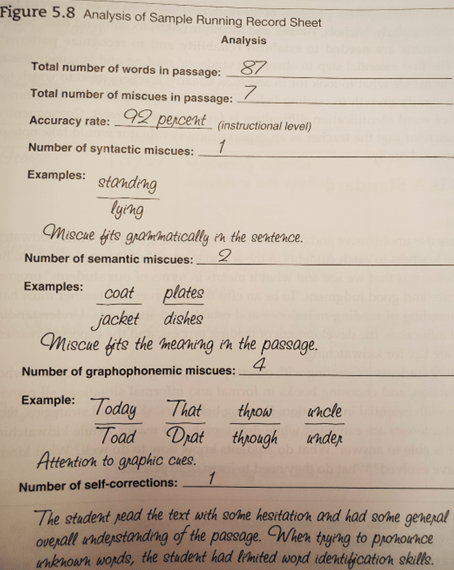
Analyzing Running Record – Analyzing running records allows teachers to understand the strengths and weaknesses of the student as well as their patterns of miscues. It also helps teachers understand how the reader uses and coordinates graphophonemic, syntactic, and semantic information from the text. Teachers must also consider the pattern of responses in order to analyze errors and self-corrections.
The figure below shows an example of an Analysis of a Running Record Sheet:
Another assessment tool used when assessing students is a Words Per Minute assessment. Words Per Minute – How many words the student can correctly read in one minute. This is an assessment in which readers read aloud for 1 minute from materials and the teacher marks the words the student reads incorrectly during the assessment. This assessment also tracks changes in reading rates and accuracy over time and assesses the appropriateness of the text’s difficulty.
Miscues – Oral reading errors. The terms error and miscue describe the same phenomenon – a deviation or difference between what a reader says and the word on the page. More positive way to describe evidence as opposed to error and also provides room for elaborate on the error.
Miscue Analysis – An informal assessment of oral reading errors to determine the extent to which readers use and coordinate graphic-sound, syntactic, and semantic information. These errors can be analyzed quantitatively or qualitatively.
Miscue Analysis uses four crucial questions:
Summaries of the Videos
In this video, a teacher conducting a Running Record assessment with a 6 year old kindergarten boy. The student starts by reading a book called “At the Farm” while the teacher encourages him to read and provides assistance when needed. During the reading the child reads and sounds out words about various animals and their young. After the reading, the teacher asks the student several questions to assess his comprehension of the story. They also discuss the differences between adult and baby animals while going over the questions. Great brief video showing what to do during a running record and read aloud.
In this video, a teacher named Mary Lou in the Almond-Bancroft School District is shown using the Fountas & Pinnell Running Record in the classroom with a student named Hunter. They are going to be reading a short story called “Animal Instincts” to do a running records assessment. Hunter reads aloud while Mary Lou records the words he reads correctly or incorrectly. About halfway through the read, she directs Hunter to read the rest of the story on his own quietly and tells him that when he is done reading, she will be asking him some questions about what they read. When he is done reading, she asks him comprehension questions about the story, such as to tell him something about the concept of instincts and specific examples of instincts in dogs and cats. They then discuss parts of the book while answering questions like how instincts help animals. Hunter also demonstrates his understanding of the story by connecting the information from the glossary to the text. This brief video contained a tremendous amount of learning and assessing and is a great example of what to do after reading a text. The video ends with a brief sketching activity where Hunter sketches a dog showing its instinctive behaviors. Mary Lou also mentions that she will be testing Hunter at a higher level in the future because he did such a good job.
Data – Any information educators collect on individual students (or a group of students) over any period of time. Although we may in some cases be referring to general information (data), more often we are talking about specific test data, gathered throughout the school year, that help educators make decisions about how and what to teach.
Screening – Quick assessments given to all students. Screening assessments are a quick indicator of student skills and can reveal which students are predicted to meet grade-level benchmarks. Screening also helps educators identify which students need more closer monitoring.
Progress Monitoring – The tracking of students’ progress over a specific instructional time. The purpose is to closely monitor how the student is learning, to catch the students before they fail, and to change the instruction to a more effective method. Some examples include exit tickets, quizzes, and student work. *More detailed description below
Outcome Measures – Summative assessments given at the end of a specific instructional period to determine learning progress and achievement. Outcome measures provide information that is global in nature and focus on how well groups of students comprehend and apply knowledge. Some examples in the CAT test in California and the Forward Exam in Wisconsin. *More detailed description below.
Diagnostic – In-depth information about possible cause of a student’s difficulties learning. Tools and information used to pinpoint specific skills a student has or does not have. Information can then be used to develop a specific, targeted instructional intervention plan. Some examples include the Measures of Academic Progress (MAPs testing), a pre-test, and teacher observations.
Curriculum-Based Measures (CBM) – A method used to monitor what students have been learning. They usually have standardized instructions, a stopwatch or timer, a set of materials (examples include passages or lists referred to as probes), scoring procedures, and record forms or charts. CBM data allow for immediate adjustment in a student’s educational program when needed. They are considered a general outcome measure and provide information about how well students have learned the skills taught in their curriculum, such as unit tests or more standardized individually administered tests. CBMS are considered general outcome measures and can be utilized for identification and progress monitoring. Examples include DIBELS-8, Acadience Reading, Easy CBM, and teacher made materials like a monthly test of expected spelling words for the grade level academic year.
Formative – An assessment used to measure the assessment for learning and assesses performance during learning, usually occurs regularly throughout the instruction process, the results are used to inform instruction, and identifies areas for improvement. Examples include using thumb and hand signals for students to indicate whether or not they understand a specific topic or concept, exit tickets, class discussions, think-pair-share, and other observations a teacher may use to inform instruction.
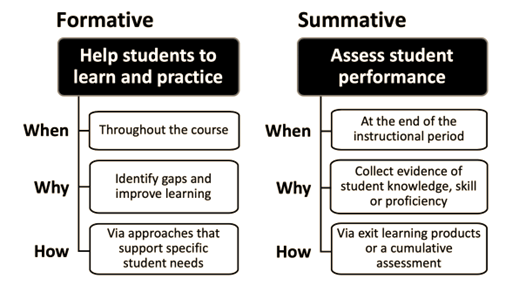
Summative – An assessment used to measure the assessment of learning, measures student achievement at the end of a period of learning (e.g. unit of study, end of semester, end of year); generalizes how well a student has performed and how much the student has learned overall. Statewide standards dash based achievement tests are summative assessments. Summative assessments occur at the end of the learning process, provide a final the evaluation of knowledge and skills, and can also involve high-stakes testing that often involves the ranking of students as well as providing students with a grade. Examples include chapter/unit tests, final portfolios and projects, essays and term papers and the ACT and SAT exams.
Standardized – standardized tests are assessments designed to be administered in a consistent manner to ensure that the conditions, questions, and scoring are uniform for all test takers. They aim to measure a student’s performance or knowledge in a specific area, often for the purpose of comparison or evaluation. They are created with the use of carefully selected sample of individuals who represent a larger group of individuals and allows comparisons of an individual score to that of a larger group. Everyone who takes the test answers the same questions and I scored in a consistent manner. Standardized tests must be administered following the standard procedures outlined in the text manual. Examples include the Scholastic Assessment Test or SAT, the Medical College Admission Test or MCAT, and the Woodcock-Johnson Tests.
Norm Referenced – Test that measures how well one student performs compared to other students at the same grade or age level who have already taken the test. Norm dash reference tests are standardized. Percentile standard scores, grade equivalent, and similar scores are used. Also referred to as normative assessments. Examples include the Woodcock-Johnson Tests of Achievement, Gray Oral Reading Test, percentile ranks, IQ Test, and the SAT.
Criterion Referenced – Tests that assess what students know and can do on a given task. Guides identification of skills to teach. Usually provide pass/fail mastery scores and occasionally have benchmark goals. Examples include Quick Phonics Screener, Words Their Way Spelling Inventory, an end of unit test, a pass/fail semester exam, and the ACT.
Curriculum Embedded – Assessments that use curriculum materials to measure student progress and achievement as well as what students are and have learned. This also involves monitoring the educational progress of students through direct assessment of academic skills. Examples include teacher made tests or test and assessments that come directly from the text book that often take the form of end of chapter tests.
Formal Assessment – Tests that are both valid and reliable and have been standardized. These are usually on a large scale and for the purpose of comparing one group’s performance to another. Examples include the SAT, ACT, IOWA, and Woodcock-Johnson Tests of Achievement.
*From the PP* – Reliable and valid. Students are given the same test, same amount of time, and same testing conditions. Scores are used to compare students to each other.
Informal Assessment – Assessments that evaluate children’s learning based on systematic observations by teachers of students performance reading tasks that are part of the daily classroom experience. They may also consist of interviews, questions, quizzes, and observations. Examples include classroom-based instructional reading assessments, teacher-made tests, and quizzes.
*From the PP* – Used during instruction to see if the student understands the instruction or not. The assessments are part of the student’s day. They may not know they are being assessed.
Observational Assessment – These are the assessments and recognized patterns teachers observe in the classroom in response to asking questions during instruction to gain insight into a student’s thinking. Sometimes it could be a simple thumbs up or thumbs down on how the students are feeling after instruction and whether or not they need to modify their instruction. These are often called “on the spot” observations and can include engaging activities such as asking to students to share what they learned with a partner or writing answers on a whiteboard for the teacher to review.
Reliability – This term refers to the extent to which assessments are accurate and consistent, that is, the general dependability of the test. *Can different teachers give a student the assessment with consistent and reliable results?
*From the PP* – The dependability of a test. Can the assessment be administered by different people at different times and get consistent results? If the results are consistent or dependable, the assessment is considered reliable.
Validity – An assessment is considered valid if it accurately measures what it is supposed to measure and predicts performance on similar assessments. A valid assessment can predict performance on a correlated assessment.
*From the PP* – Measures what it is supposed to measure. It should be able to predict the student’s performance. A running record would be valid and predict if a student will pass the grade-level reading test.
Four Types of Formal Assessments:
Universal Screening Assessments – Sometimes called benchmark assessments these screening assessments are usually given to all students at the beginning (BOY), middle (MOY), and near the end of the year (EOY). In primary grades, these screening tools typically measure phonological awareness, phonics, fluency, vocabulary, comprehension, and spelling progress. In fourth through sixth grades, the screenings assess comprehension, fluency, and writing.
These screenings reveal which students are predicted to meet grade-level expectations/benchmarks, and they also help educators identify which students need closer monitoring. *Universal Screening determines students who may be at risk for reading difficulties: they help educators answer the question, “Which of my students are at risk for reading difficulty?” Examples of Universal Screening Assessments include TPRI, AIMSweb, and Acadience Reading.
Progress Monitoring – Assessment designed to track a student’s progress over a specific instructional time period. They determine whether the student is making expected progress and if the instruction needs to be changed. The assessment measures how accurately and automatically the students perform the task, as well as tracking a student’s performance over a specific instruction time period. One of its purposes is to closely monitor how the student is learning, to catch the students before they fail. This also means changing instruction when necessary to a more effective and appropriate method. Assessment examples include AIMSweb, EasyCBM, DIBELS-8, Acadience Reading, and those done by university research centers, core or basal reading programs, and those done by school districts themselves.
These progress monitoring assessments are typically a timed 1-minute probe and a quick assessment of student skills. For students at risk, assessments are done every two weeks or every few weeks depending on the student’s needs, and they are done over a period of several weeks and months. Teachers will use progress monitoring data to: determine which level of intervention the student should receive, change the instruction materials being used, and increase the intensity of instruction (smaller groups, more frequent interventions). The assessments answer the question: “How much progress are my students making?” and “Are they making the expected progress, and do I need to make chances in my instruction?”
Diagnostic Assessments – Assessments that provide in-depth information about possible causes of student’s difficulties learning. These can sometimes be referred to as diagnostic screeners or surveys, and they identify specific skills the student needs to learn. These screeners are then used to develop a specific, targeted instructional intervention plan for the student in a small group. Some of the reading skills a teacher may need to assess more in-depth include: phonological/phoneme awareness, letter sounds orthographic knowledge, high-frequency words knowledge, decoding fluency, multiple cue efficiency, or oral language/listening comprehension. If and when students are not making the expected progress over time in Tier 2 or 3 interventions, more specialized individualized assessments may be needed. These are usually administered by school psychologists, special education teachers, occupational therapists, speech-language pathologists, interventionists, or other trained personnel. Examples include: Comprehensive Test of Phonological Processing, Test of Word Reading Efficiency, and Acadience Reading Diagnostic. These assessments answer the question, “Where do I need to focus intervention?”, and “What specific skills do the students need to learn?”
Outcome Evaluations – Assessments that provide outcome data for a group of students. These groups of students can include an entire class, a school, a district, and even the nation. Outcome evaluations and outcome measures are called summative assessments because they are given at the end of a specific instructional period to determine learning progress and achievement. They provide information and focus on how well groups of students comprehend and apply knowledge. Many of these assessments are mandated by federal and state governments and are aligned with a state’s standards and determine the skills and knowledge students learned in the past year. These results are then compared across the state or nation to determine effectiveness as well as determining teacher accountability. Examples of these assessments include TNReady, MCAS, CMAS, and Acadience Reading. These assessments answer the question, “Have my students learned the material that has been taught?”
Classroom Application
When it comes to classroom application there was a lot to unpack in this short chapter. One of the things I am nervous about for when I become a teacher is that I will have all of these observations and assessments but won’t know what to do with them all. While I am more familiar with making informal observations about students and progress monitoring, I am not as familiar with all of the specific diagnostic assessments used today. I have done several running records and similar assessments with students, but I do not have any experience with the Comprehensive Test of Phonological Processing, and I am not sure how to diagnose specific skills or deficits students are lacking in. On the positive side I do have a lot of practice and experience with using hand gestures for thumbs up thumbs down thumbs middle for understanding in the middle of a lesson as well as using exit tickets to inform future instructional plans. I am also excited to be able to create fun and competitive learning games and assessments for students. I have been on the participant side of many education learning games and assessments such as Jeopardy and Kahoot, but I have not gotten to create my own yet. I think it will be excited to try to find new ways to educate and assess my future students.
Video Notes:
https://youtu.be/4p5286T_kn0 – Be a Mr. Jensen – This short video details the time a young student at 10 years old kept getting in trouble for tapping on his desk and being disruptive. When all of the other teachers scolded him or sent him to the office (which was no help either), one teacher pulled him aside after class and changed his life. That teacher saw the student’s potential for drumming and gave him his first pair of drumsticks. The teacher told the student directly that he isn’t a problem and gave him an outlet for his “fidgeting” and this student went on to become a very successful musician.
Sight words vs high frequency words – This video describes the difference between sight words and high frequency words. High frequency words are words that we frequently see when reading and speaking. They can be divided into 2 categories: regular and irregular. Sight words are words that students know by sight. Sight words are words we don’t have to read by sounding out. Words we know more and more as we learn and read more and more.
https://youtu.be/zTkQjH-_97c – Assessments in Education – The video starts with the speaker describing the differences between formative assessments are using during the teaching process and a quick check for understanding. Summative assessments measure long term academic goals and can often be used for grading. The video goes on to describe the many different types of assessments with examples for each type of assessment. The video also goes over behavioral assessments and emotional assessments and screenings.
https://youtu.be/_WDfT46nijA – Formal vs Informal assessments – This brief video describes the many key points and differences between formal and informal assessment with many great details and examples for each one.
https://youtu.be/JI-YgK-l4Sg – Formative vs Summative vs Diagnostic – Same guy from previous assessment videos describes the key details and differences between these three assessments. First, he very clearly explains why we should implement each assessment. Then he describes when we should implement each assessment as to whether it be before, during, or after a learning lesson. He then goes on to detail some examples of each assessment and how we should use each assessment like planning for future lessons and making groupings.
https://youtu.be/O5hJNpO0JPE – Criterion-referenced vs Norm-referenced assessments – He mentions the goal for norm referenced assessments is to rank students based on test achievement and criterion referenced is to measure the skills and knowledge a student has mastered. He then goes on to describe other key differences between the two in this great brief video.
https://youtu.be/6ndJygJixqY – Validity, reliability, authenticity, and cultural bias – In this video the speaker defines each other the words before explaining and detailing examples in the classroom. She does a fantastic job explaining each one of the words thoroughly and effectively. The many definitions she used are real life examples and situations many of us can relate to. Overall, a great simple video explaining things.
Components of a Basal – Basal reading programs are popular materials used for reading instruction and are commercially published materials that are well-designed to offer a more thorough and explicit instruction than many teachers can provide on their own. A basal program also offers greater continuity from class to class and grade level to grade level, providing both vertical and horizontal articulation. Progress monitoring, differentiated instruction, technology integration, and suggestions for working with English language learners are hot topics in current basal reading programs. Below is a figure detailing the key terms and definitions of the language used in basal instruction:
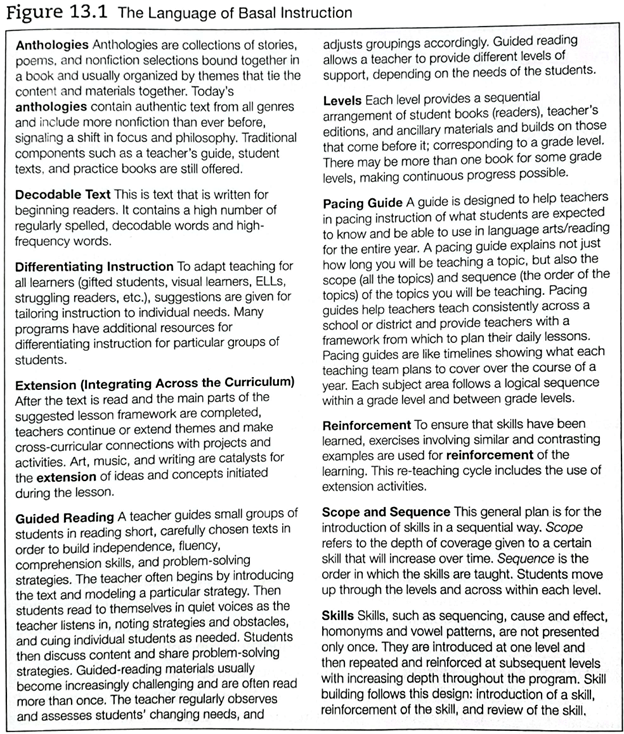
Student Books – Emergent literacy programs are often organized thematically, include a variety of supported materials, and capitalize on children’s curiosity about print to get them excited about reading and making predictions. Some of these materials include anthologies, trade books, e-books, and leveled books. Older students use hard cover anthologies (a bound collection of reading selections such as stories, poems, and informational text) and then small, leveled readers for each student. Stories are also chosen to illustrate and develop specific skills, which are taught in a predetermined sequence.
Leveled Readers – Leveled books are student books that are included in the program and used during guided reading. Children are matched with text at, below, or above grade level to help mean the needs of each student.
Teacher’s Editions – Teacher’s editions provide an instructional guide and in-service support. There are three important features of teacher editions: the scope and sequence chart, a reduced version of the student text, and suggested lesson plans. Because of the abundance of information and teaching options/directions, the size of a typical teacher’s edition for one unit is the same size as former editions for the whole year. Because of the amount of information and options, it may be overwhelming for novice teachers. However, others have found that they have become discriminating consumers and realize they do not need to slavishly follow the teacher’s manual.
Workbooks – Workbook content can include practice in spelling, phonics, and decoding skills in the primary grades and comprehension or study skills in the intermediate grades. There are also new opportunities for open-ended, personal, and creative responses too. A wide range of practice books such as phonics, vocabulary, writing, CCSS, and handbooks for ELLs are included with basal reading programs. Many workbooks are completely online now and can be uploaded into a teacher’s electronic dropbox. The key question for today’s teachers is: “What do I choose from the many available resources to differentiate for each child?”
Assessments – Basal reading programs include a comprehensive set of assessments to assess students’ strengths and needs, determine ability levels, pinpoint foundational skill gaps, and challenge advanced learners. These assessments also include screenings, progress monitoring, benchmark tests, and unit tests, and they are offered in both print form and online. The important thing for assessments is for teachers to carefully select what assessments they need and for what purpose.
Technology and Online Learning – Basal readers have gone digital and can offer opportunities to personalize and differentiate learning to meet the needs of individual students. Online versions of nearly everything that is printed along with practice activities, flash cards, writing assignments, and other support materials now accompany print materials within these programs. Many also offer online quizzes and online management tools for teachers such as customizable skill instruction, online lesson planning, and even online coaching. The largest contribution technology has made as been the immediate, real-time assessments and data reporting systems now part of most programs.
Intervention – Basal programs provide options such practice books, diagnostic assessments, games, and online interactive resources to reteach skills to students who need intervention. Leveled books in a series allow students to read on, above, or below grade level. Small group instruction suggestions are also provided with these programs.
*(From the Power Point) Components Which Are Part of Every Basal Series –
Lesson Framework of a Lesson in a Basal – Most teacher’s editions of basal readers have lessons for whole group, small group, and independent activities. A typical lesson follows a before, during, and after reading framework for teaching a selection over a number of days.
Modifying Basal Lessons – Commercial reading programs provide a starting point for making sound instructional decisions. However, teachers must be judicious about selecting materials to use for the core reading program and the plethora of supplemental materials to accompany it. Modifications to these programs must
also be to accommodate our students. Modifications of basal reading lessons allow teachers to rely on their own strengths as well as those of the students. These teachers must also decide where to place instructional emphasis as well. Modifying lessons also personalizes reading instruction for teachers and students. Teachers must adapt to meet the needs of their students.
Below is a figure displaying some of the pros and cons of core instructional materials teachers may use:
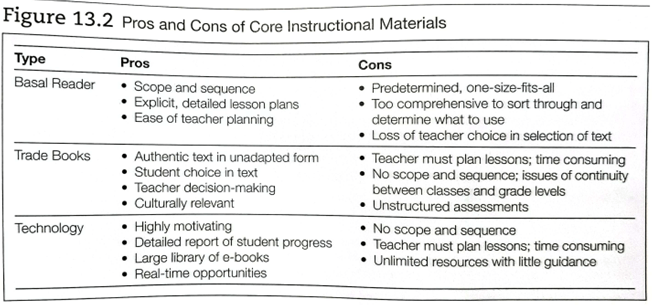
Evaluating Reading Materials for Instruction – First off, the decisions that go into selecting core materials should be of supreme importance to a district. Districts cannot trust or rely on basal and curriculum publishing companies to adopt a particular program. Because of how important core programs are to any school, it is critical to put a great deal of time and thought into selecting a set of materials. Publishing companies and vendors are responsible for developing quality products, but the ultimate burden falls on educators to thoroughly evaluate the deluge of instructional materials flooding the market. Here are some questions and steps for educators to consider before deciding whether to consider new programs:
Here is a sample checklist for examining the potential effectiveness of materials for a current basal program or other curriculum resources:
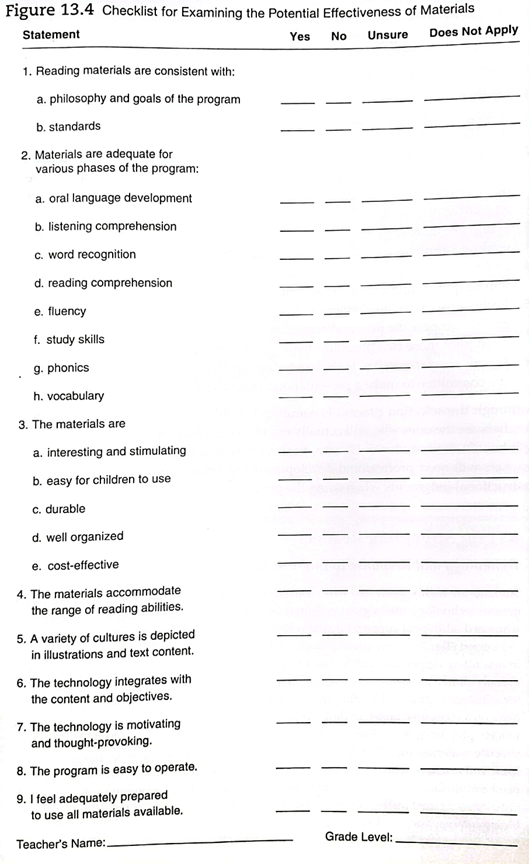
Below is another procedure and guidelines for selecting a core reading program that goes above and beyond the basic checklists that allows districts to make informed decisions about textbook adaptations:
*It is noted that teachers are the ones who will actually use the materials to make critical decisions that will benefit their students. They will also need professional development and training on how to make informed instructional judgements when using the programs.
Classroom Application – Although much of this week’s chapter information regarded basal reading programs and other instructional materials teachers and districts use, there were some useful parts to reflect on. One of my key take-aways was actually something to consider as both a parent and educator and has to do with what sort of materials is the classroom teacher using to supplement their basal reading program or other reading program and why? The same questions can and should be considered for new and incoming teachers to an already existing reading program. A teacher should not just take over a classroom and simply reuse all of the “old” teacher’s materials, reading programs, and curriculums. They should be using the guideline questioning and checklist to evaluate the existing programs effectiveness. Some materials may be incomplete or outdated while others may simply be ineffective. Questions like, “What kind of learning environment does the program recommend? Is it child-centered? How are lessons structured? Are there different genres being used and included throughout the year?” should be asked. The checklist example from figure 13.4 shows an effective way to reflect on current materials and can help teachers add more effective materials or take away ineffective materials easily. While teachers may not have much say when it comes to existing basal programs and curriculums in their school, they do have the ability to modify them by adding more effective and interesting materials. I will definitely be keeping a copy of the “Checklist for Examining the Potential Effectiveness of Materials” to evaluate my future classroom’s materials as well as modifying it to examine other subjects and materials.
*Other notes from this week’s Chapter 13 pages:
Reading Materials
There are three categories of instructional reading materials used in elementary classrooms:
Basal Programs Today
Basal programs are the most widely used materials for teaching reading, more often than not, these form the core reading program of a school. The basal programs are very comprehensive, attempting to satisfy every consumer, and therefore are a one size fits all model. The programs often contain stories by well-known authors, and in recent years they include more nonfiction than ever before. Within basal programs students are supported in developing their thinking, comprehension, and study skills, particularly as the teacher integrates these with other subjects, such as music, science, and social studies.
Key Features of Basal Instruction
There are key features across all basal instruction programs. These are:
Anthologies – Bound collections of stories and poems in reading programs.
Decodable text – Text which is written for beginning readers. It contains a high number of regularly spelled decodable words and high-frequency words.
Differentiating instruction – Teaching adapted for all learners to meet individual needs.
Extensions – Using activities such as art, music, and writing as catalysts to extend ideas and concepts initiated during a formal lesson.
Guided reading – A teaching approach designed to help individual readers build a system for processing increasingly challenging texts over time.
Levels – Books that are categorized into stages of difficulty in order to select text based on ability.
Pacing guides – A guide designed to help teachers in pacing instruction of what students are expected to know and be able to use in language arts/reading for the entire year.
Reinforcement – Exercises involving similar and contrasting examples that are used to reinforce learning.
Scope and sequence – General plan in basal reading programs for the introduction of skills in sequential or vertical arrangement.
Skills – Skills, such as sequencing, cause and effect, homonyms, and vowel patterns.
Steps for selecting a core program
Supplemental Materials
A review of school wide data may reveal that the school’s core reading program does not provide adequate instruction in one or two components essential to meeting the needs of the majority of students. If this is the case, schools should select a supplemental program to strengthen instruction and provide more practice to students on those particular skills. For example, if the core does not provide enough fluency practice in reading connected text, a supplemental program that focuses on fluency should be implemented for all students.
Analysis of student data may reveal that certain students are performing low on specific essential components of reading ability. In order to help these student’s catch up to their peers, they must be given targeted support in those specific essential components (such as word identification or fluency). A supplemental program should be implemented with that subset of students to provide more explicit instruction and practice opportunities, so that these students can make adequate progress to meet grade level standards.
Intervention
Teachers help struggling readers and writers by:
Early intervention is critical to helping children who are struggling to read and write. Research over the past few decades has demonstrated that children that get off to a poor start in reading and writing rarely catch up. These continued findings are the impetus for ensuring that early intervention occurs. Often these interventions are family-focused programs to develop children’s awareness of literacy, parents’ literacy, and parenting skills. Early interventions to resolve reading and writing problems and accelerate literacy development for low-achieving Kindergarten to Third Grade students.
Reading Recovery
One highly effective intervention is the Reading Recovery program which is designed for low-achieving first graders, involving daily 30-minute sessions of one-to-one tutoring for 12 to 30 weeks. Instruction within the reading recovery program is provided to struggling students by specifically trained and supervised teachers.
Reading Recovery Lesson Components
Response to Intervention
Tier 1: Screening and Prevention
Tier 2: Early Intervention
Tier 3: Intensive Intervention
Inventions for Older Students
Making Instructional Decisions
Teachers who rely solely on their teacher’s manual are not following best practice. Teachers need to plan lessons with students in mind. Modifying lessons personalizes reading instruction.
Trade Books
Trade books better respect the linguistic, social, and cultural heritages of students. Trade books are more interesting and engaging which fosters interest in reading and a lifelong love of reading. When students self-select books to read, they are more likely to finish the text. Easier to use trade books to model a love of reading through reading aloud, book talking, engaging students and emphasizing the value of reading.
Technology-Based Materials
Technology based materials are great for meeting and supporting the diverse learning needs of students, and as such they make great supplementary instructional tools to the core reading program. Drawing upon supplementary materials such as internet websites, e-books, online games, online word processors and mobile device applications (apps); when integrated into the classroom seamlessly and thoughtfully, can improve student engagement and provide opportunities for students to develop ownership over their own learning.
The video linked below: “Using Technologies to Support Diverse Learning Needs” details where students and school staff in an Alberta K-6 school discuss the importance of providing students with the technology tools they need in order to be successful learners. https://youtu.be/RY4eR2Ntxtc
Literature-Based Reading Program – A reading program that encourages students to select their own trade books, with the sessions followed by teacher-student conferences at which students may be asked to read aloud from their selections; used by teachers who want to provide for individual student differences in reading abilities while focusing on meaning, interests, and enjoyment. It is important to surround students with books, including those with a multicultural perspective, in order to immerse students in hearing various types of text and to help them find books they want to read.
Community of Readers – The conceptualization of children, in alliance with their friends and teacher, working together in classrooms where school reading imitates adult reading; an effect created by literature-based reading programs. Literacy development is personal, and readers benefit from a supportive environment in order to create a community of readers. Students who view themselves as contributing members of a classroom of readers and writers develop a sense of self-worth and commitment.
*Notes from weekly readings and information – Reading expands children’s experiential backgrounds, providing a window to a world they are yet to explore. Additionally, literature provides readers with good models of writing. Students learn to read by reading. When the prime purpose for reading is pleasure, children want to understand what they are reading. Wide reading provides opportunities for children to develop vocabulary knowledge. Here is a link to a brief video on how we can best foster a community of readers: https://youtu.be/TYSU6j2k4FM
Developing a community of readers goes beyond just reading books. Discuss with students and have them lead discussion on a variety of texts they have read. Include magazines, ebooks, informational texts, novels, graphic novels and so forth. Have students share what excites them in the scope of literacy and literature.
As a teacher you can model and support this process by reading and presenting your own book talks. See the example below by teacher Ashley Strausser who presented her own book talk. Here is another brief video showing and example of good book talk: https://youtu.be/fTwpMcmetoM
While it is important to model this process as a teacher, it is equally important to follow up on students’ recommendations by reading the texts they recommend so you can follow up with an in-depth discussion to build the value of reading in your class community. Having students make their own recommendations to the school library, school community and their peers is powerful.
How to Hook Students on Books – Hooking students on books helps them realize their literacy potential and teachers play a critical role in creating a literate environment that motivates students to read. Below are several ways to hook students on books:
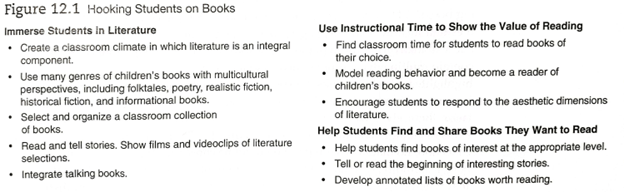
Selecting a Classroom Collection of Books – Teachers must choose books and classroom activities to surround children with print and nonprint materials. They need to include both literature and informational text in their classroom collections as well. Literature books typically include a variety of genres such as stories, dramas, and poetry while informational texts include nonfiction, historical, scientific, and technical readings. Books need to inform, have the appropriate complexity, and be of high interest. Other materials include books, articles, websites, videos, and newspapers as well as many different electronic texts like e-books. E-books should focus on literacy experiences rather than distractions such as movies and games. The stories, illustrations, content appeal, and motivation to develop imagination and abilities are just a few reasons for choosing these books. The sources of these books should come from different sources too. They include the teacher’s personal collection, the school library, the public library, and paperback book clubs. Titles should also be changed frequently to keep interests high as well.
How to Choose Classroom Literature –
Determining Good Literature – A teacher’s first priority is to choose books that students will like and will read. They must also be knowledgeable of and enthusiastic about children’s and adolescents’ literature and informational text, as well as consideration of students’ diverse backgrounds, academic abilities, and interests. Here are 5 criteria to use when building a balanced collection of books:
Multicultural Literature – Multicultural books help us celebrate our distinctive differences and understand our common humanity. Culturally diverse books portray what is unique to an individual culture and universal to all cultures. Multicultural books help us understand and appreciate differences among people, and they also show how people are connected to one another through human needs, desires, and emotions. These books help us celebrate our distinctive differences and understand our common humanity.
For those who think to themselves, why multicultural literature? Here are five reasons for multicultural literature in the classroom:
1. All children need to experience multicultural books.
2. Children perceive that members of their cultural group make contributions to the world.
3. Children love hearing and reading stories about children like them.
4. Multicultural literature offers hope and encouragement to children who face the types of dilemmas and experiences depicted in some of the books they read.
5. Children who read culturally diverse books encounter authors who use language in inventive and memorable ways.
When it comes to the criteria for selecting multicultural literature, here are 5 things to consider:
1. Cultural accuracy
2. Richness in cultural details
3. Authentic dialogue and relationships
4. In-depth treatment of cultural issues
5. Inclusion of members of minority group for a purpose.
Designing a Classroom Library – Access to books in classroom libraries affects students’ reading. Students will read 50% more books in classrooms with libraries than those who don’t have such access. Classroom libraries should have a wide range of books of various reading levels and include books on topics that will be studied in subject areas. The physical features of a classroom library are also something to pay close attention to. Here are some physical features and suggestions for a library that can increase children’s voluntary use of the library:
Listening to Literature – Through hearing stories and poems, students develop a positive disposition toward books. Cumulative experiences with hearing stories and poems are likely to improve reading comprehension and vocabulary development. Being read aloud helps students develop literacy and language skills and interest in reading, as well as provides opportunities for social interactions.
Reading Aloud – When reading aloud, teachers should consider the complexity of the ideas, development of characters, language, and visuals integrated throughout the book. They should also consider the age, background, and interests of the students. Teachers need to prepare for story time by first being familiar with the story’s sequence of events, mood, subject, vocabulary, and concepts, and they must also decide on how to introduce the story. Here are some things to consider when preparing for a read aloud:
*Teachers should also strike a balance between formal and informal approaches.
Read Aloud – Generally a group event in which literature is read orally.
Storytelling – The act of telling a story orally without the use of a text. Storytelling provides students the opportunity to learn about oral tradition of literature, enhance speaking and listening skills, and develop an interest in personal expression. Here are three reasons for including story telling in the curriculum:
1. Few students have participated in this activity.
2. Opportunity for the teacher to involve the children in the storytelling.
3. After watching the teacher tell a story, the students also want to story tell.
Below is a step-by-step lesson for preparing a story for telling:
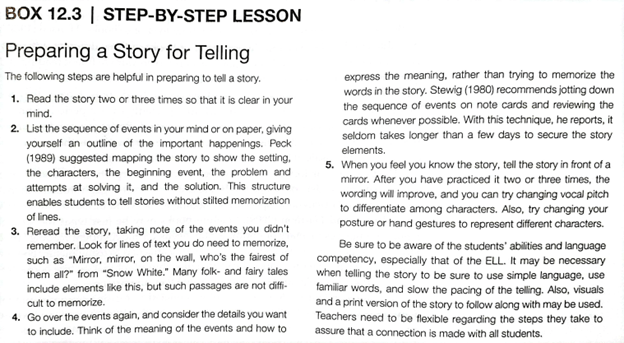
Helping Students Choose Just Right Books – There are several ways for teachers to help students choose the right books and students should be able to select books they can enjoy and from which they can get personally important information. In order to do this, teachers can tell exciting anecdotes about authors, provide previews of interesting stories, show videos about stories, suggest titles of stories that match students’ interests, encourage author searches on the internet, share leveled book listings, or compile teacher-or student-annotated book lists. Teachers also need to know their student’s interests as well as be well versed in children’s and adolescents’ literature and informational texts.
Here are a few videos to learn more about helping children select books:
Selecting Good Fit Books – https://www.youtube.com/watch?v=rwtHGh0PVHo
Student reading to determine a good fit book with five finger check – https://www.youtube.com/watch?v=6cW3E9xOMvA
PICK – https://www.youtube.com/watch?v=p-Gj0-h5JV0
Core Books – A collection of books at a grade level which are to be read by every student at that grade level. *Or, a collection of books that forms the nucleus of a school reading program at each grade level; usually selected by a curriculum committee. These core books are taught within the framework of whole class study across disciplines and students have little or no choice in selecting the books.
Literature Units – Lessons organized around book collections featuring unifying elements such as genre, author, or conceptual theme. The teacher chooses the theme and gets a collection of books around that theme (genre, author, conceptual theme). The students, however, have options as to what books to choose from the collection and what activities they might pursue. Literature units are also known as thematic instruction or integrated instruction.*Thematic Instruction – Another name for literature units.*Integrated Instruction – Another name for literature units. Literature Circles – Discussions or study groups based on a collaborative strategy involving self-selection of books for reading; each group consists of students who independently selected the same book. In literature circles, students choose the book they want to read out of a selection and groups are formed. Typical groups are 3-4 elementary students and 4-5 middle school students. Then roles are assigned to the students. These roles include discussion leader/director, literary luminary or passage monitor, connector, and illustrator or word wizard. Students read the text (in class or on their own) and discuss what they have read in the literature circle. Roles in Literature Circles – the roles utilized in literature circles vary depending on the purpose of the circle, the reading, and the students. Generally, there will be a leader who leads the discussions, a student who monitors the text to assure that the discussion relates to the specific sections of the text, and a student who tries to connect the discussion to real life experiences and other literature. Finally, the illustrator creates a visual representing the group’s responses. Reading Workshop – An organizational framework which allows readers to demonstrate their use of reading strategies by responding to books and sharing meaning with others. There are also several components to a reading workshop:Minilessons: The teacher demonstrates a reading strategy through explicit teaching. The topic of the lesson comes from the teacher’s observations of what the students need. Status-of-the-Class Report: Students check-in and let the teacher know what they will be working on during the readers workshop. Sustained Silent Reading: Everyone is reading silently. Individual Reading Conferences: A student meets with the teacher to discuss what they are reading. Group Sharing Time: Students share what they are reading about and make recommendations to other students.Below are two videos going over reading workshops: Rick’s Reading Workshop Overview – https://www.youtube.com/watch?v=TSfJBAhFNXA Reader’s Workshop Mini Lesson – https://www.youtube.com/watch?v=qVClhemUhjY&t=8s
Responses to Literature – Teachers must design strategies for encouraging readers to respond to texts. They also need to lead students in classroom experiences in which they analyze their personal reactions to what they have read. Every reading event or transaction involves a reader and a text. In any reading event, the reader adopts one of two stances: the efferent stance or the aesthetic stance. With an efferent stance, attention is focused on accumulating what is to be carried away from the reading. Readers using this stance may be seeking information. In an aesthetic stance, however, readers shift their attention inward to center on what is being created during the reading. Reading is driven by personal feelings, ideas, and attitudes that are stirred up by the text. Also, in most reading situations, there is both an efferent and an aesthetic response to the text.
Read-Response Theory – A theory that proclaims that the reader is crucial to the construction of the literary experience. Readers must be given the opportunity to respond to what they are reading to have a deeper understanding of what they read. In this theory, the reader actively creates meaning by relating to his or her knowledge as well as past experiences. The reader is thinking about, predicting, and verifying those predictions while actively creating meaning.
*Other responses to literature include book-talks, free response, and literature journals.
***Other notes from the weekly readings:
Surrounding Children with Text
An important aspect of bringing children and text together to create a community of readers and writers is to create a learning environment that is print rich and provides a wide variety of literature.
Surrounding your students with a variety of texts and a variety of ways to engage with texts can be challenging, but here are a few starting points.
Begin a Classroom Collection of Books
Begin by collecting a variety of books, including a wide range of reading levels, now while you are still completing your degree. By doing this, you will
Here is a great video on how to build your classroom library: https://youtu.be/oxASP-p0H08.
Listening to Text:
Class read alouds are important at any grade level. In order for students to benefit the most from listening to text read aloud, teachers should:
Prepare to read aloud. Practice in front of the mirror or with others. Make sure you use character voices if needed and expression.
Set the mood. Build some anticipation about the story. Make sure students are comfortable where they are situated. Can they find their own space to listen to the story?
Introduce the story. Give some teasers about what the story might be about. Review the cover and discuss some of the illustrations to intrigue students and build interest.
Encourage students to respond to text. While reading take time to pause after significant events in the story, or at the end of each chapter and discuss what students are feeling about it. What do they think might happen next? Did their previous predictions come true?
Another way to have students listen to texts is to listen to audiobooks. Of course, you can purchase these, but that can get expensive. You can create your own for FREE by using the free audio editor Audacity. You can download it for free using this link https://www.audacityteam.org/download/. Here is a link to record your own audiobooks with Audacity: https://youtu.be/KmsfqRxFSI8
Storytelling
Storytelling is more than just reading a story. There is a long historical tradition of oral storytelling in many cultures, and telling stories should be encouraged and shared in the classroom. There are many tools for sharing stories and the classroom should have many of these available to children.
Flannel/Feltboards are great for engaging students in storytelling and story making.
Tell and Draw Stories – these are stories that you draw as you tell them. One of the most well-known is the story BINGO.
This blog has quite a few different storytelling methods and is a good place to start if you are unfamiliar with these http://meusenotes.blogspot.com/p/draw-and-tell-stories.html
Helping Children Select Books
Have students use the ‘Goldilocks Strategy’ to choose a text to read. This strategy helps students choose the text that is just right for them, it is not too hard, not too easy, it is just right.
Selecting Multicultural Literature
Schools are more culturally diverse now than ever before, and through the inclusion of multicultural literature in the class library fiction collection, teacher can ensure they provide their students with texts that represent the culturally diverse classrooms and home environments in this country, and those across the globe. With recent global events, it has become increasingly important that students do not become ethnocentric. Exposure to a variety of multicultural literature can assist in breaking down cultural barriers.
Likewise, multicultural literature can also assist students with their identity formation (Hseu & Hetzel, 2000). Identity formation is important in the social development of all children, as it gives them a sense of belonging and acceptance in society. Inclusion of multicultural literature in library collections confirms that the beliefs and experiences of minority students are valued (Steiner, 1998). When students see themselves reflected in the pages of literature, they are more likely to engage with a text. Familiar concepts in multicultural literature help to build security, familiarity, and confidence, which can lead to an improvement in student learning (Agosto, 2007).
There are several criteria though for selecting multicultural literature that is appropriate and does not stereotype cultures. When considering texts to include in your library ask yourself the following questions:
References
Agosto, D. E. (2007). Building a multicultural school library: issues and challenges. Teacher Librarian, 34(3), 27-31.
Hseu, M., & Hetzel, J. (2000). Bridging the Cultural Divide Through Multicultural Children’s Literature. http://buddies.org/articles/Literature.html
Steiner, S. F. (1998). Who Belongs Here? Portraying American identity in children’s picture books. Multicultural Review, 7(2), 20-27.
Organizing for Text-Based Instruction
Organizing patterns for text-based instruction vary from structured whole class studies of core books to independent reading of self-selected books in literature units and literature circles.
Literature Circle Roles
Within the literature circle students take on a variety of roles. While students may maintain the same role throughout the duration of their literature circle time, particularly in the early elementary grades, as they become more familiar and competent at the process, they can organically switch roles in the moment as the need arises.
Some common literature circle roles include:
Encouraging Response to Literature
Louise Rosenblatt (1982) was one of the earliest proponents of the reader-response theory. She believes that the reader actively creates meaning by relating to his or her knowledge as well as past experiences. The reader is thinking about, predicting, and verifying those predictions while actively creating meaning. Ways to encourage this are:
Classroom Application – The biggest take away for me this week in regards to reading and classroom literature application would be about selecting hey classrooms collection of books. Teachers should not just fill classroom libraries with as many books as they can so that they’re overflowing with books, but they also shouldn’t fill them with random books as well. Books should be chosen for the classroom library with a purpose. Whether that purpose be a certain learning unit or something else educational related, these classroom libraries should include books with a variety of reading levels, types of books, and contain multicultural themes. Both the teacher and the students should also enjoy these books. Our classrooms are becoming more and more diverse, and children love hearing and reading stories about children like themselves. I also think it’s still important that students still read many of the old great classics, but only if it’s purposeful. We shouldn’t read The Old Man and the Sea, The Great Gatsby, and Where the Red Fern Grows just because all other previous generations of students read them. We should be reading them because the stories have a great lesson or brilliant descriptive writing. Students won’t want to read an old boring book just because a teacher said so. They should be intrigued by storylines, plots, and great characters. Taking charge of building an effective classroom library is no quick and easy task. Teachers should be making notes about which books work and which books don’t for their future classrooms.
Video Notes
The video “How to Organize Your Classroom from Instructor Magazine” brings us to two elementary schools to see how real and effective teachers organize their classrooms. It offers insight on how to create an effective and organized classroom while also making it comfortable for students to help with their learning. Some of the tips from the video include decluttering the classroom, utilizing storage solutions, creating designated spaces for things, and making the classroom accessible for students. It also mentions having students be a part of the process to create a sense of community in the classroom as well. Overall, great brief video full of tips and tricks.
The brief video “How to choose a good-fit book” gives teachers and children advice on how to select appropriate books. Students need to pick books that aren’t too difficult or too easy as well. The video describes using the “Five Finger Rule” to help choose a good-fit book as well as providing examples of different genres and topics that children might be interested in.
Similar to the previous video, this video describes how to pick a “just right book”. It mentions the five finger rule again while also detailing how and why students should pick books that they are interested in to keep them engaged and motivated to keep reading.
The video “1 Rick’s Reading Workshop Overview” shows us a fantastic teacher doing an effective lesson. In this video Rick details and describes the many aspects of his reading workshop and the importance of creating a positive and engaging reading environment. One key detail Rick describes is the importance of letting students choose their own books. His lesson starts off with a reading skill mini lesson before moving on to independent reading time. Rick then works with several students during small group instruction time and provides many strategies to help support student learning. Another great video overall that had many good ideas.
The video “Rick’s Reading Workshop Mini Lesson” is another great video with Rick doing a mini-lesson during his reading workshop. This mini-lesson teaches students about characters and character development. Rick asks the students many questions during this mini-lesson to get the students to think about the characters and to examine the characters actions, thoughts, and feelings. Asking questions encourages student participation and helps the students stay engaged. Providing the students with explicit instruction can also help further develop their reading skills and is critically important for student learning. Great video overall from an effective classroom teacher.

 Travis Davis ENGED 275