Chapter 2: The Reading and Writing Processes


The Reading Process – The reading process involves a series of 5 stages during which the readers comprehend the text.  The goal is comprehension, understanding text, and being able to use it for the intended purposes. This process involves using phonemic awareness and phonics, word identification, fluency, vocabulary, and comprehension.  They also use the phonological system to assist with reading and understanding. 

Phonemic Awareness – The ability to manipulate the sounds in words orally. 

Phonics – Predictable relationships between phonemes and graphemes. The relationship between a sound and the letter(s) representing it is also called the phoneme-grapheme correspondence.

Word Identification – Strategies students use to decode words. Students also recognize common and high frequency word automatically and use phonics and word parts to decode unfamiliar words.

Fluency – Reading quickly, smoothly, and with expression.  Students become fluent readers once they can recognize most words automatically. This also frees up their cognitive resources for comprehension instead of decoding words.

Vocabulary – The meaning of words students are reading.  Knowing the meaning of words helps students comprehend better because it is difficult to understand the text when the words don’t make sense. 

Comprehension – The process of constructing meaning using both the author’s text and the reader’s knowledge for a specific purpose.  To understand what they are reading, students use a combination of reader and text factors.  They predict, connect, monitor, and repair as well as using their knowledge of genres, patterns, and literary devices.  


The Five Stages of the Reading Process:

Stage 1: Prereading

  • Students active or build background knowledge and related vocabulary
  • Think about the genre for a better understanding
  • Set purposes
  • Introduce key academic vocabulary words
  • Make predictions about characters and events
  • And preview the text by flipping pages and looking at headlines

Background Knowledge – General and specific knowledge that the student already knows.  General knowledge or world knowledge is what they students have acquired through life experiences and specific knowledge is literary knowledge, or what students need to read and comprehend a text. 

Stage 2: Reading

  • Read independently or with a partner
  • Reading with classmates using shared or guided reading
  • Listen to the teacher read aloud
  • Read the entire text or specific sections depending on the purpose
  • Apply reading strategies and skills
  • Examine illustrations, charts, and diagrams

Interactive Read-Aloud – During interactive read alouds teachers read books that are developmentally appropriate but written above students’ reading levels.  And, even though the teacher is reading the students are still being actively engaged through questioning, making predictions, identifying ideas, and making connections.  Read-alouds are important because they benefit students of all ages.

Shared Reading – During shared reading, the teacher will read a book that the students cannot read independently on their own while the students follow along with their own copy.  The teacher models how the students should read and at what pace.  After the teacher reads the book or story multiple times, the students can begin to join in the reading as well.

Guided Reading – These are 25-30 minute lessons with four or five students who read at the same level.  The students do the reading themselves and they use books that the students can read with 90-94% accuracy.  The teacher will observe each of the students for a few minutes to check their fluency skills among other things as well as their attempts to identity words and solve reading problems.  These observations can be helpful for teachers to plan future lessons as well as interventions. 

Stage 3: Responding

  • Write in reading logs
  • Participate in grand conversations or other discussions

In stage 3, students are responding to their readings by writing in reading logs and participating in classroom discussions. Reading logs are used by students to keep track of what they are thinking and feeling throughout readings.  Grand conversations are a part of discussions as well.  Students will talk with their classmates about stories and poems they have read and may explain what they liked/didn’t like about a text as well as personal reactions. 

Stage 4: Exploring

  • Reread all or part of the text
  • Learn new vocabulary words
  • Participate in minilessons
  • Examine genre, other text features, or the writer’s craft
  • Learn about the author
  • Collect memorable quotes

In this stage, students will go back and reread their text to examine it more analytically.  This stage is more teacher led than others.  Many times the teacher will ask the students questions like: What was the author’s purpose? What were the main ideas and structural elements?  And How appropriate was their word choice and sentence structure?

Word Wall – This one is quite straight forward. It is a wall full of important words posted on it in the classroom. Students can refer to it when they write and use the words for different activities.  A word wall is especially important when students are learning new vocabulary throughout the year. Students can even add words to the word wall for future situations.  The word wall can also significantly cut back on student interruptions from them not knowing how to spell several words. Instead of raising their hand to ask how a word is spelled or interrupting, they can now check the word wall first. 

Word Sorts – A word sort is a simple activity where individuals or groups of students have a list of words in which they need to identify the meanings.  They then have to sort the list of words into collections or categories of words with similar features. 

Mini lessons – These are short lessons in which concepts, procedures, strategies, and skills are taught.  They shouldn’t be more than 10 minutes long. They are to introduce a topic and make connections between the topic and previous selections or ideas.

Stage 5: Applying

  • Construct projects
  • Read related books
  • Use information in thematic units
  • Reflect on the reading experience

In stage 5, students are now applying what they have learned and creating projects to show competency and comprehension. They extend their comprehension, reflect on their understanding, and value the reading experience in this final stage.

Readers Theatre – During a readers theatre, students perform an excerpt from a book they have read.  They will usually act it out in front of the class as well. 


The Writing Process:
Simply stated, the writing process is a series of 5 stages that describe what students think about and what students do as they write.  However, the stages are not linear, and they involve recuring cycles. They are numbered to help when identifying writing activities.

The Five Stages of the Writing Process:

Stage 1: Prewriting

  • Choose a topic
  • Consider the purpose
  • Identify the genre
  • Engage in rehearsal activities to gather ideas
  • Use a graphic organizer to organize ideas

Stage 2: Drafting

  • Write a rough draft
  • Use wide spacing to leave room for revising
  • Emphasize ideas rather than mechanical correctness
  • Mark the writing as a “rough draft”

Stage 3: Revising

  • Reread the rough draft
  • Participate in revising groups
  • Work at one or more revising centers
  • Make substantive changes that reflect classmates’ feedback
  • Conference with the teacher

Stage 4: Editing

  • Proofread the revised rough draft with a partner
  • Work at one or more editing centers
  • Correct spelling, capitalization, punctuation, and grammar errors
  • Conference with the teacher

Stage 5: Publishing

  • Format the composition
  • Make the final copy
  • Share the writing with an appropriate audience

Stage 1: Prewriting

Simply stated, prewriting is the “getting ready to write stage.”  This is where students choose a topic, consider purpose and genre, and gather and organize ideas.  Students should choose their own topics for writing so that their more engaged, but sometimes teachers provide the topics. Then students should consider the purpose like whether their writing is to entertain, inform, or persuade.  Because different genres have varying distinctions, teachers should avoid calling all writings “stories.” Students finally gather and organize ideas during the prewriting stage.  They will often draw pictures, brainstorm lists of words, read books, do internet research, and talk about ideas with classmates. 

Stage 2: Drafting

This stage is where students get their ideas down on paper or a computer writing program and write a first draft of their composition.  These drafts are usually messy, and students will often skip every other line when writing leaving room for corrections.  Using computer to compose rough drafts, polish their writing, and print out final copies has many benefits as well.  Students are often more motivated, write longer pieces, their writing looks neater, and they tend to use spell-check programs to correct misspelled words. 

Stage 3: Revising

During this stage, writers refine and revise their ideas in their compositions.  Revision isn’t polishing, however. It’s adding, substituting, deleting, and rearranging material.  Revisions also consist of three activities: rereading through a rough draft, sharing the rough draft in a revising group, and revising on the basis of feedback.  When rereading through a rough draft students will make changes and place question marks by sections that may or do need work and ask for help with these spots in their revising groups.  They then share their compositions with their revising group while the revising group suggests possible revisions.  Next the students make the changes to their works.  There are four types of changes to their rough drafts: additions, substitutions, deletions, and moves. Lastly, the students visit revision centers the teacher has set up where they can either talk with their classmate/s about the ideas in their rough draft, examine the organization of their writing, consider their word choice, or check that they’ve included all required components in the composition.  Teachers will usually setup a checklist of revising and editing center options for their students like looking at word choice, using graphic organizers, highlighting, sentence combining, spelling, homophones, punctuation, capitalization, and sentences.

Stage 4: Editing

This editing stage involves putting the piece of writing into its final form. After the focus has changed from the content of the writing to the editing and mechanics students polish their writing by correcting spelling mistakes and other mechanical errors.  Some of these involve capitalization, punctuation, spelling, sentence structure, usage, and formatting considerations specifically for poems, scripts, letters and other writing genres.  Then the students move through two other activities: proofreading to locate errors and correcting the errors they find.  Proofreading is a unique type of reading in which students read word by word to hunt for errors rather than reading for meaning.  This can be difficult even for experienced readers so teacher modeling and demonstrating is crucial.  After proofreading students then attempt correct any errors they find, but they may need assistance from other students, teachers, or even dictionaries. 

Stage 5: Publishing

The final stage of the writing process is publishing. In this stage students bring their writing to life by creating final copies and sharing them, often orally, with others.  When they share their writing with real audiences of classmates, teachers, parents, and community members, students think of themselves and real authors.  This is a very powerful motivator for students to continue writing and improve upon their quality.  Some ways students can publish and share their writings are by making books, publishing their writings online, reading to parents and siblings, displaying their writing on posters or bulletin boards, and displays at school.


Reading and Writing Strategies – Reading and writing are complex, thoughtful processes that involves both strategies and skills. Strategies represent the thinking that students do as they read and write while skills are quick automatic behaviors that don’t require any thought.  Strategies are deliberate, goal-directed actions. Students exercise control in choosing appropriate strategies, using them effectively and monitoring their effectiveness, and these strategies are linked to motivation as well.  In contrast, skills are automatic actions with an emphasis on effortless and accurate use. 

Here are several reading strategies students can use throughout the reading process that highlight the kinds of thinking students engage in:

  • Decoding Strategies – Students use strategies such as phonics and morphemic analysis to identify unfamiliar words
  • Word-Learning Strategies – Students apply strategies such as analyzing word parts to figure out the meaning of unfamiliar words
  • Comprehension Strategies – Students use strategies such as predicting, drawing inferences, and visualizing to understand what they’re reading
  • Study Strategies – Students apply strategies such as taking notes and questioning  to learn information when they’re reading content area books

Here are several writing strategies students can use throughout the writing process to purposefully draft and refine their writing. 

  • Prewriting Strategies – Students use prewriting strategies like organizing to develop ideas before beginning to write
  • Drafting Strategies – Students apply drafting strategies like narrowing the topic and providing examples to focus on ideas while writing the first draft
  • Revising Strategies – Students use revising strategies like detecting problems, elaborating ideas, and combing sentences to communicate their ideas more effectively
  • Editing Strategies – Students apply strategies like proofreading to identify and correct spelling and other mechanical errors
  • Publishing Strategies – Students use strategies like designing the layout to prepare their final copings and share them with classmates and other authentic audiences

Videos

Phonological Awareness and Phonics – https://youtu.be/yS46jqYfZDg

Right at the beginning the presenter describes how phonological awareness is speech awareness.  She also mentions that students need to be aware that speech can be broken up into smaller pieces like sound components.  These components can then be broken down into words, words into syllables and syllables can be broken up to individual components.   

Difference Between Phonemic Awareness and Phonics – https://www.youtube.com/watch?v=LyeFoJkbqOo

This video shows us a great example of a phonemic awareness and phonics lesson where the students would break down words into individual sounds and speak aloud the individual sounds. They were also working on phonics by looking at the letters and answering the questions.  They even substituted during the exercise which is another great lesson for participating students


How I Would Use This In My Classroom

One of the biggest ideas the stood out to me this chapter was the fact that prewriting has probably been the most neglected stage in the writing process and that students should be spending 70% of their writing time prewriting.  This prewriting stage is something that I have struggled personally with for a very long time. I would either not plan enough for my writings and work on the outline or rough draft as I go or I would plan too much and make notes on everything before even getting started.  Because that is what I struggle/ed with and have observed others struggling as well, I would like to focus on that with my students. 

I also liked the part about the writing genres.  I think I would like to spend a bit of time on that with my students as well.  I feel like I may have missed some of those important parts of learning the writing process and don’t want my students to miss out on that either.

One last bit of super useful information is about all the different types of reading there is to do with students.  When it comes to reading aloud to students, shared reading, guided reading, partner reading, and independent reading, they each have their strengths and weaknesses.  Thoroughly understanding these will help teachers become more effect.  I also thought it was interesting to think about some of those different types of readings and how they would be used in the classroom.  For example, would some of these work better in smaller classrooms or during intervention time?
Chapter 1: Becoming an Effective Teacher of Reading – Part 2

Principle 5 – Effective Teachers Address Standards

The Common Core State Standards are a clear set of shared goals and expectations for the knowledge and skills students need in English Language Arts and Math at each grade level so they can be prepared to succeed in college and in the workforce.  These standards have identified the knowledge the students are expected to learn at each grade. But they do not tell the teachers how the information and materials should be taught. These standards are also researched based and include rigorous content.


Principle 6 – Effective Teachers Scaffold Students’ Reading and Writing

Scaffolding – Simply stated, scaffolding is the way teachers help students by varying the amount of support they provide depending on the students’ needs and the lesson.  Teachers will demonstrate, guide, and teach while also modeling how experienced readers read and proofread their writings.  Also, there are five levels of support when it comes to scaffolding: modeled, shared, interactive, guided, and independent. 

  • Modeled Reading and Writing – Teachers will model how expert readers read by reading with expression and reading fluently. They will model writing by writing a composition so everyone can see it (on a smartboard or chart paper), creating the text, doing the writing, and thinking aloud about their use of different writing strategies and skills.
  • Shared Reading and Writing – In shared reading, a teacher will read a story and do most of the reading with the younger children joining in to read familiar and predictable words and phrases. With older students, when a novel is too hard to read independently, the teacher will read aloud while students follow along, reading silently when they can.  With shared writing, the teacher will use the Language Experience Approach, where the teacher writes what a student talks about on their artwork or journals for them, and they will use KWL charts where the students and the teacher discuss and write down things they Know about a subject or topic, they Want to know about a subject, and at the end they will write about things they Learned about the subject.  The purpose of shared writing is to involve students in literacy activities they can’t do independently, create opportunities for students to experience success in reading and writing, and to provide practice before students read and write independently. 
  • Interactive Reading and Writing – During interactive reading and writing students assume an increasingly important role by actively participating with their teacher and classmates.  The reading instructional texts together and take turns doing the reading while the teacher helps them read with expression.  They also create text and share the pen to do writings with the teacher and their classmates.  They also spell words correctly while also adding capitalization, punctuation, and other conventions.  The purpose of this interactive reading and writing is for students to practice reading and writing high-frequency words, apply phonics and spelling skills, read and write texts that students can’t do independently, and have students share their literacy expertise with their classmates. 
    • Choral Reading – Students take turns reading
    • Readers Theatre – Students assume the roles of characters and read lines in a script
    • Interactive Writing – Students and the teacher create a text and write a message together.  The text is composed by the group and the teacher assists as students write down text on chart paper.
  • Guided Reading and Writing – The students are doing the reading and writing themselves while the teacher is only providing support and observing them.  In guided reading the teacher will meet with the students in small homogenous groups where they will read a book as the teacher guides them as they read.  In guided writing, the teacher will structure the activity and supervise students as they complete writing activities and often provide feedback. Teachers use guided reading and writing to support students’ reading in appropriate instructional-level materials, teach literacy strategies and skills, involve students in collaborative writing projects, and to teach students to use the writing process with revising and editing. 
    • Mini Lessons – During a mini lesson, the teacher will provide practice activities and supervise as students apply what they’re learning.
  • Independent Reading and Writing – At the independent stage, students do the reading and writing themselves.  They choose their own books to read, work at their own pace, choose their own writing topics, and move at their own pace.  While the students do all of the work the teacher is still continuing to monitor and guide their works.  Teachers use this independent reading and writing to create opportunities for students to practice literacy strategies and skills, provide authentic literacy experiences, and to develop lifelong readers and writers. 

    *These five levels of support illustrate the gradual release of responsibility as the students move from modeled to independent reading and writing.  As the students do more of the reading and writing the teachers gradually transfer responsibility to them.

Principle 7 – Effective Teachers Organize for Instruction

Effective teachers organize for instruction by creating their own program to fit the needs of their students and their school’s standards and curricular guidelines.  The principle of these programs is for teachers to create a community of learners in their classrooms, for teachers to incorporate the components of the balanced approach, and for teaches to scaffold students’ reading and writing experiences.  The five most popular of these programs are guided reading, basal reading programs, literature focus units, literature circles, and reading and writing workshops

Guided Reading – Guided reading is often a 20-minute lesson with small groups of students who read at approximately the same levels for teacher directed lessons.  These lessons include word-identification and comprehension strategies. The goal of these lessons is usually for students to understand what they are reading, which we call comprehension, and not just saying the words correctly. 

Basal Reading Programs – These are commercial produced reading programs that feature a textbook of reading selections with accompanying workbooks, supplemental books, and related instructional materials at each grade level.  These programs focus on phonics, vocabulary, comprehension, grammar, a spelling instruction and are often aligned with grade-level standards.  These also come with testing materials to monitor student’s progress. 

Literature Focus Units – Teachers create literature focus units by picking books from a district- or state-approved list of award-winning books that all students are expected to read. These books include: The Very Hungry Caterpillar, Charlotte’s Web, Officer Buckle and Gloria, Holes, and Flora and Ulysses.  Everyone reads the same book, and the teacher supports students learning through explicit instruction and reading and writing activities.  Through these units teachers teach about literacy genres and authors, and they develop students’ interest in literature. 

Literature Circles – In literature circles, a teacher will select fire or six books of varying levels that are often related for small groups of students to read.  They will give a book talk to introduce them before forming a group and responding to the book.  They will set up a reading and discussion schedule where they work independently while a teacher sometimes sits in on them.  Literature circles will help students develop responsibility for completing assignments.

Reading and Writing Workshop – Students do authentic reading and writing in workshop programs.  They select books, read independently, and conference with their teacher about their reading and write books on topics their choose.  In these programs students read and write more like adults do while making choices and working independently and responsibly. 

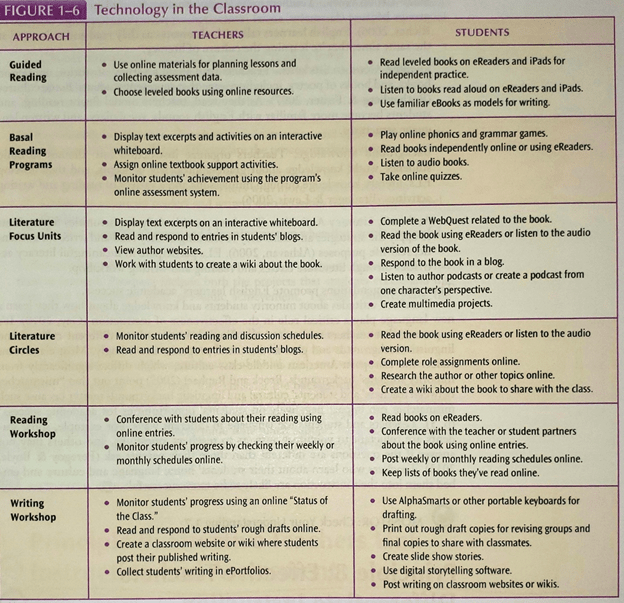
Incorporating Technology Into Instruction is another crucial part of balanced literacy instruction.  They often include digital software, the internet, and computer technology.  They help by presenting information to students, scaffolding students’[ reading and writing, involving students in activities and projects, responding to students’ work, and assessing students’ achievements. 

Below is a figure detailing the different organizational programs and how they could use technology in the classroom:

Nurturing English Learners – English learners benefit from participating in the same instructional program that mainstream students do. It is also more difficult for them to learn to read and write English because they are learning to speak English at the same time.  There are, however, a few ways teachers scaffold oral language acquisition and literacy development together.  By using explicit instruction, providing many opportunities for oral language participation, having students work in small groups, reading aloud to the students, having some background knowledge, and having authentic literacy activities.  Teachers attitudes about minority students also plays a critical role. 


Principle 8 – Effective Teachers Differentiate Instruction

Effective teachers adapt their lessons and adjust their instruction because students vary in their levels of development, academic achievement, and ability.  If instruction is either too easy or too hard their students won’t learn anything.  Teachers differentiate their instruction by varying the content, varying the process in which the lessons are taught, or students are challenged, and they vary the product and how students demonstrate what they have learned.  A one-size-fits-all instructional model is obsolete, and differentiation is needed. 


Principle 9 – Effective Teachers Link Instruction and Assessment

Assessment is the collecting and analyzing data to make decision about how children are performing and growing.  We use these assessments to determine students’ reading levels, monitor students to make sure they are making progress, diagnose students’ progress in specific subjects, evaluate students’ achievement, and document students’ achievement.  Teachers collect and analyze this data from observations, conferences, and classroom tests. They then use the data to make decisions and plan interventions. 

Linking Instruction and Assessment in Four Steps – Assessment is linked to instruction and some teachers do assessments before they teacher, some while they teach, and others afterwards.  There is a cycle to assessments that includes four steps as well. 

  • Step 1: Planning – Teachers use their knowledge about students’ reading levels, their background knowledge, and their strategy and skill competencies to plan appropriate instruction that is neither to easy nor too difficult. Simply stated, step one involves teachers planning for future instruction using the knowledge they already have.
  • Step 2: Monitoring – Teachers monitor instruction that’s in progress by observing students, conferencing with them, and checking their work to make sure their instruction is effective.  They then make modifications like reteaching to improve the quality of their instruction.
  • Step 3: Evaluating – Teachers evaluate students’ learning using rubrics and check lists to assess students’ reading and writing projects and administering teacher made tests. They also collect samples to document students’ achievements.  Simply put, stage three involves checking things to make sure they are working and if not figure out why. 
  • Step 4: Reflecting – Teaches judge the effectiveness of their instruction by analyzing students’ reading and writing projects and test results and consider how they might adapt instructions to improve student learning.  Simply stated, stage four involves teachers reflecting on whether or not their instructional strategies and assessments helped and could they have been better. 

When it comes to the assessment tools that teachers have available to them, there are many choices. They can use observations of students as they participate in instructional activities, running records of students oral reading to analyze their ability to solve reading problems, examination of students’ work, conferences to talk with students about their reading and writing, checklists to monitor students’ progress, and rubrics to assess students’ performances, written products, and multimedia projects. These Running Records are a type of assessment where the teacher is taking many notes about what the student is saying and doing during an oral reading. Rubrics on the other hand assess the student’s performance by noting how well they did on an assignment or project.


Videos – These were the most impactful videos to me that I believe I will actually be able to put to use in the early childhood classrooms in which I hope to teach in. 

Interactive Writinghttps://youtu.be/s4FsR1xiI5o

In this video the teacher is going over a lesson with the whole class.  In this interactive writing lesson, the teacher asks many open-ended questions, calls on students to answer some of the questions and participate in writing answers on the board, and includes the whole class to participate in answering other questions and suggesting answers. This interactive lesson is great because she teaches them details of good writing, models good writing, and guides them to use the strategies on their own. She also greatly engages the students throughout by varying her pitch and tone while also using her scaffolding skills when asking questions and helping them.

A Day in the Life of Our Writing Workshophttps://youtu.be/s4FsR1xiI5o

This video shows some great examples and ideas for creating writing workshops and doing a quick focus lesson for 5 to 10 minutes before letting the students begin their writings. Some of her great ideas involve letting discussing how writers get their ideas, when to revise their writing, how the students get comfortable, conferencing with them while they are writing, sharing with listening partners offering suggestions and praise, publishing their works around the room, using mentor texts to model good writing and writing with their friends. The video had many great examples with many great pictures showing what the students would be and are doing.

Choral Readinghttps://youtu.be/o_-z8d0sRUA

Choral reading is very effective when working with young students.  The book should be relatively short and not too difficult (age appropriate) while also having a bit of rhythm or dialogue. Each student must also have their own copy of the book. This teacher was being very effective by modeling how the students should be reading aloud while also telling the students that she will be modeling how the reading will go first.  After the teacher reads the book, the students will all read together in unison while the teacher pays close attention to pacing, fluency and expression.  This was a fantastic example of how choral reading should be done. 

Readers Theatre Scriptshttp://www.readingrockets.org/strategies/readers_theater

This website contained some amazing information for real world classroom instruction.  It described the benefits of readers theatre like how it promotes fluency, helps readers learn to read with expression, and builds confidence.  It also describes how to integrate readers theatre as a technique for math problems as well.  There was even a section on differentiation with English language learners and those with varying reading skills.  I have book marked this website and definitely plan to use it in the future.

The video example with the shared reading was another great example of textbook reading strategies in real life. 


How would we use these things in the classroom?

One of the best bits of information that will apply directly to all classroom teachers is the effective use of scaffolding.  Scaffolding is the way teachers help students by varying the amount of support they provide.  This can be a tough one for teachers to deal with because they want to help their students and they want them to succeed, but they can’t just give them the answers.  One of the ideas in the shared reading and writing support level includes KWL charts.  I have seen a few teachers do these with theirs and this is a great way to spark interest in their students and to see how much they know.  Another great bit of information was with use of technology in the classroom.  The use of technology in the classroom can be very effective and Figure F 1-6 has some great information.  One part I liked was the mention of listening to audiobooks and podcasts.  Having the book on hand and listening to the audio version of it can be effective for different learners.  They can also better relate to and find out cool facts about the author or the book too. 

Introduce Yourself (Example Post)

This is an example post, originally published as part of Blogging University. Enroll in one of our ten programs, and start your blog right.

You’re going to publish a post today. Don’t worry about how your blog looks. Don’t worry if you haven’t given it a name yet, or you’re feeling overwhelmed. Just click the “New Post” button, and tell us why you’re here.

Why do this?

  • Because it gives new readers context. What are you about? Why should they read your blog?
  • Because it will help you focus you own ideas about your blog and what you’d like to do with it.

The post can be short or long, a personal intro to your life or a bloggy mission statement, a manifesto for the future or a simple outline of your the types of things you hope to publish.

To help you get started, here are a few questions:

  • Why are you blogging publicly, rather than keeping a personal journal?
  • What topics do you think you’ll write about?
  • Who would you love to connect with via your blog?
  • If you blog successfully throughout the next year, what would you hope to have accomplished?

You’re not locked into any of this; one of the wonderful things about blogs is how they constantly evolve as we learn, grow, and interact with one another — but it’s good to know where and why you started, and articulating your goals may just give you a few other post ideas.

Can’t think how to get started? Just write the first thing that pops into your head. Anne Lamott, author of a book on writing we love, says that you need to give yourself permission to write a “crappy first draft”. Anne makes a great point — just start writing, and worry about editing it later.

When you’re ready to publish, give your post three to five tags that describe your blog’s focus — writing, photography, fiction, parenting, food, cars, movies, sports, whatever. These tags will help others who care about your topics find you in the Reader. Make sure one of the tags is “zerotohero,” so other new bloggers can find you, too.

Design a site like this with WordPress.com
Get started