Nurturing Children’s Oral Language Development
Simply stated, young children learn and develop their oral language skills through everyday experiences and interactions with people. They learn words from their parents, their grandparents, workers at the grocery store, and ever while watching certain educational TV shows like Super Why, Blue’s Clues, and Daniel Tiger’s Neighborhood. Through these experiences they develop expertise in all four language modes:
- Phonology – Children learn to produce sounds and manipulate language in playful ways
- Syntax – Children learn to combine words into different types of sentences and to use irregular verb forms, pronouns, and plural markers and other influential endings
- Semantics – Children acquire knowledge about the meanings of words and add several thousand words to their vocabularies each year
- Pragmatics – Children learn to use language socially like when saying thank you and telling stories
Oral Language Activities – Children continue to learn and develop language through different literacy activities. Many of these activities involve reading and listening to stories read out loud. Here are some examples of the different ways students participate:
Shared Reading – During shared reading, the teacher will read a book that the students cannot read independently on their own while the students follow along with their own copy. The teacher models how the students should read and at what pace. After the teacher reads the book or story multiple times, the students can begin to join in the reading as well. There are also five strategies of the reading process in shared reading: prereading, reading, responding, exploring, and applying. During this shared reading experience the teacher will also be demonstrating concepts; pointing out letters, words, and punctuation marks; modeling strategies; and asking questions about concepts of print.
Interactive Reading – During interactive read alouds teachers read books that are developmentally appropriate but written above students’ reading levels. And even though the teacher is reading the students are still being actively engaged through questioning, making predictions, identifying ideas, and making connections. As students listen, they learn new vocabulary and acquire more sophisticated sentence structures. Read-alouds are important because they benefit students of all ages.
Choral Reading – This is a type of reading done within the classroom by having the students take turns reading aloud. As they read and reread text aloud, they become increasingly fluent readers.
Guided Reading – These are 25–30-minute lessons with four or five students who read at the same level. The students do the reading themselves and they use books that the students can read with 90-94% accuracy. The teacher will observe each of the students for a few minutes to check their fluency skills among other things as well as their attempts to identity words and solve reading problems. These observations can be helpful for teachers to plan future lessons as well as interventions.
Word Wall – This one is quite straight forward. It is a wall full of important words posted on it in the classroom. Students can refer to it when they write and use the words for different activities. A word wall is especially important when students are learning new vocabulary throughout the year. Students can even add words to the word wall for future situations. The word wall can also significantly cut back on student interruptions from them not knowing how to spell several words. Instead of raising their hand to ask how a word is spelled or interrupting, they can now check the word wall first.
Mini Lessons – These are short lessons in which concepts, procedures, strategies, and skills are taught. They shouldn’t be more than 10 minutes long. They are to introduce a topic and make connections between the topic and previous selections or ideas.
Literacy Concepts
Concepts Of Print – Young children learn that print has meaning and that reading and writing can be used for a variety of purposes by interacting and observing. They notice menus in restaurants, they listen to books and stories told by parents and teachers, and they observe teachers and parents using written language nearly every day. Here are some ways which teachers can foster this opportunity to experiment with written language and demonstrate the purpose of written language:
- Posting signs in the classroom
- Making a list of classroom rules
- Using reading and writing materials in literacy centers
- Exchanging messages with classmates
- Reading and writing stories
- Labeling classroom items
- Drawing and writing journals
- Writing notes to parents
Children also learn about how to hold a book correctly, where to begin reading, which direction to read in, and that the text and the illustrations have meanings.
Concepts About Words – Young children start off having vague notions of literacy terms like word, letter, sound, and sentence, but then they develop an increasingly sophisticated understanding of these terms as they develop through the four stages of word consciousness. First, they don’t differentiate between words and things. Next, they describe words as labels for things. Then, they understand that words carry meaning and that stories are made up of words. Finally, the more fluent readers and writers will describe words as having meanings of their own.
Young children also learn about the concept of words through environmental print. Students will often recognize the golden M or golden arches of McDonalds before recognizing the letters in their name. Young students also learn about writing by experimenting with their scribbles and letterlike forms to represent words. They then move on to phoneme-grapheme correspondence as they learn about letters and letter names. They also progress from capitalizing words randomly to using capital letters at the beginning of sentences and to mark proper nouns and adjectives. Young children also learn about literacy through play. They make signs for buildings they create, they play doctor and write prescriptions, they read and write stories for their stuffed animals, and they use food packaging while playing in the “Home and Family” center to describe the prices and use money.
Concepts About The Alphabet – While young children learn about the literacy, they develop concepts about the alphabet and how letters are used to represent phonemes. Here are the components of letter knowledge:
- The letter’s name
- The formation of the letter in both upper- and lowercase
- The features of the letter that distinguish it from other letters
- The direction the letter must be turned to distinguish other letters such as b and d
- The use of letter in known words
- The sound the represents in isolation
- The sound the letter represents in combination with others such as th, sh, and ch
- The sound the letter represents in the context of a word
Routines To Teach The Alphabet
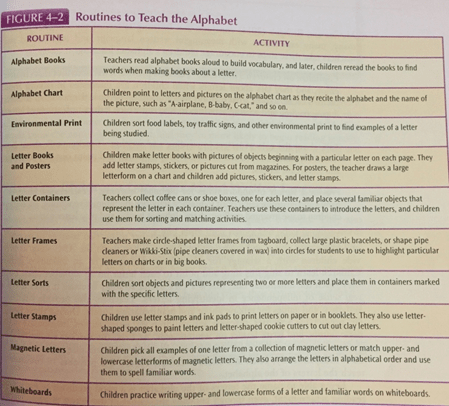
There are also some recommended steps teachers take to encourage children to learn the alphabet: Teachers should capitalize on the children’s interests, teachers should talk about the role of letters in reading and writing, and teachers should provide a variety of opportunities for alphabet learning.
Assessing Concepts of Written Language – While looking at and reading/rereading books teachers monitor their children’s developing knowledge about written language concepts. They also look at children as they are playing. Teachers look for how children pretend write and write their names. They also make note on which concepts children understand and which ones need continued learning and demonstrations. Teachers also use different test or assessments for their students as well. One such test is the Concepts About Print (CAP). Teaches read a book aloud and asks the child to point out different book concepts like directionality, orientation concepts, and word concepts.
How Children Develop as Readers and Writers
Young children move through three stages as they learn to read and write. First, during the emergent stage, they gain an understanding that print has communicative properties as they move from pretend reading to reading predictable books and from using scribbles to simulate writing to writing patterned sentences. During the second stage, beginning reading and writing, the focus is on the child’s growing ability to use phonics to decode and spell words. They also learn to read and write many high frequency words and write several sentences. Lastly, during the fluent stage, children are automatic, fluent readers and they develop good handwriting skills, spell many words correctly, and organize their writings into multiple paragraphed works.
The figure below summarizes the accomplishments in reading and writing at each development stage:
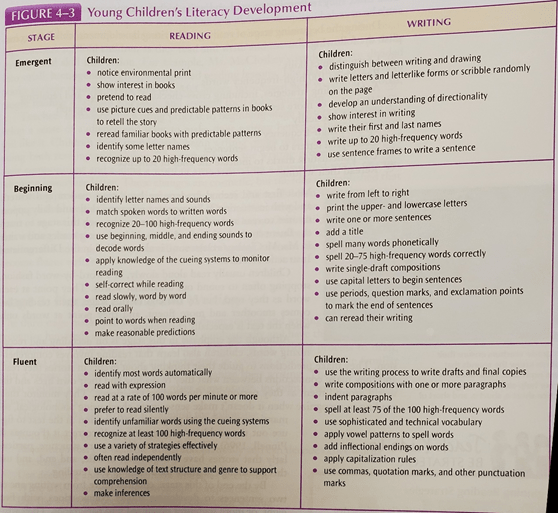
Stage 1: Emergent Reading and Writing – In this beginning stage, children begin to understand that print can be communicative, and they develop an interest in reading and writing. They learn that their speech can be written down and they notice environmental print all around them. Young children also begin to make scribbles. These scribbles look random, but with experience they begin to line them up left to right and from top to bottom of a page. During this emergent stage, children:
- Develop an interest in reading and writing
- Acquire concepts about print
- Develop book-handling skills
- Learn to identify the letters of the alphabet
- Develop handwriting skills
- Learn to read and write some high-frequency words
Stage 2: Beginning Reading and Writing – In stage 2, children grow and develop an awareness of alphabetic principles. They learn about phoneme-grapheme correspondences, phonics rules, and word families. They then apply their developing phonics knowledge to spell words. During the beginning of this stage 2 of reading and writing development, children will accomplish:
- Learning phonics skills
- Recognizing 100 high-frequency words
- Applying reading strategies
- Writing five or more sentences
- Spelling phonetically
- Spelling 50 high-frequency words
- Using capital letters to begin sentences
- Using punctuation marks to end sentences
- Rereading their writing
The emphasis in this stage is certainly on decoding and recognizing words, but children also learn that reading involves comprehension. They also make predictions to guide their thinking about events in the stories they read, they monitor their reading to recognize when things don’t make sense, and learn about story structure and how they often have a beginning, middle, and ending. By the end of the stage children move from writing one or two sentences to writing and organizing 5 to 8 sentences into paragraphs.
Stage 3: Fluent Reading and Writing Stage – This third stages marks the transition to fluent readers and writers. Fluent readers recognize hundreds and hundreds of words automatically while fluent writers draft, revise, and publish their writings using the writing process and revising groups. They also know how to use punctuation, capital letters, organize their writing, and are familiar with many genres. Fluent readers and writers accomplish the following in this stage:
- Read fluently and with expression
- Recognize most one-syllable words automatically and can decode other words efficiently
- Use decoding and comprehension strategies effectively
- Write well-developed, multi-paragraph compositions
- Use the writing process to draft and refine their writing
- Write stories, reports, letters, and other genres
- Spell most high-frequency and other one-syllable words correctly
- Use capital letters and punctuation marks correctly most of the time
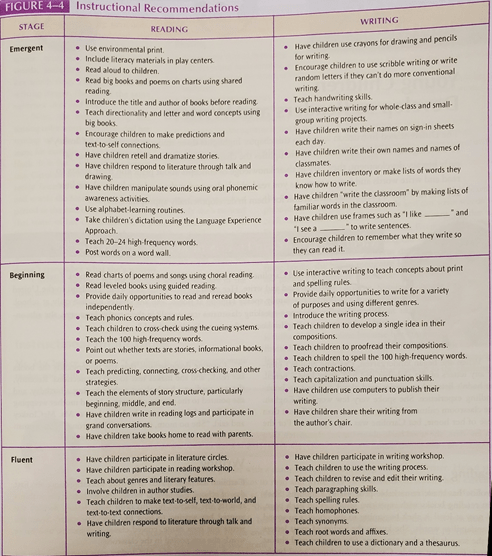
This fluency stage is reached by some second graders and should be reached by all third graders by the end of the year. This is a very important stage and milestone because this indicates that the children are ready for the greater literacy demands of fourth grade. There, students are expected to be able to read longer chapter books, use writing to respond to literature, read content area textbooks, and write essays. The distinguishing characteristic of fluent readers is that they read words accurately, rapidly, and expressively. Below is an extremely useful table full of instructional recommendations for these three stages for both reading and writing:
Revising Groups – Revising groups involve students meeting and sharing their compositions with classmates. The group members respond to the writer’s rough draft and suggest possible revisions. These writing and revising groups are great because they provide a scaffolding opportunity for both students and teachers to help each other. They talk about plans and strategies for their writings and revisions.
 Travis Davis ENGED 275