High-Stakes Testing – Testing which is intended to provide the public with a guarantee that students can perform at a level necessary to function in society and in the workforce. The premise of high-stakes testing is that consequences, whether good or bad, including promotion or retention decisions, are link to test performance.
Authentic Assessment – Asking students to perform tasks that demonstrate sufficient knowledge and understanding of a subject. Students are doing reading and writing tsks that look like real-life tasks, and students are primarily in control of the reading or writing tasks.
Retelling – An assessment in which students identify and discuss integral parts of a story. These retellings can be an effective performance-based assessment when used with a clear rubric.
Formative Assessment – An assessment that is used to gather information for teachers to adapt instruction to meet students’ needs. These assessments inform the teacher and the assessments are ongoing to determine student strengths. Formative assessments also notice details of literate behavior, interpret students’ understanding and perspective, and know what the reader knows. They also help assist student thinking and assess their own learning.
Progress Monitoring – Diagnosing reading and writing problems and monitoring the progress of each student. Progress monitoring is usually completed in a regular, preplanned schedule to evaluate rate of progress as well as helping to measure student performance and improvement or responsiveness to instruction.
Self–Assessment – A process-driven evaluation system where students have the ability to use assessments to change their behaviors, set goals, and redirect their learning efforts. Self-Assessment is also an assessment in which students identify their strengths and weaknesses to help provide a plan for intervention.
Formal Assessment
Formal Assessments – Formal assessments include standardized measures that are often administered to an entire class, grade level, or group of students. The same assessment is administered to all students at the same time to get a picture of each student’s performance in comparison to other students. Systemic, preplanned tests that allow us to measure how well as student has mastered learning outcomes.
Standardized Tests – Machine scored with questions that are either right or wrong with no room for input and given once. They are used to make comparisons among individuals or groups at the local, state, and national level. Some standardized reading tests are machine-scored instruments that sample reading performance during a single administration.
Norms – Representation of the average score of a sampling of students selected for testing according to age, sex, race, grade or socioeconomic status. It is nearly impossible to test every student in the entire population, so these “norms” are important for comparing one or many students to the students in the “norm” sampling. Once the norms are established, future scores are compared to the norm. This is done to see if a student is making “normal” progress and performing in “normal” ways. Norms can be different depending on the population taking the assessment and it is important you’re comparing the same norms.
Reliability – The stability of the test, and/or the consistency of test results over time and administrations.
Validity – How well does the test measure what it is supposed to measure. *Probably the most important characteristic of a test. Test developers look at construct validity, content validity, and predictive validity when creating and designing tests.
Types of Assessments – There are many different types of assessments especially when assessing reading performance. Some of these assessments include formal assessments, portfolio assessments, informal assessments, survey tests high-stakes testing, and authentic assessments. There are also other forms of assessments like diagnostic assessments, formative assessments, and summative assessments.
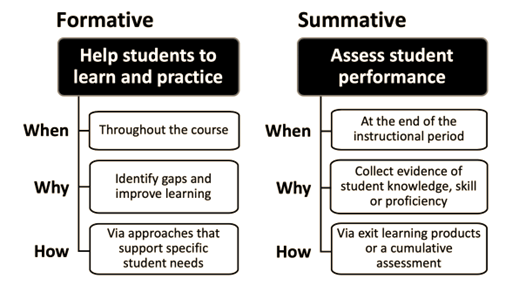
Diagnostic Test – A formal assessment intended to provide more detailed information about and individual students’ strengths and weaknesses of reading performance. These are often sed for special education and can be used individually or with group administration.
Criterion–References Tests – Formal assessment designed to measure individual student achievement according to a specific criterion for performance. The test performance of the student is measured against an acceptable score for each of the objectives. The student is also judged on what they can or can not do with regard to the skill objectives of the test. This test shows the assessor the strengths and weaknesses of the student in specific skill areas.
Informal Assessment
Informal Assessments – Informal measure of reading that yield useful information about student performance without comparisons to the performance of a normative population. These assessments yield useful information about student performance and can be used to guide instruction. They are also given throughout the year to students or groups of students and could involve things like reading inventories, miscue analysis, running records, observations, and questions/interviews.
Informal Reading Inventory – An individually administered reading test. These tests usually consist of graded word lists, graded reading passages, and comprehensions questions that assess how students orally and silently interact with print.
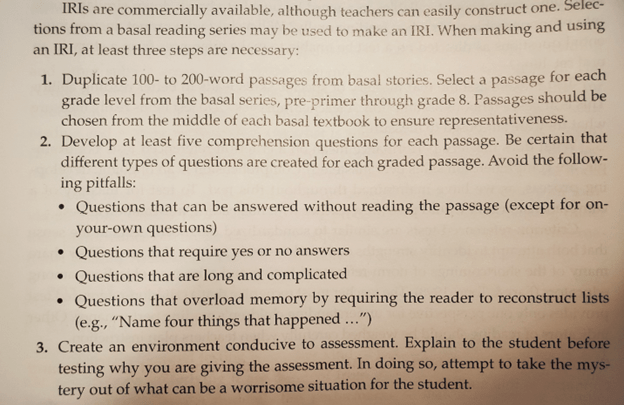
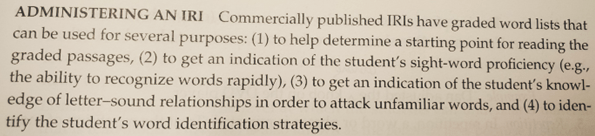
Determining Reading Levels – The following reading levels can be determined for individual students by administering an IRI.
Independent Reading Level – The level at which the student reads fluently with excellent comprehension. The independent level has also been called the recreational reading level because not only will students be able to function on their own, but they also often have high interest in the material.
Instructional Reading Level – The level at which the student can make progress in reading with instructional guidance. This level has been referred to as the teaching level because the material to be read must be challenging but not too difficult.
Frustrational Reading Level – The level at which the student is unable to pronounce many of the words or is unable to comprehend the material satisfactorily. This is the lowest level of reading at which the reader is able to understand. The material is too difficult to provide a basis for growth.
Listening Capacity Level – The level at which the students can understand material that is rad aloud. This level is also known as the potential level because if students were able to read fluently, they would not have a problem with comprehension.
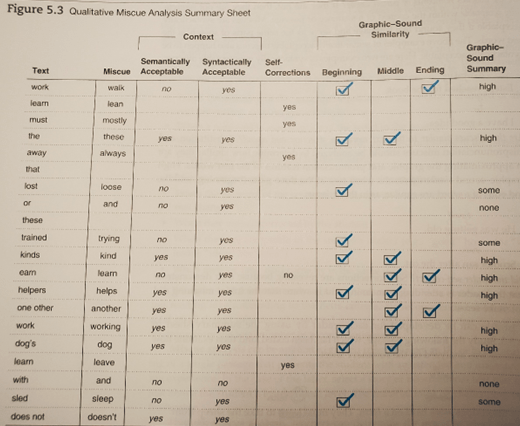
Miscues – Oral reading errors. The terms error and miscue describe the same phenomenon – a deviation or difference between what a reader says and the word on the page. More positive way to describe evidence as opposed to error and also provides room for elaborate on the error.
Miscue Analysis – An informal assessment of oral reading errors to determine the extent to which readers use and coordinate graphic-sound, syntactic, and semantic information. These errors can be analyzed quantitatively or qualitatively.
Miscue Analysis uses four crucial questions:
- Is the meaning changed?
- Are the miscues nonwords or partial words?
- Are the miscues similar to the text words in structure and sound?
Did the reader self-correct?
Running Record – An assessment system for determining students’ development of oral reading fluency and word identification skills and strategies.
Recommended guidelines for when administering a running record:
- Sit next to the student to view the student’s text (it is preferable to use text materials that are part of the everyday program) and the reader’s observable reading behaviors.
- Record everything the student says and does on a blank sheet of paper (in place of a blank sheet of paper, you can use a duplicate copy of the pages the student will read).
- Make a record of the student reading three book selections (a sample reading of 100 to 200 words from each text is recommended, as is choosing readings form one easy, one instructional, and one difficult text).
- Mark a check for each word the student says correctly, matching the number of check s on a line of the paper with the number of words in a line of the text being read.
- Record every error (substitution, insertion, omission, repletion, mispronunciation, and prompt) and self-correction. Deviations from print are marked in much the same way as in other miscue analysis procedures. The sample coded running record passages in Figure 5.5 display a coding system for marking oral reading errors and self-corrections.
Record all observable behaviors.
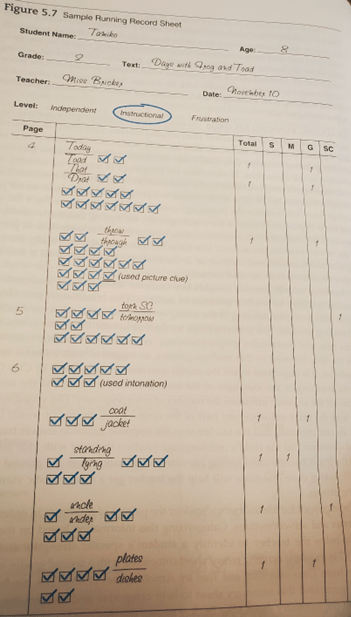
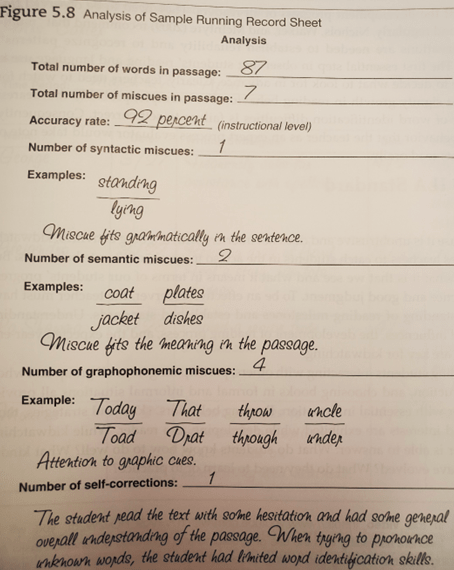
Analyzing Running Record – Analyzing running records allows teachers to understand the strengths and weaknesses of the student as well as their patterns of miscues. It also helps teachers understand how the reader uses and coordinates graphophonemic, syntactic, and semantic information from the text. Teaches must also consider the pattern of responses in order to analyze errors and self-corrections.
Words Per Minute – How many words the student can correctly read in one minute. This is an assessment in which readers read aloud for 1 minute from materials and the teacher marks the words the student reads incorrectly during the assessment. This assessment also tracks changes in reading rates an accuracy over time and assesses the appropriateness of the text’s difficulty.
Portfolios – A compilation of an individual student’s work in reading and writing, devised to reveal literacy progress as well as strengths and weaknesses. These portfolios document the literary development of a student. These portfolios are also child-centered and can be organized digitally, with a 3-ring binder, or with a pizza box to store items and works that wouldn’t normally fit into a typical folder or binder.
What to consider when selecting what goes into a portfolio:
- The students typically select what goes into their portfolio
- Items should show growth, effort, achievement in learning goals
- The portfolio should have a variety of artifacts which represent materials across the curriculum
- Artifacts could be essays, letters, stories, poems, videos, and anecdotal records
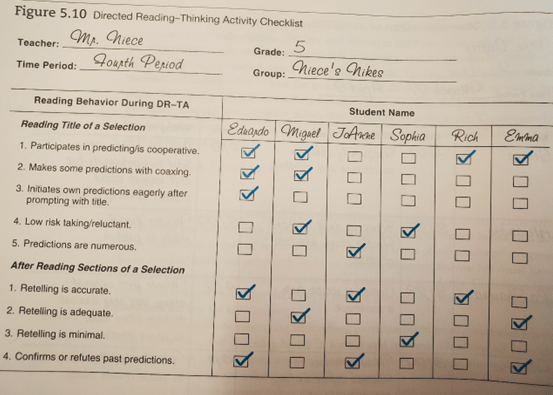
Anecdotal Notes – Short notes written about students for teachers to capture what they observed which reveals something the teacher considers significant to understanding a child’s literacy learning. These can be anything from notes written on post-it notes and writings in a journal or even notes written on index note cards or small pieces of paper. Checklist – Open-ended observations consisting of categories that have been presented for specific diagnostic purposes. These checklists guide teachers to notice what students can do in terms of their reading and writing strategies.
Interviewing – Periodic communication with individual students to asses reading interests and attitudes, self-perception, and understanding of the language-learning process. Teachers ask students questions about their reading to discover what they are thinking and feeling. Teachers can learn about the whole child and these interviews can provide a rich source of information. A few questions to ask students include: (1) Are you a good reader? How do you know? (2) Who is a good reader? Why do you consider hi or her a good reader? And (3) If another classmate were having a difficult time with reading, what would you tell him or her in order to help?
Notes on Videos:
https://youtu.be/4p5286T_kn0 – Be a Mr. Jensen – This short video details the time a young student at 10 years old kept getting in trouble for tapping on his desk and being disruptive. When all of the other teachers scolded him or sent him to the office (which was no help either), one teacher pulled him aside after class and changed his life. That teacher saw the students potential for drumming and gave him his first pair of drum sticks. The teacher told the student directly that he isn’t a problem and gave him and outlet for his “fidgeting” and this student went on to become a very successful musician.
Sight words vs high frequency words – This video describes the difference between sight words and high frequency words. High frequency words are word that we frequently see when reading and speaking. They can be dividing into 2 categories: regular and irregular. Sight words are words that students know by sight. Sight words are words we don’t have to read by sounding out. Words we know more and more as we learn and read more and more.
https://youtu.be/zTkQjH-_97c – Assessments in Education – The video starts with the speaker describing the differences between formative assessments are using during the teaching process and a quick check for understanding. Summative assessments measure long term academic goals and can often be used for grading. The video goes on to describe the many different types of assessments with examples for each type of assessment. The video also goes over behavioral assessments and emotional assessments and screenings.
https://youtu.be/_WDfT46nijA – Formal vs Informal assessments – This brief video describes the many key points and differences between formal and informal assessment with many great details and examples for each one.
https://youtu.be/JI-YgK-l4Sg – Formative vs Summative vs Diagnostic – Same guy from previous assessment videos describes the key details and differences between these three assessments. First, he very clearly explains why we should implement each assessment. Then he describes when we should implement each assessment as to whether it be before, during, or after a learning lesson. He then goes on to detail some examples of each assessment and how we should use each assessment like planning for future lessons and making groupings.
https://youtu.be/O5hJNpO0JPE – Criterion-referenced vs Norm-referenced assessments – He mentions the goal for norm referenced assessments is to rank students based on test achievement and criterion referenced is to measure the skills and knowledge a student has mastered. He then goes on to describe other key differences between the two in this great brief video.
https://youtu.be/6ndJygJixqY – Validity, reliability, authenticity, and cultural bias – In this video the speaker defines each other the words before explaining and detailing examples in the classroom. She does a fantastic job explaining each one of the words thoroughly and effectively. The many definitions she used are real life examples and situations many of us can relate to. Overall great simple video explaining things.
Classroom Application – One of the parts of the chapter I would like to implement in my future classroom deals with portfolios. This past summer I actually looked through a couple of my old portfolios from when I was in 4th and 5th grade. And after looking through them and reflecting on this chapter’s portfolio section I can actually remember choosing which things to put into my portfolio. Portfolios for students is a great idea to implement in classrooms without taking much effort to start and maintain, and I believe more teachers should be doing them. I really like the fact that students can see how their literacy has grown throughout the year and that they have a personal stake in the matter. Just looking at how some of my writings went from a few sentences long to complete paragraphs was pretty cool to look at. There are many effective ways to use portfolios and even more so with our digital age technology. At the Head Start program I used to teach at, we would take pictures of our student’s artwork and share them with their parents/guardians. We would also use them for making observations about the student’s growth and development as well. Using portfolios effectively can have lasting impacts of students and I look forward to using them in my future classroom.
 Travis Davis ENGED 275