Defining Word Identification
Word Identification – Putting a name or label on words that are encountered in print.
Word Recognition – A process that involves immediate identification – immediately recognizing a word: sight words, sight-word recognition, or sight vocabulary.
Word Attack – Word Analysis – and Decoding – the act of translating print into speech. This is done through the analysis of letter-sound relationships – phonics.
Decoding – Decoding is the ability to apply your knowledge of letter-sound relationships, including knowledge of letter patterns, to correctly pronounce written words. Understanding these relationships gives children the ability to recognize familiar words quickly and to figure out words they haven’t seen before. Although children may sometimes figure out some of these relationships on their own, most children benefit from explicit instruction in this area. Phonics is one approach to reading instruction that teaches students the principles of letter-sound relationships, how to sound out words, and exceptions to the principles.
Phonics – The tool readers use to pronounce words by associating sounds (phonemes) with letters (graphemes). This process involves mediated word identification because readers must devote conscious attention to “unlocking” the alphabetic code.
Four Phases of Word Learning
Pre-alphabetic Phase – Also called logographic or visual cue phase, occurs before the development of alphabetic knowledge. Happens in preschool-kindergarten. Children will recognize some words at sight, because of distinctive visual and contextual clues as well as looking at environmental print.
Partial Alphabetic Phase – Occurs in kindergarten/first grade when children begin to develop some knowledge about letters and detect letter-sound relationships. They may misread words which start with the same letter.
Full Alphabetic Phase – Occurs in first grade and emerges when readers identify words by matching all of the letters and sounds, are able to read unknown words by sounding them out, and segmenting words into phonemes.
Consolidated Alphabetic Phase – Occurs in second grade when readers become more skilled at identifying words. In this phase children use knowledge of predictable letter patterns to speed up the process of reading words, chunk letters and look for familiar parts of words, and segment into onset and rime.
Onsets – The initial consonants and consonant patterns that come at the beginning of syllables.
Rimes – The vowel and consonants that follow them at the end of syllables.
Analytic Phonics – “Whole-to-part” instruction where children learn a whole word first and then analyze the individual parts and relevant phonics generalizations. In a basal program, analytic phonics relies on the use of workbooks and practice exercises and can spend too much time on paper and pencil activities.
The sequence of instruction in Analytic Phonics is to:
- Observe a list of unknown words with a common letter
- Questioning of how words look and sound the same/how they are different
- Common letter-sound relationship and discuss
- Learners phrase a generalization about the letter-sound relationship
Synthetic Phonics – Teaching sounds in isolation followed by blending the sounds to form words. Students learn that sounds are represented by letters and blending those sounds together pronounce words before identifying phonics generalizations.
The sequence of instruction in Synthetic Phonics is to:
- Teach the letter names
- Teacher the sounds each letter represents
- Drill on the letter-sound relationships
- Teach the blending of separate sounds to make word/s
- Provide the opportunity to apply blending to unknown words
Linguistic Instruction – The beginning reading approach based on highly regular sound-symbol patterns; it emphasizes learning to decode words through regular letter patterns like with dish, fish, wish, and swish; and stories are written with words that repeat specific letter-sound relationships.
Decodable Text – Text that is written with a large number of words that have phonetic similarities and there is typically a match between the text and the phonic elements the teacher has taught.
Consonant Digraphs – When two or more consonants are combined to produce a new sound, the letter cluster is called a consonant digraph. The most common consonant digraphs are these: ch as in chin ph as in phone sh as in shell gh as in ghost th as in think nk as in tank wh as in whistle ng as in tang
Vowel Digraphs – Two vowels that are adjacent to one another. The first vowel is usually long and the second is silent. Vowel digraphs include oa, ee, ai, and ay as in boat, beet, beat, bait and bay. There are also notable instructions: oo as in look, ew as in flew, and ea as in head.
Consonant Blends – Two or three consonants grouped together, but each consonant retains its original sound. There are several major groups of blends:
- l blends: bl cl fl gl pl sl
- r blends: br cr dr fr gr pr tr
- s blends: sc sk sm sn sp st sw
- three-letter blends: scr spr str
Diphthongs or Vowel Diphthongs – Sounds that consist of a blend of two separate vowel sounds. These are /oi/ as in oil, /oy/ as in toy, /au/ as in taught, /aw/ as in saw, /ou/ as in out, and /ow/ as in how. Generally, children do not need to be taught these formally.
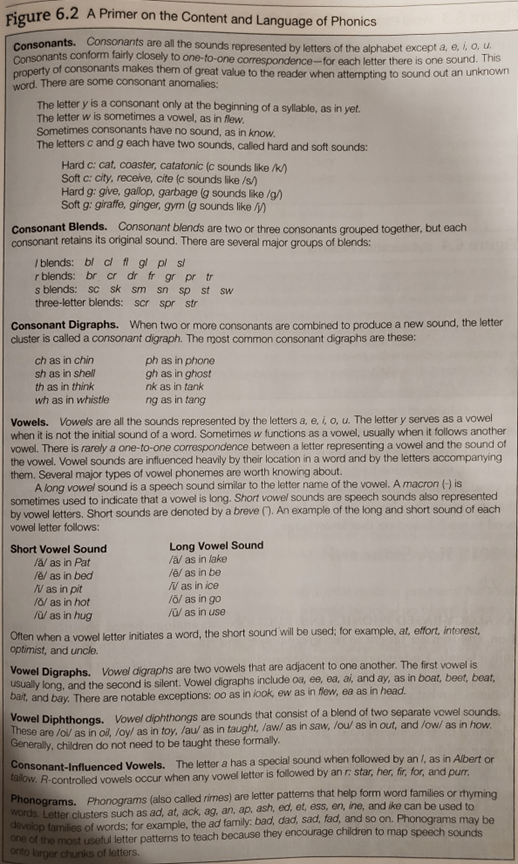
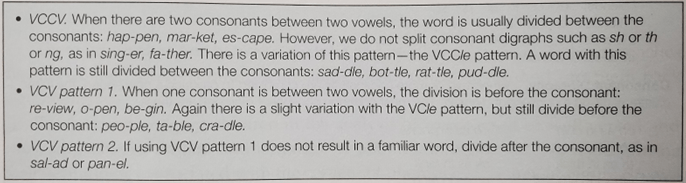
Syllables – A vowel or a cluster of letters containing a vowel and pronounced as a unit.
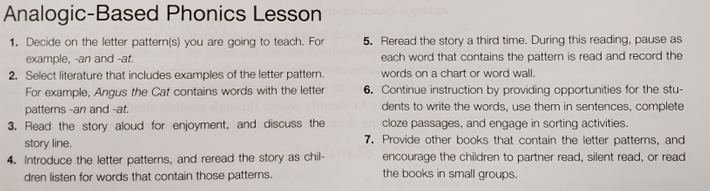
Analogy–Based Instruction – Students are taught to recognize onsets and rimes as they learn to decode unfamiliar words. This instruction strategy also believes that children learn to read words in context and “chunking words” by letter patterns ins what good readers do. In regard to using this strategy for teaching phonics, teachers teach and demonstrate that words with similar onset and rime patterns have similar pronunciations, use known word/s to compare patterns and break a word into chunks (meadow = m, ead, ow), and make words using letter patterns. Below is an example of a step-by-step analogic-based phonics lesson:
Embedded Phonics Instruction – A holistic, meaning-centered instruction approach that teaches phonics within the context of stories that make sense to the children. Children learn phonics through the context of stories and the importance of embedded phonics instruction is using meaningful literature.
Phonograms (also called rimes) – Letter patterns that help form word families or rhyming words. Letter clusters such as ad, at, ack, ag, an, ap, ash, ed, et, ess, en, ine, and ike can be used to develop families of words; for example, the ad family: bad, dad, sad, fad, and so on. Phonograms may be one of the most useful letter patterns to teach because they encourage children to map speech sounds onto larger chunks of letters.
Making Words – A consonant-based phonics teaching strategy where students practice making words using various consonants and rimes. One way to engage students in the process of making words is simply having them make words. Using consonants and consonant blends along with rimes, students can practice making many new words by using the rimes and changing the initial consonant to create the new words. Teachers can make and have many different consonant, consonant blends, and rime cards or folders for students to manipulate. These interactive activities and lessons are a great way for students to practice making words.
Word Walls – Words “hung up” on a wall in a classroom which creates a literal wall of words. These word walls are used by teacher to engage students in word study for a variety of instructional purposes. Teachers can create a “Word Wall” in their classroom to help students spell and understand the definitions of words. This involves the use of an actual wall in the classroom which is easily accessible to all students. Whenever a student comes across a word they either do not know the definition to or don’t know how to spell it goes up on the wall. The teacher, or a student, will then create a new card for the word wall with that word. On the front of the card will be the word in easy-to-read letters that the students can either read from their desks or by walking over towards the wall. Some teachers will have a separate accessible area with the words and their definitions too. By having a word wall, with a separate dictionary nearby as well, helps reduce interruptions during instructional and work time as well as helping teach the students to find answers to questions independently.
High-Frequency Words – Words that appear often in printed material. These sight words make up a large percentage of written words and are grammatically necessary. Many of these are often called function words because they help a sentence function but do not give it meaning.
Cloze Sentences – A strategy (for teaching context) in which words or letters are omitted from the text and students are required to fill in the blanks using information from the passage. Teachers can use selective word deletion choosing words like nouns, adjectives, etc. to be left out for selective practicing, Systematic word deletion where every nth worth is deleted, and partial word deletion where every nth word or selected word is partially deleted. Cloze passages and sentences can also be fill in the blank or have words to choose from.
Cross–Checking – Reading a sentence or two to “cross-check” –confirm, modify, or reject–probable pronunciations of unknown words encountered during reading. If the sentence sense, then the cross-checking confirms the reader’s pronunciation and if not, the reader tries again.
Self–Monitoring – Being aware of miscues, the pronunciation of unknown words, and comprehension processes during reading to develop the ability to correct oneself. When students have good self-monitoring skills, they know what to do when they come to a word they don’t know.
*Cross-Checking and Self-Monitoring Strategies help readers combine letter-sound and meaning information to make sense while reading.
Structural Analysis – A word recognition skill that involves identifying words in meaningful units such as prefixes, suffices, and root words. Structural analysis also includes being able to identify infected endings, compound words, and contractions.
Strategies for Teaching Structural Analysis:
- Word Study Notebook-list prefixes and suffixes and what they mean
- Word Chart Carousel-brainstorm as many words which have the given prefix or suffix
- Compound Word Cups-making compound words
- Contraction Search-find as many contractions as you can in magazine
Morpheme – The smallest meaningful unit of a word. For example, the word unhappy has two morphemes. The first us “un” meaning not and the second is “happy” meaning joyful.
Inflected Endings – Suffixes that change the tense or degree of a word but not tis meaning. Some examples of this would be:
ing as in going s as in books d as in saved es as in dresses ed as in looked ly as in slowly er as in smaller est as in tallest
Classroom Application
This chapter was full of great information on words, word learning, and word identification. One of the key take aways for me deals with word walls and cloze sentences/passages. A few years ago I observed a tremendously useful and successful word wall full of high frequency words used in writing along with rarely used words and those with uncommon spelling patterns. I observed students directly walking up to the wall to see how to spell a word correctly on several different occasions all the while not interrupting the teacher. After reading about word walls several times throughout our book, it’s easy to see how effective they can be and there are many different ways they can be implemented and created as well. It was also interesting to learning about cloze sentences and the different options for using them. I feel like there are many ways to use cloze sentences to help students learn to use context in a sentence, but also to observe students to informally assess them on whether they are meeting the lesson’s/activity’s objectives. Cloze sentences can be very successful when working certain types of spellings and word families as well as when learning about nouns, adjectives, verbs, and adverbs. Students need to learn to use the meaningful information from passages to help determine and choose the missing word.
Video Notes
https://youtu.be/_Njxbc-oEWo – Syllables in English: This video discusses what a syllable is and what the different types are. It describes how syllables have vowels and that the number of syllables is how many pronounced vowels there are. The video then goes on to describe the seven different types of syllables: closed, open, vowel team, diphthong, vowel-consonant-e, consonant-le, and R-controlled. The video continues explaining the differences between the syllables and includes many great examples. https://youtu.be/-EJpDFmbaMI – Curious About Orthographic mapping? – This brief video describes what orthographic mapping is and its impact on teaching. The narrator describes orthographic mapping as the process by which we store words for instant recognition and that it facilitates our sight word knowledge. The video then goes onto describe why sight words are important and how they work while also mentioning how sight word knowledge is more about phonemic awareness than visual memory. The video then goes on to detail why manipulation is the most important skill and ways to help struggling readers.
Extra notes for the week!
Traditional Approaches
There are two traditional approaches to teaching phonics: analytic and synthetic. Analytic phonics instruction is an approach to phonics teaching that emphasizes the discovery of letter-sound relationships through the analysis of known words. Whereas, synthetic phonics instruction is a building-block approach to phonics intended to foster the understanding of letter-sound relationships and develop phonic knowledge and skill.
Watch the video “Analytic and synthetic phonics” [5 minutes 17 seconds] where Sarah Mitchell explains the difference between the two approaches.
Both of these approaches are favoured by teachers who devote large chunks of time to early, intensive, and systemic instruction designed to help master the sounds of the letters (Vacca, Vacca, Gove, Burkey, Lenhart & McKeon, 2018).
Again, take this opportunity to reflect on your own philosophical stance and what belief system you hold about teaching reading. Remember that teachers with a traditional philosophical stance will typically gravitate towards the bottom up curriculum perspective to teaching reading. “Teachers who possess a bottom-up belief system believe that students must decode letters and words before they are able to construct meaning from sentences, paragraphs, and larger text selections” (Vacca et al., 2018, pp.35-36). They believe that each word must be recognized; that word and letter-sound cues are used exclusively to identify words; and, they place an emphasis on letters, letter-sound relationships and words.
Contemporary Approaches
Contemporary approaches to teaching phonics are analogy-based and embedded phonics instruction. Analogy-based instruction teaches children to use onsets and rimes they already know to help decode unknown words.
Watch the video “Decoding – Part 3: Tutoring Using Phonics by Analogy” [6 minutes 47 seconds] which demonstrates where an adult literacy tutor is using analogy-based instruction to assist the student to use parts of known words to identify unfamiliar words by analogy.
Embedded phonics instruction is often called holistic, meaning-centered instruction, embedded phonics teaches phonics within the context of stories that make sense to the children. An example of this approach is the Letterland literacy program. This program teaches phonics using a story-based, multi-sensory approach.
Watch one of the stories from the Letterland Story Corner, “Red Robot and the recycling” [6 minutes 7 seconds].
Again, take this opportunity to reflect on your own philosophical stance and what belief system you hold about teaching reading. Remember teachers that hold progressive, critical theorist and existential philosophical stances will typically embrace a top down curriculum perspective to teaching reading. Vacca et al. (2018) state “teachers who have a top-down belief system consider reading for meaning an essential component of all reading instructional situations” (p. 36). They believe that comprehension can occur without identifying each word; that all cues are used to identify words; and, they place an emphasis on sentences, paragraphs, and text selections.
Guidelines for phonics instruction
Phonics instruction needs to:
- build on a foundation of phonemic awareness and knowledge of the way language works.
- Be integrated into a total reading program.
- Focus on reading print rather than on learning rules.
- Include the teaching of onsets and rimes.
- Include invented spelling.
Organizing word identification instruction
While there is no magic one way to organize word identification instruction, there are guiding principles which you should adhere to when planning and implementing your literacy lessons to focus on these skills. These principles are:
- Identifying words does not mean just “sounding them out”.
- Use assessment and kid watching to guide grouping.
- Teach and reinforce identification in meaningful contexts.
Strategies for Teaching Use of Context
Cloze Passages – a strategy in which words or letters are omitted from the text and students are required to fill in the blanks using information from the passage.
Watch the video “Cloze Strategy” [2 minutes 8 seconds] where the teacher is using a cloze procedure to encourage students to use clues from the text to fill in the blanks.
Inferring word meanings through context
Watch the video “Inferring Word Meaning in Context” [4 minutes 14 seconds] where a teacher is supporting her students to infer word meaning by using contextual information from the text.
Monitoring unknown words
Cross-checking is when students use letter-sound information and meaning to identify words.
Watch the video “Teaching for Cross-Checking” [1 minute 28 seconds] as literacy expert Jan Richardson works with emergent readers and prompts them to cross-check while they read the book.
When children use self-monitoring strategies they are demonstrating that they are aware of miscues, the pronunciation of unknown words, and comprehension processes during reading and they have the ability to correct oneself.
Watch the video “Learning to Self Monitor” [2 minutes 21 seconds] as four and a half year old Jaxson demonstrates his developing self-monitoring skills through assembly of his own cut up sentence.
 Travis Davis ENGED 275