Aptitude Hypothesis – The belief that vocabulary and comprehension reflect general intellectual ability.
Knowledge Hypothesis – The suggestion that vocabulary and comprehension reflect general knowledge rather than intellectual ability. Large vocabularies on a topic have a lot of knowledge about that topic.
Instrumental Hypothesis – Belief in a causal chain between vocabulary knowledge and comprehension; that is, if comprehension depends in part on the knowledge of word meanings, vocabulary instruction should influence comprehension. If comprehension depends in part on the knowledge of word meanings, vocabulary instruction ought to influence comprehension.
Vocabulary – The Panoply of words we use, recognize, and respond to in meaningful acts of communication. The suggestion that vocabulary represents the breadth and depth of all the words we know–the words we use, recognize, and responds to in meaningful acts of communication. Breadth involves the size and scope of our vocabulary; depth concerns the level of understanding we have of words. Teaching vocabulary is not a one-time deal, the students need to see the purpose of the word.
Components of Vocabulary – Vocabulary is classified into four components: listening, speaking, reading, and writing. It is assumed that listening and speaking vocabularies are learned in the home, and reading, writing, and transliteracy vocabularies fall within the domain of school. However, its much safer to assume that both home and school are profoundly influential in the development of vocabulary. Children’s first vocabulary is listening before they eventually learn to identify and use as many written and spoken words. By adulthood, a person’s reading vocabulary often outmatches any of the other vocabulary components.
Principles to Guide Vocabulary Instruction
Principle 1: Select words that children will encounter while reading literature and content materials. Below are 4 ways to choose words for instructional emphasis:
- Key Words – Key words convey major ideas and concepts related to the passage content and are essential for understanding to take place.
- Useful words – Useful words are relevant. Children encounter useful words repeatedly in a variety of contexts and students should be familiar with them.
- Interesting words – Interesting words tickle the imagination and create enthusiasm, excitement, and interest in the study of words.
- Vocabulary – Words should be selected for instruction that will show students how to inquire into meaning of unknown words – through structural analysis or context analysis. Classroom instruction should include words to build vocabulary-building skills and seeking clues to find word meanings on their own.
Principle 2: Teach words in relation to other words.
Vocabulary words are often crucially tied to basic concepts and as children develop definitional knowledge, they are able to relate new words to known words. When words are taught in relations to other words, students are actively drawn into the learning process. There are four cognitive operations associated with learning concepts and words:
- Joining: “How are words related” and “bringing together” – Comparing, classifying, and generalizing are possible through the act of joining.
- Excluding: “Which word doesn’t belong” – Children must discriminate, negate, or reject items because they do not belong in a conceptual category.
- Selecting: “Choose what word fits the best” – Students learn to make choices and to explain why they made their choices based on what they have experienced, know, or understand.
- Implying: if-then, cause and effect, analogy – Is a child able to make decisions based on if-then, cause and effect relationships among concepts and words?
Principle 3: Teach Students to Relate Words to their Background Knowledge.
Ask, “What is it the student already knows about that they can build upon this new concept?” Students use what they know to make initial predictions about the learning of the word and then refine the meaning. Teaching students to relate words to their background knowledge is important for all students, especially for ELLs.
Principle 4: Teach Words in Prereading Activities to Activate Knowledge and Use Them in Postreading Discussion, Response, and Retelling.
Through prereading activities, vocabulary words can be focused on before students read to help activate background knowledge in activities involving predicting. Prereading activities are activities designed to help students activate prior knowledge, set purpose, and/or engage their curiosity before reading. Prereading and Postreading vocabulary activities that connect vocabulary words to content are more desirable than isolated vocabulary exercises and especially for ELLs. Acquiring and using vocabulary in a variety of activities before, during, and after reading, including conversation, help children develop language, vocabulary, and comprehension skills.
Principle 5: Teach Words Systematically and in Depth.
In order for students to process vocabulary in depth, they must interact with word and generate a novel product using the term. They do this by restating the definition in their own words, compare the definition to their own experiences with the concept, or make up a sentence using the term that clearly demonstrates the word’s meaning. Class discussion leads students to process words deeply by drawing connections between new and known information. By teaching systematically, the authors describe it as following a vocabulary program that includes 10 to 12 conceptually related words that are taught and reinforced over an extended period of time. Students learn by engaging with words by hearing them, saying them, manipulating them, and playing with them.
Principle 6: Awake Interest in and Enthusiasm for Words. Promoting students’ interest and engagement helps to develop rich vocabularies, especially for less advantaged students. Teacher attitudes can also be contagious and a good teacher’s excitement for words is irreplaceable. When students see that learning words can be fun, they become interested and curious about them. Incorporating pictures, charts, audiotapes, videotapes, songs, and video clips allow students to learn vocabulary words in more than one format.
Best Practice: Strategies for Vocabulary and Concept Development
Vocabulary instruction and concept development should not be neglected and opportunities for incidental instruction and reinforcement arise in content area instruction throughout the school day. Best practice in vocabulary instruction begins with the teacher’s commitment to teach words well. Here are a few examples of best practice strategies for vocabulary development. Effective teachers:
Vocabulary instruction and concept development should not be neglected and opportunities for incidental instruction and reinforcement arise in content area instruction throughout the school day. Best practice in vocabulary instruction begins with the teacher’s commitment to teach words well. Here are a few examples of best practice strategies for vocabulary development. Effective teachers:
- Relate experiences to vocabulary learning.
- Use context for vocabulary growth.
- Develop word meanings.
- Classify and categorizing words.
- Develop word meanings through stories and writing.
- Develop independence in vocabulary learning.
Relating Experiences to Vocabulary Learning – The more direct, firsthand experiences students have, the better. Vicarious secondhand are valuable int their own right as well. All these experiences provide for in-depth vocabulary development.
Using Context for Vocabulary Growth – The goal for context and vocabulary growth is to teach students to use context to gain information about the meanings of new terms.
Developing Word Meanings – Student develop a greater understanding of word and word meanings by thoroughly understanding their definitions and their meanings. Some words some similar meanings, while others mean opposites. Some words even have multiple meanings. Instruction with synonyms, antonyms, and words with multiple-meanings is crucial for success.
Definitional Knowledge – The ability to relate new words to known words, can be built through synonyms, antonyms, and multiple-meaning words.
Synonyms – Words that are similar in meaning to other words.
Antonyms – Words that are opposite in meaning to other words.
Multiple-Meaning Words – Words for which readers must rely on context in order to determine meaning. These words give students opportunities to see how words operate in context. Here are a few strategies for dealing with multiple-meaning words involving prediction and verification:
- Select multiple-meaning words from a text assignment. List them on the board.
- Have students predict the meanings of these words an write them on a sheet of paper next to each term.
- Assign the reading selection, noting the numbers of the pages where students can find each word in the text reading.
- Ask student to verify their original predicted meanings. If they wish to change any of their predictions, they can revise their meanings based on how each word was used in the selection.
Classifying and Categorizing Words – Working with word relationships provides students an opportunity and experience of thinking about, thinking through, and thinking with vocabulary. Some ways to classify and categorize words are though word sorts, categorization, semantic mapping, analogies, paired-word sentence generation, and collaborative learning experiences.
Categorization – Critical manipulation of words in the relation to other words through the labeling of ideas, events, or objects. Students will learn to study words critically and form generalizations about the shared or common features of concepts. They do this by using strategies that involve the process of joining, excluding, selecting, and implying.
Word Sorts – Vocabulary development through categorization activities with groups of words. Words are grouped into different categories by looking for shared and similar features among their meanings. There are two types of sorts:
- Closed – Students know in advance what the main categories are. They must select and classify words according to the features they have in common with a category. Closed sort reinforces and extends the ability to classify words.
- Open – Students do not know what the main categories are. Students must search for meanings and discover relationships among words. Open sorts stimulate inductive thinking.
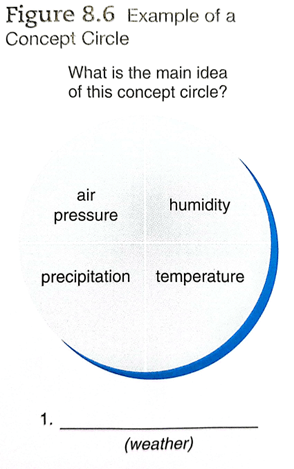
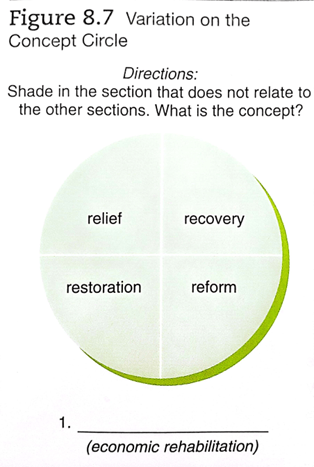
Concept Circles – A vocabulary activity in which students identify conceptual relationships among words and phrases are partitioned within a circle. A concept circle simply involves putting words or phrases in the sections of a circle and then directing students to describe or name the concept relationship among the sections. These concept circles give students the opportunity to study words critically and relate words conceptually to one another.
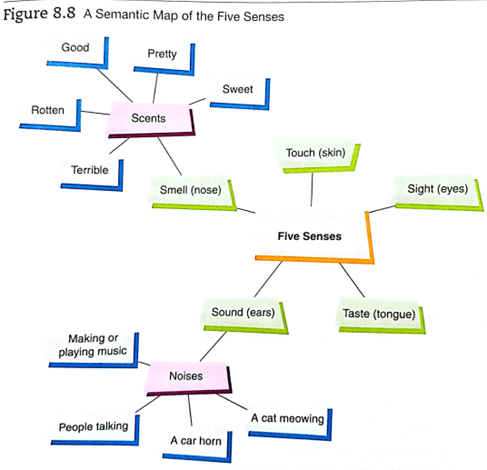
Semantic Mapping – A strategy that shows readers and writers how to organize important information. This mapping strategy can revolve around vocabulary learning by providing a visual display of how words are related to other words. Students can also use semantic mapping to cluster words belonging to categories and to distinguish relationships.
Analogy – A comparison of two similar relationship. Analogies should be taught to students beginning in the intermediate grades and several short demonstrations of the process involved in completing analogies should be modeled for students.
Paired-Word Sentence Generation – A teaching strategy that asks students to take two related words an create one sentence that correctly demonstrates an understanding of the words and their relationship to one another. The students produce a sentence that correctly demonstrates an understanding of the words and their relationships to each other. Paired-word sentence generation is also considered an instructional strategy for developing word meanings through stories and writing.
Developing Word Meanings Through Stories and Writing
Stories provide a situational context that could be used for rich development of word meanings. Teachers will narrow the selection of words to those semantically related to the theme and then students develop definitions based on personal schemata for the theme. When using semantic analysis to writing:
- The Teacher identifies the theme and composes a questions involving critical thinking related to the theme. The teacher develops questions involving critical thinking related to the theme.
- The teacher selects words used by the author or consults a thesaurus to find about five words, both synonyms and antonyms, relating to the theme. (Words that are too closely synonymous are discarded.)
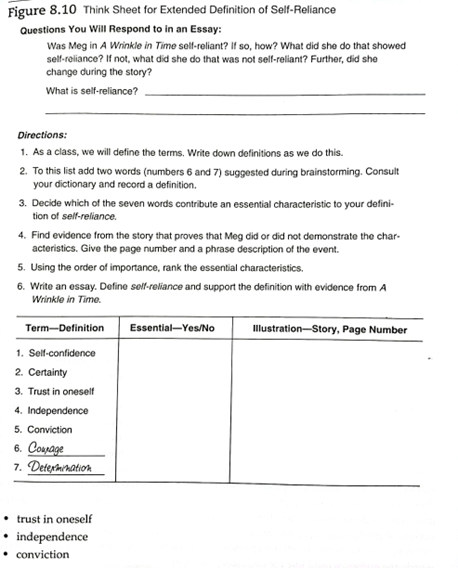
- The teacher constructs a think sheet for discussion purposes as well as for writing.
Think Sheets – A list of questions used to elicit responses about texts for discussion purposes.
Predictogram – A strategy that develops students’ meaning vocabulary through the use of story elements including the setting, incidents in the plot, characterizations, the characters problem or goal how the problem or goal is resolved, and the theme or larger issues. To effectively use predictograms: a teacher will choose words from a story that will challenge students. Next the words and meanings are discussed in class and students relate their personal associations with the words. After that, students work in groups to predict how they think the author might use each term in the story (describe the setting, characters, problem or solution).
Self-Selection Strategy – A strategy that helps students monitor their own vocabulary growth by selecting unknown vocabulary words. The first step to use this strategy is to ask students to bring to class one word they believe the class should learn; the teacher also chooses a word. The words are then written o the board, and students give the definitions they gleaned from the context in which they found the word. Class members then add any information they can to each definition. The students and teacher next consult pertinent references such as dictionaries, glossaries, thesauri, dictionary internet sites, and texts to add to definitions that are incomplete or unclear. The students then narrow the list to choose which word or words they think are most important to learn and which ones are not as useful. The agreed upon terms are documented and defined and kept throughout the year.
Word Knowledge Rating – A strategy that helps student develop an awareness of how well they know vocabulary words by rating themselves on their knowledge of words based on a continuum. Words chosen by the teacher or the students from the self-selection strategy are written on a worksheet or on the board. Students then rate themselves on how well they know the word. Our authors suggest using the ratings:
- I’ve never seen the word.
- I’ve heard of it, but I don’t know what it means.
- I recognize it in context. It has something to do with __________.
- I know the word in one or several of its meanings.
After the students have rated themselves on their knowledge of the words, the teacher leads them in a discussion using many questions about the words. It is through these discussions where students begin to make judgements concerning the depth of their knowledge and the amount of effort needed to add the terms to their meaning vocabulary.
Classroom Application
When it comes to being an effective classroom teacher, using the Principle 1 strategy of selecting words that children will encounter while reading text and content material can be a tremendously effective. Readers can tolerate a few unknown words while reading so vocabulary instruction is critical for learning. When teachers select words appearing in actual text selections that will be read in class, comprehension can be enhanced significantly. I really liked that the textbook goes into detail about why teachers should be doing this and how it can impact our students. We shouldn’t just introduce “big” vocabulary words for students to learn just because they are big, we should be introducing vocabulary words that are useful for the lesson’s activities and the unit’s learning objectives. These key words also need to be useful. Will the student need to know these terms in the immediate future or even continued future use? Words with multiple meanings is another important topic when choosing vocabulary words. Many words have multiple meanings and students, especially ELLs, must learn what these different meanings are, how and when to use them, and how to tell which meaning of the word the text is detailing by looking at the context. Choosing the right vocabulary words for students to learn about can an exhausting task. But by doing so, we are setting up our students to be more successful learners and readers.
Video Notes
https://youtu.be/DC0HNtvxuRg – Dr. Anita Archer – Vocabulary Instruction: This great vocabulary video starts off with the teacher going over some vocabulary terms. She goes over a term by defining it, discussing its synonyms and such, and goes over many great examples. She then uses the vocabulary term many times in sentences before having the students discuss their own sentences with a partner/group. She does this for every vocabulary term and the students get great firsthand experience and knowledge from thinking about how to use the word in a sentence and then actually using the term when talking with their partners. She even went over the differences with one word by discussing how some words can be an adjective, adverb, and noun. Great example of a vocabulary lesson with firsthand discussions and learning.
https://youtu.be/WgQYvj2U4Kw – Close Reading – Vocab Focus – Grade 1: Great video showing an effective vocabulary instruction starting off with an introduction to vocabulary terms the students will see in the text they are going to read together. The teacher then told the students to circle any unknown words they come across when they then read together. The teacher knew that there would be a few unknown words and this was one way to go over some of the unknown terms. He then had the students discuss what they think the terms mean and the main ideas of the story. He then asked if other classmates agreed or disagreed on things and filled in the gaps of the definitions when they weren’t quite right. He then had the students reread the story before going over the vocabulary terms again. Great lesson and example with tremendous student participation.
https://youtu.be/p9DPKgBrJQE – Tier Two Vocabulary Instruction: When going over vocabulary terms, the teacher has the students first discuss what they think the word means by sharing the first thing that comes to their mind about the word. He mentions only teaching one or two of these tier two words so the students can really hone in on the definitions and use the words more often than simple reading about them once or twice. He has the students discuss and share the word in sentences and even teaches the students the sign language for the word. He also discusses playing games with the students on Fridays and this a great to informally assess the student’s knowledge of the weeks lessons as well. The students in the video were very engaged and even had fun learning. Another incredible example of an effective teacher.
 Travis Davis ENGED 275