Narrative Text – Literature that tells a story and is characterized as fiction. There are many genres of narrative text: mysteries, fantasies, fairy tales, science fiction, myths, and folk tales. Historical fiction is another genre as well where there can be text with a mix of fact and fiction.
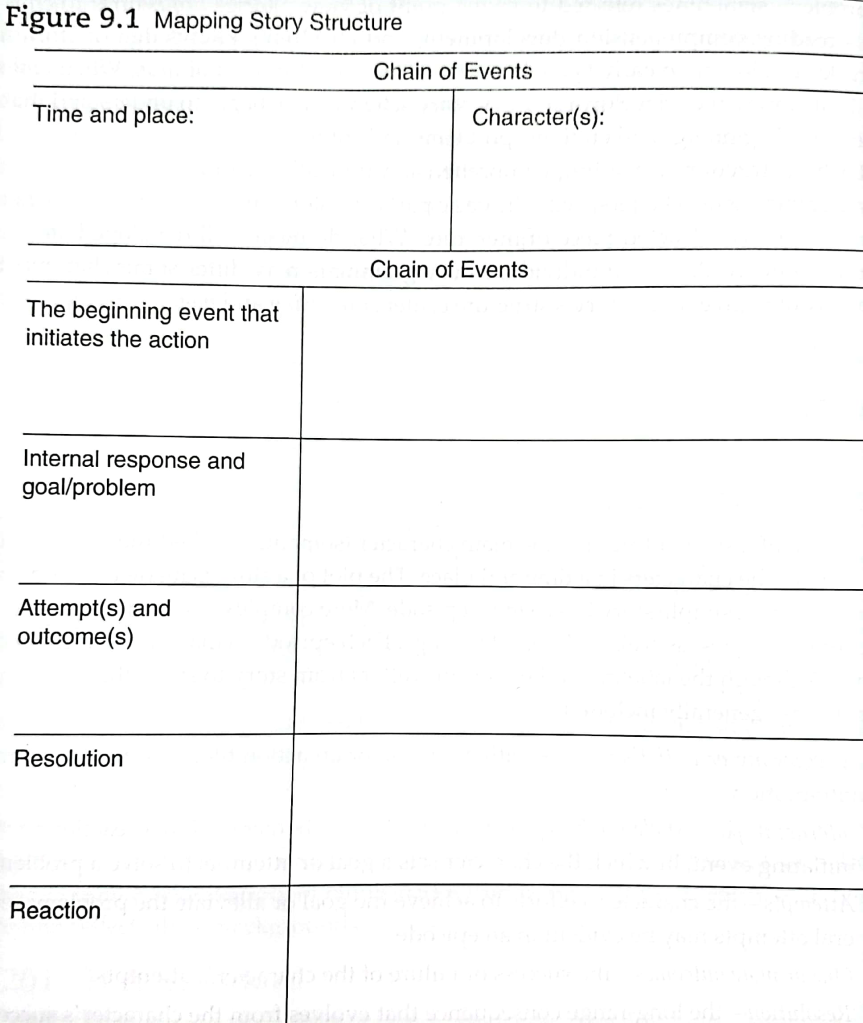
Elements in a Story – The setting of a story introduces the main character, and the plot is made up of one or more episodes and includes a chain of events. The following elements are generally included:
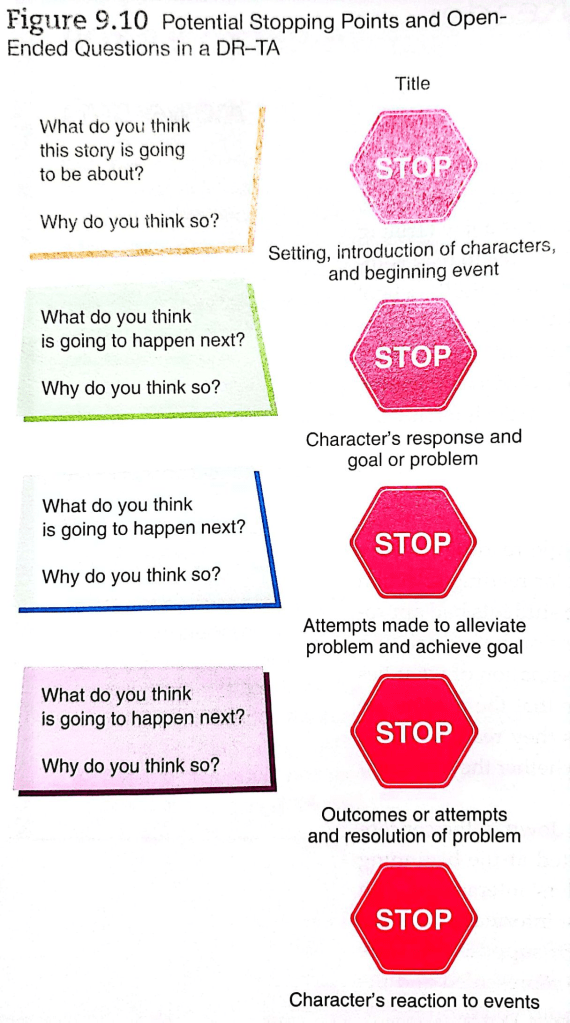
- A beginning or initiating event – Either an idea or an action that sets further events into motion.
- Internal response (followed by a goal or problem) – The character’s inner reaction to the initiation event, in which the character sets a goal or attempts to solve a problem.
- Attempts – The character’s efforts to achieve the goal or alleviate the problem; several attempts may be evident in an episode.
- One or More Outcomes – The success or failure of the character’s attempts
- Resolution – The long-range consequence that evolves from the character’s success or failure to achieve the goal or resolve the problem.
- A Reaction – An idea, emotion, or further event that expresses a character’s feelings about success or failure in reaching a goal or resolving a problem or that relates the events in the story to some broader set of concerns.
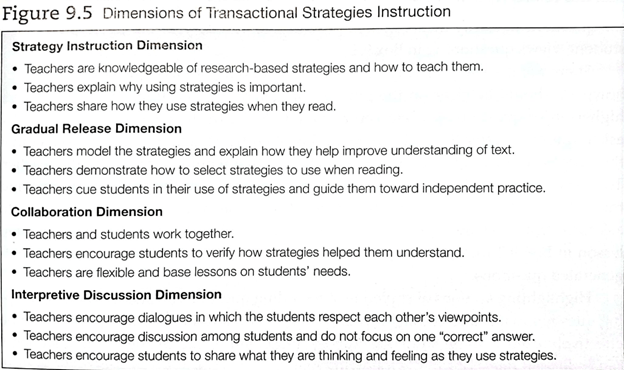
Scaffolded Instruction – Teachers model strategies step-by-step and explicitly demonstrate the processes of thinking before, during, and after one reads. Scaffolded instruction also provides guided practice which is followed by independent practice and application.
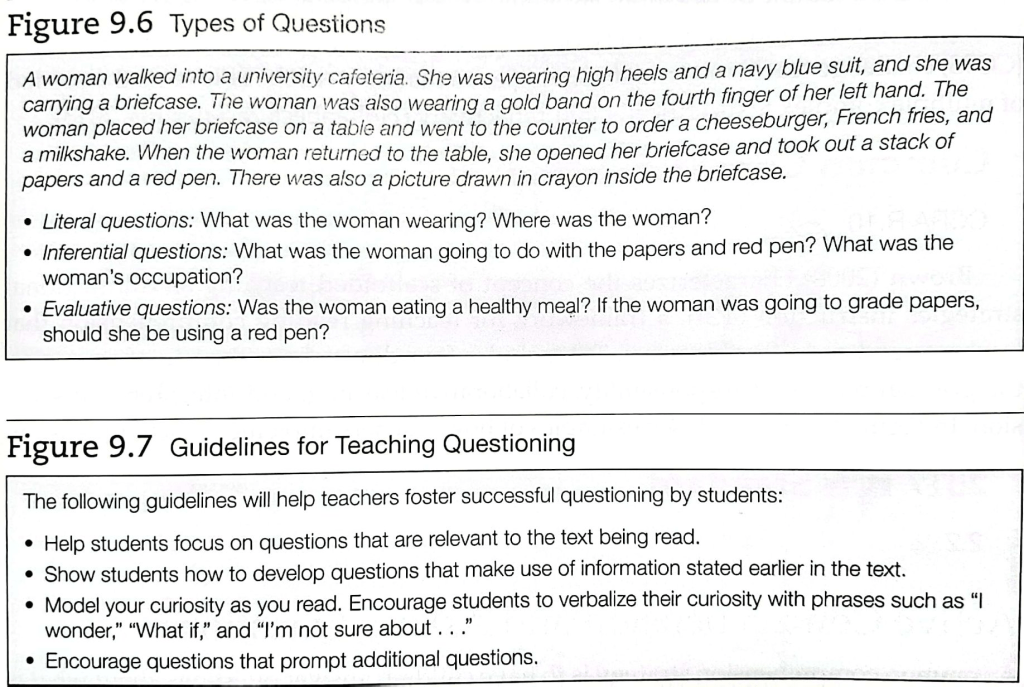
Literal Questions – Questions that are based on explicitly stated information in the text.
Inferential Questions – Questions in which the reader uses background knowledge and information from the text.
Evaluative Questions – Questions that focus on making a judgement about what is read.
Active Comprehension – Using prior knowledge, schemata, and metacognition to construct textual meaning; fostered by the use of questioning during reading. Could also possibly be stated as the engaged process of generating questions and making connections throughout reading.
ReQuest (Reciprocal Questioning) – A teaching strategy that encourages students to ask their own questions about the material being read. Here’s how it works:
- The teacher selects the story for the group to read and divides the literature into logical stopping points.
- The group, including the teacher, reads the first section silent Play with the intent of asking a question or questions after reading.
- The teacher models questions, and small group discussion takes place.
- The next section is read silently followed by another question or questions by the teacher and small group discussion.
- After the next section is read, the children begin asking their questions, followed by group talk.
- The procedure continues with the teacher and students taking turns asking questions.
Here are the steps to how it works:
1. Discuss importance of asking questions.
2. Model the type of questions that should be asked.
3. While reading, ask questions that require questions in response (what you would like to know about the setting of the story).
4. Class words in small groups and one student plays the role of teacher by getting
questions from other students.
5. Students work in pairs to ask each other questions as they read.
6. Students independently come up with questions and discuss them as a whole group.
Here are some question prompts for ReQuest:
What does _____ remind you of?
Do you know someone like the character ______?
Do you agree with what _____ did in the story?
What do you think will happen next in the story?
What do you think the author chose _____ as the setting?
What do you picture in your mind when you read this part of the story?
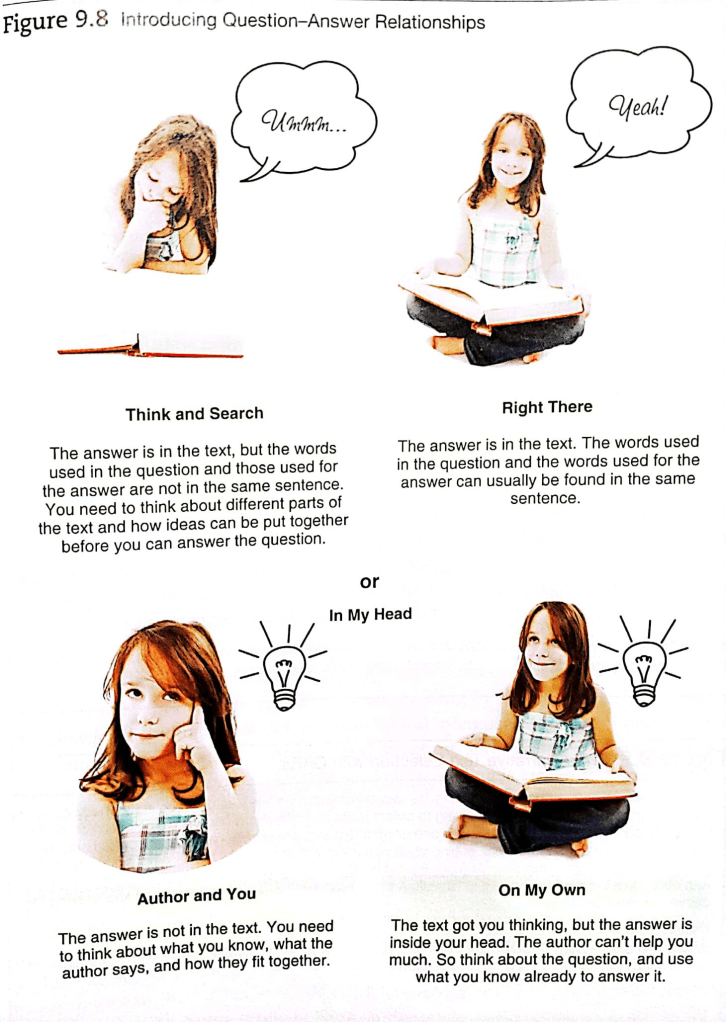
QAR’s (Question-Answer Relationships) – A comprehension strategy that enhances children’s ability to answer comprehension questions by teaching them how to find the information they need to respond. Explicit instruction will make students sensitive to two information sources where information can be found: the text and the reader.
Text: Some answers can be found right there in the text while others demand a think and search strategy. The student searches for the information and thinks about relationships that exist among the bits of information found.
Reader: Some answers must come from the reader’s mind. These questions might state, “What do you think about…” or “How do you feel about…”
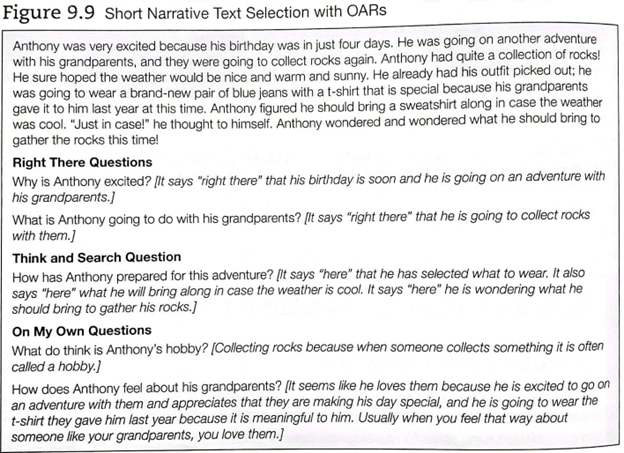
Question the Author (QtA) – A comprehension-centered instructional strategy designed to show readers how to question the author’s intent while reading. This strategy models for students the importance of asking questions while reading.
Close Reading – The same selection is read several times in order to locate, explain, identify, and be able to discuss and analyze the text in depth and support answers to questions with examples from the text. reading complex texts multiple times in order to gain multiple levels of meaning for different purposes through analysis. An important purpose of close reading is teaching children how to read analytically.
Annotating Text – A note taking strategy in which students jot down thoughts within the actual text and margins that indicate the evidence that supports text-based questions. Teachers need to model for students the process of annotating. Teachers can also show students they can use highlighters, colored pencils, colored pens, or even sticky notes and “code words” to make annotations.
Reciprocal Teaching – Reciprocal teaching-an approach to scaffolding reading comprehension in which teachers introduce four strategies, model the strategies, and gradually encourage independent use of the strategies in small groups as student takes on the role of teacher. The four strategies are:
- Predicting what the text is about
- Raising questions about the text
- Summarizing the text
- Clarifying difficult vocabulary and concepts
Here is a brief step-by-step lesson on Reciprocal Teaching:
- Select a story in which you can identify conflict.
- Read the text closely and identify major themes where questions may arise.
- Segment the text so students stop reading at a critical point.
- Construct questions that prompt the students to think about what the author suggests by rereading the text.
- Continue with thoughtful queries that encourage the students to question the author.
For Reciprocal Teaching in Primary Grades:
- Teacher introduces prereading strategies by modeling how to make predictions and setting a purpose for reading.
- Using the fishbowl technique, the teacher models the strategy in the center of a circle while the rest of the class observes.
- Students are groups and the teacher provides substantial support while the students practice the strategy. Student who participated in the fishbowl activity are the leaders of the groups, other students are the prediction maker, questioner, clarifier, visualizer and summarizer.
- Students are grouped and the teacher provides reduced support while they practice the strategy.
- Students are grouped and teacher provides even less support, individuals are held accountable through written responses.
Think–Alouds – A strategy in which teachers and students share their thoughts, discuss what they wonder about and what confuses them, and make connections as they are reading. A great opportunity to conduct think-alouds is when teachers read aloud to students. By modeling comprehensive strategies that involve asking questions, making predictions, visualizing, making judgments, and sharing personal connections, teachers invite students to share their own thoughts. The teacher is directly modeling these comprehension strategies for students.
To conduct a think-aloud:
- Teacher selects a passage which elicits ambiguity, difficult vocabulary, or contradictions.
- As the teacher reads aloud, the students follow along silently and listen as the teacher describes what he/she is thinking.
- After modeling, the students are encouraged to describe their thoughts.
Developing Readers’ Awareness of Story Structure
Narrative Text – Literature that tells a story and is characterized as fiction. There are many genres of narrative text: mysteries, fantasies, fairy tales, science fiction, myths, and folk tales. Historical fiction is another genre as well where there can be text with a mix of fact and fiction.
Elements in a Story – The setting of a story introduces the main character, and the plot is made up of one or more episodes and includes a chain of events. The following elements are generally included:
- A beginning or initiating event – Either an idea or an action that sets further events into motion.
- Internal response (followed by a goal or problem) – The character’s inner reaction to the initiation event, in which the character sets a goal or attempts to solve a problem.
- Attempts – The character’s efforts to achieve the goal or alleviate the problem; several attempts may be evident in an episode.
- One or More Outcomes – The success or failure of the character’s attempts
- Resolution – The long-range consequence that evolves from the character’s success or failure to achieve the goal or resolve the problem.
A Reaction – An idea, emotion, or further event that expresses a character’s feelings about success or failure in reaching a goal or resolving a problem or that relates the events in the story to some broader set of concerns.
Story Map – An analysis of a story’s organizational elements; used to strengthen instructional decisions. A story map is a way of identifying major structural elements, both explicit and implicit, underlying a story to be taught in class. A story map discusses the order of events, like time and place and characters, and the chain of events like the beginning event, the internal response and goal/problem, attempts and outcomes, resolution, and reaction.
Here are some generic comprehension questions for these categories:
- Setting
- Who is the main character? What is (character’s) problem?
- Internal Response and Goal/Problem
- What does the (character) decide to do?
- Attempts and Outcomes
- What happened to (character)?
- Resolution
- How did (character) solve the problem?
- Reaction
- Why did (character) do (action)?
Here are more specific comprehension questions:
- Theme:
- What is the moral of the story?
- What did you learn from the story?
- Characters:
- Why do you think (character) did that
- Does (character) remind you of anyone else you know?
- Personal Response:
- Is there anything you would have changed in the story?
Was there anything in the story that didn’t make sense?
- Is there anything you would have changed in the story?
Schema/Story Schema – Story schema is the underlying structure and relationships in a story that act as a catalyst for constructing meaning and distinguishing important ideas and events. Students develop a sense of story schema at an early age when they begin to understand that stories have beginnings and endings, problems and solutions. They also begin to learn that a story’s structure centers on setting and plot.
Activities to Build Schema for Stories – Here are some activities and suggestions to help students build a better sense of story and reinforce their awareness of story schema and structure:
- Read, tell, and perform stories in class on a regular basis.
- Show relationships between story parts:
- Use flowcharts – Flowcharts provide a visual for students to understand how stories are organized. They give children a visual image of how stories are organized and reflect best practices for mapping relationships that exist between events in the story.
- Teachers must discuss flow charts and explain to students how the events in a story form a chain.
- Reinforce story knowledge through instructional activities.
- Children’s understanding of story structure can be extended through varied instructional tasks like story frames and circular story maps.
- Macrocloze stories: The teacher deletes single words from a passage; can also delete several sentences.
- Scrambled stories: The story is separated into its parts and then scrambled. Students must then put story back in order.
Story Frames – A way of heightening an awareness of stories by providing students with a skeletal paragraph in which the students fill in. There are five store frames: plot summary, setting, character analysis, character comparison, and the story’s problem. An example of this would look like:
- “In this story, the problem starts when____________”
- “After that, ________”
- “Next, ________”
- “The problem is finally solved when _______”
- “The story ends ___________”
*Textbook definition: Story frames are skeletal paragraphs represented by a sequence of spaces tied together with transition words and connectors signaling lines of thought; frames can emphasize plot summary, setting, character analysis, character comparison, and the story’s problem.
Circular Story Map – A visual representation using pictures to depict the sequence of events leading to the problem in the story. This strategy is useful to use with students whose strengths include visual representation and is great to use with students who struggle to write because of spelling.
Directed Reading – Thinking Activity (DR-TA) – An activity that builds critical awareness of the reader’s role and responsibility in interacting with the text through the process of predicting, verifying, judging, and extending thinking about text material. DR-TA builds critical awareness of the reader’s role and responsibility in interacting with the text. In order to use this strategy, a teacher must first read the story to themselves, analyze its structure and identify important story parts (map the story), and decide on logical stopping points to discuss the story.
Discussion Webs – A strategy used in cooperative learning that requires students to explore both sides of issues during post-reading discussions before drawing conclusions. Discussion webs use a graphic aid to guide children’s thinking about the idea they want to contribute to the discussion. Discussion webs give students a collaborative way to enhance their comprehension by making connections to the story and listening to the connections made by the other members of the group. They also have a high degree of participation because the students are eager to hear how other groups reach consensus and draw conclusions.
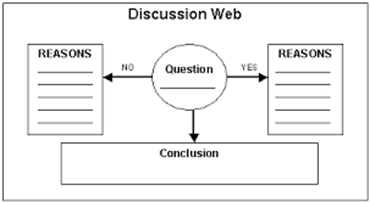
- Center of web is the question, which reflects more than one point of view.
- Students explore the pros and cons of the question in the yes/no columns.
- Draw a conclusion based on the discussion.
Text Connections: A comprehension strategy in which students are encouraged to share how texts relate to themselves, to other texts, or to the world. Teaching students to actively think while reading helps them relate their prior knowledge to what they are reading and fosters comprehension.
Text to Self – A text connection that asks students to share what a piece of text reminds them of personally. For narrative text, this is typically related to the plot of the story, the actions of a character, the setting, the problem, or the solution. A question for students might be, “What does the story remind you of?”
Text to Text – A text connection that asks the students to recall another text that reminds them of the one they are reading. For example, a child reading Goldilocks and the Three Bears might make a connection that there are three characters in The Story of the Three Little Pigs, too. On more sophisticated levels students might recognize similar problems in stories, similar character traits, or similar settings. A question for students might be, “What other text does this text remind you of?”
Text to World – A text connection asking students to make connections beyond the story. What world issues does this story bring to mind? Does Goldilocks and the Three Bears bring up issues of theft? Does The Story of the Three Little Pigs bring up issues of starvation? The text-to-world connections should be reserved for older students who are capable of making higher-level inferences and connections. A question for students might be, “What world issues does this story bring to mind?”
Here is a song about the different types of text connections: https://youtu.be/jadc0WuT47w
Classroom Application: There were two key take aways for me this week. The first one involves using reciprocal questioning and having students ask and answer questions. Reciprocal questioning helps students be actively engaged in thinking about their own thought processes during reading and can help monitor their comprehension as they read. This all works by teaching students how to ask questions to themselves during reading which then becomes more and more independent as they practice. Reciprocal questions encourages students to ask questions about the material during and after the reading. This leads to a better understanding and greater comprehension. Using reciprocal questioning effectively is a great way for students to increase their comprehension and reading skills. The other take away for me this week involves story maps and comprehension questions. Story maps and comprehension questions are a great tool for teachers to assess students for understanding and can easily be adapted to many different stories and situations. Going over things like the setting of the story and the chain of events leading up to a problem/solution helps students better understand the story and its lesson. Understanding why the character made the choices they made or reflecting upon the moral of a story are great ways to increase comprehension. Learning more about the best ways to implement these strategies for learning and comprehension is something I will definitely look into when I get the chance to teach.
Video Notes:
https://youtu.be/Sd1FlXxpVIw – Before, During and After Questions: Promoting Reading Comprehension and Critical Thinking: This video demonstrates a teacher going over questions students have before, during, and after the reading of a book. She prompts them that they are to use the phrase, “I wonder about…” when asking their questions. She has them discuss with a friend before having them write down questions. After discussing some of the questions during the read aloud, the teacher moves them on to writing questions they have for after the book is read. She then goes over the questions they had during the reading to see if any of the questions they had were answered and then goes over the questions they had after the reading. A great example of an easy lesson activity for asking questions before, during, and after reading.
https://www.youtube.com/watch?v=s4A85oOjZW0 – Teaching Reading and Comprehension to English Learners, Grades K-5: This video discusses different techniques for teaching reading and improving comprehension. The strategies are designed for most mainstream classroom teachers. It mentions that vocabulary is the foundation for instruction. It then discusses and asks teacher to think about what key words are most important for students to know which will help them learn the most. Next is mentions that teachers should provide opportunities to say words aloud. The video also shows us that students will often learn from each other when discussing vocabulary and other subjects rather than just from the teacher’s teachings. They can often explain it in a different way for each other to understand better. It also suggests improving engagement and comprehension with partner reading. It briefly discussed how engaging students in writing and reading together can lead to more success in students. Next, the video discusses the use collaborative strategies to give all students a chance to succeed. Finally, the video discusses the strategies a principal’s teachers used with their students and the impacts it had. She mentions that the students had higher level of engagement, the teachers had a more rigorous instruction, and the teachers can easily share things like successful strategies with other teachers.
https://www.youtube.com/watch?v=84VyogMSuv0 – Close Reading: An Instructional Strategy for Conquering Complex Text: This great video goes through the instructional strategy of a close reading process in a classroom. The teacher first reads the complex text once without interruption so the students are acquainted with the text. She then goes over the learning target/s to engage support and hold students accountable for their learning. After discussing a few key terms, she then asks the students why they read the text over and over again and follows up their answers with the explanation of why. “Teachers can encourage students to be metacognitive about the things that close readers do.” was a great tid bit that for teachers to remember to explain things to their students and to help them think about the way their thinking about and reading the text. She has done such a great job during the year that the students are able to underline and circle the key details and words and writing the gist of the passages that were previously scaffolded lessons. She does a back to back partner sharing and text check that is followed by a “whip around” where the teacher checks for understanding by having the students share the students key details they found with the students at their table. Student talk is the key take away here and that they can help each other more than we expect. An incredible lesson activity done by a veteran teacher.
Reading Rockets Comprehension Notes
Sentence Unpacking for Meaning – Grade 5: This video and description details how we can rewrite complex sentences as a series of simple sentences. This 8-minute-long video took 7 minutes to rewrite one very long sentence into 6 different “simple” sentences. The teacher and the students looked through and discussed all of the different parts of the sentence to break down what it truly meant. They discussed things like pronouns and who the pronouns represented, prepositional phrases, and how words can imply other meanings than their original definitions. Great video on a brief lesson about sentence unpacking and how it can help out students fully understand and comprehend complex sentences.
Metaphor, Simile, Personification, and Hyperbole|Figurative Language Lesson: The video starts off with a great definition for figurative language and why it’s used. Young students and ELLs reading figurative language can easily become confused about what the meaning of a sentence is trying to say and it’s important for them to understand these definitions and examples. It also helps students writing sound better as well. The video had wonderful visuals and was full of incredible examples with many modern references. These references as examples actually taught me more about personification and a better understanding of similes and metaphors.
How to Use Text Dependent Questions in Close Reading: There are numerous reasons as to why we ask students questions during and after readings, but we don’t always think about the fact that answering these questions can help students understand the text better. Using text to support these answers or even to prove these answers is crucial for student learning and comprehension. While we want our students to be able to find and cite text evidence for the basic type of questions, we also need to teach them how to collect and use the information from the text as evidence to make their own argument and to state their own position or opinion. This is when text evidence becomes important because the students are now using it in their own writing and own presentations. Having students expand and explain their answers and writings using the text is a great skills for students to learn.
 Travis Davis ENGED 275