Fluency – In everyday terms it means reading easily and well, but the essential characteristic of fluency is the ability to decode and comprehend at the same time with the less important characteristics of accuracy and speed. Another textbook definition is the ability to read expressively and meaningfully, as well as accurately and with appropriate speed.
3 Dimensions of Fluency:
1. Accuracy in word decoding – Ability to sound out words in text with few errors.
2. Automatic processing – Reading is automatic and students don’t have to sound out each word or think about reading.
3. Prosody or Prosodic reading – Using pitch, stress, pause and duration when reading with expression.
Effective Fluency Instruction:
1. Instruction – Incorporating the teaching of basic phonemic awareness and phonics skills as well as modeling what fluency looks and sounds like.
2. Practice – The use of decodable text and independent level texts to strengthen the sounds and spelling that are taught in the classroom.
3. Assessment – Assessing fluency needs to include assessing all dimensions: accuracy, automaticity, and prosody. Many of these assessments involve timing how long it takes a student to read a passage (wpm). Assessments should also inform instruction as well.
Automaticity – Using little energy to read and being able to refocus rapidly when needed. Fluent readers read at least 100 words per minute and reading comes automatically. However, reading quickly is not the same as reading fluently.
Prosody – Simply stated it means reading with expressions. It can also meaning reading with/using pitch, stress, pause, and duration as well as allowing it to sound expressive.
Predictable Text – Easy to read text. These texts and books have a context and setting that is familiar or predictable to most children. The pictures in the story are supportive of the text, the language is natural, the story line is predictable, and can have repetitive patterns.
*Our textbook also defines predictable text as: literature that is distinguished by familiar or predictable characteristics of setting, story line, language patterns, or rhyme and consequently can promote fluency.
Types of Predictable Texts:
- Chain or Circular stories – plot leads back to the beginning
- Cumulative stories – each time a new event occurs, the previous events in the story are repeated
- Pattern stories – scenes are repeated throughout the story with some variation
- Question and Answer stories – the same or similar questions are repeated throughout the story
- Repetition of Phrase stories- word order in a phrase is repeated
- Rhyme stories-rhyming words, refrains or patterns are used throughout the story
- Songbooks stories-familiar songs with predictable elements, such as repetitive phrase
Here are some great examples of predictable texts for each type:
- Chain or Circular story: “If you give a Mouse a Cookie”
- Cumulative story: “The Very Hungry Caterpillar”
- Pattern story: “Three Billy Goats Gruff
- Question and Answer story: “Brown Bear, Brown Bear, What Do You See?”
- Repetition of Phrase story: “Pout, Pout Fish” or “Good Night Gorilla”
- Rhyme story: “I Went Walking”
- Songbook story: “Down by the Bay”
Fluency Strategies for Groups of Students
Choral Reading – A way to engage children in listening and responding to prosodic features in oral language in order to read with expression. Choral readings involve reading aloud in unison with a whole class or group of students. The teacher reads and discusses a text first before the students reread it together. The teacher models one way to read the text while the students think about and learn about the different ways to read aloud using pitch, loudness, stress, and pauses.
*Textbook definition – Oral reading, often of poetry, that makes use of various voice combinations and contrasts to create meaning or highlight the tonal qualities of a passage.
Echo Reading – A method of modeling oral reading in which the teacher reads a line of a story and then the students echo by reading the same line back while imitating the teacher’s intonation and phrasing. This strategy allows teachers to provide a great deal of support or scaffolding and works well with the whole class, small groups, or individuals.
Fluency-Orientated Reading Instruction (FORI) – This instructional strategy was developed for whole group instruction with a grade-level basal reader and incorporates the research-based practices of repeated assisted reading with independent silent reading within a three-part classroom program of teacher-led repeated oral reading and partner reading, a free-reading period at school and at home reading. First, the teacher reads the basal story in class. Then the students read story to parents. Next, students reread story with partner in class. Then, the third day the students chorally read the story, and on the fourth day they partner-read. There are also many discussions in-between readings to make sure students fully understand the text and vocabulary terms as well as teacher support and guidance before and after reading.
Readers’ Theater – An oral presentation of drama, prose, or poetry by two or more readers. The readers take the parts of the characters in the story and simply read their lines out loud. The focus is on what the audience hears as opposed to what they see. Here are some guidelines for Reader’s Theater in the classroom:
- Introduce the piece, and have the students read it through once (chorally) to become familiar with the words.
- Direct students to look for places where they could add things like feeling, expression, pauses, and enunciation.
- Ask students to model suggestions for the class for enhancing the text.
- Practice the piece of text together, phrase by phrase.
- Read the entire piece as a class using the suggested expression.
- Stop the process when necessary to reteach, model, or discuss fluency issues.
- Assign reader’s theater parts to students.
- Practice individual reader’s theater parts
- Perform reader’s theater.
- Ask students to self-assess: “What did you do this time that was better?”
- Confirm their comments, offering suggestions.
Fluency Strategies for Pairs and Individual Students
Repeated Readings – A student reads a text several times until he or she achieves a certain level of automaticity that improves speed and comprehension. These readings involve having a child read a short story or passage from a text more than once with differing amounts of support to develop rapid, fluent oral reading. Here are some suggestions when using repeated readings:
- Students choose sort selections (50 to 200 words) from stories that are difficult enough that students are not able to read them fluently.
- Students read the passage several times silently until they are able to read it fluently.
- The teacher can involve students in a discussion of how athletes develop athletic skills by spending considerable time practicing basic movements until they develop speed and smoothness. Repeated reading uses the same type of practice.
- Samuels suggests that students record their oral rendition of the passage as well as their oral rendition after practice so that they can hear the difference in fluency.
- Students continue practicing until they can read the passage with accuracy and fluency.
Paired Repeated Readings – With a partner, a student reads an individually chosen passage that is different from their partner’s passage more than once with different levels of support to develop rapid, fluent oral reading skills. A self-evaluation assessment is often used with these readings and the partners will also discuss how much improvement they have made after each reading as well. More fluent students are often paired with less fluent students so that fluency is modeled firsthand.
Fluency Development Lesson (FDL) – An instructional framework designed to develop oral reading fluency. It incorporates the use of various repeated reading techniques such as choral reading and paired reading routines. Here are the six steps in the fluency development lesson:
- Read the text expressively to the class while students follow along silently with their own copies. This step can be repeated several times.
- Discuss the content of the text with attention to developing comprehension and vocabulary as well as the expression the teacher used while reading to the class.
- Together, read the text chorally several times for variety. The students could read in groups of two or more or echo read.
- Have the class practice reading the text in pairs. Each student takes a turn reading the text to a partner multiple times. The partner follows along with the text, provides help when needed, and gives constructive feedback.
- have a brief word study activity with words chosen from the passage. Match the words to those on a word wall, for example.
- Have volunteers perform the text as individuals, pairs, or groups of four. Arrangements can be made for students to read the principal, the secretary, the custodian, or other teachers and classes. Students should also read the text to their parents. In this way, students are given much praise for their efforts.
Automated Reading – A reading approach in which students individually listen to audio recorded stories while reading along with the written text. This automated reading program employs a process called simultaneous listening and reading (SLR) which simply means listening while reading a text. The student reads and listens to the same story until they can read the story fluently. *This often happens in the “Listening Center”.
Oral Recitation Lesson (ORL) – A two-component (direct instruction and student practice) instructional strategy for working on fluency in daily reading instruction. The first component, direct instruction, incorporates comprehension, practice, and then performance. The second phase, indirect instruction, involves practicing until mastery is achieved. Here are the steps for ORL:
- The teacher models fluency by reading a story to the class.
- Next, the teacher leads a discussion of the story, and asks the students to summarize what happened. (As a variation, the children can predict what will happen as the story unfolds. Hoffman emphasizes that predictable story should be used in the ORL.)
- the class discusses what expressive auto reading is like – that it is smooth, not exceedingly slow, and demonstrates an awareness of what punctuation marks signal.
- Students read in chorus and individually, beginning with small text segments and gradually increasing the length of the segment.
- the teacher chooses individual students to select an orally read a portion of the text for their classmates. Other class members provide positive feedback to students on the aspects of expressive oral reading discussed.
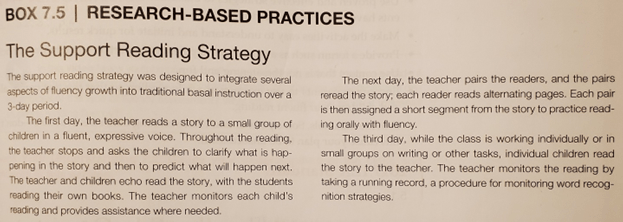
Support Reading Strategy – A strategy designed to develop the ability to read fluently by combining several instructional elements.
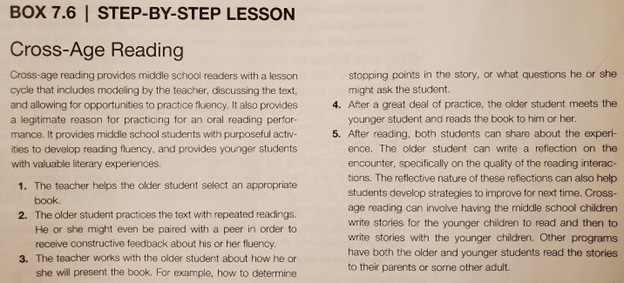
Cross-Age Reading – A routine for fluency development that pairs upper-grade readers with younger children.
Involving Parents
Many teachers develop home reading programs that motivate parents to read to their children at home and some even hold workshops to help parents as well. Here are some guidelines for a successful home reading program:
- Use proven and effective strategies to maximize the effectiveness of the time parents have to work with children.
- Make activities easy to understand and initiate for quick results.
- Provide a forum such as a workshop for parents to report on what they are noticing.
- Use content that is nonthreatening and fun.
- Encourage parents to use expression while reading so that the text comes alive and children hear fluent reading.
- Provide materials. Some parents don’t have reading materials available – don’t let this cause your plan to be unsuccessful.
What Parents Can Do at Home to Help Their Child Become a Fluent Reader?
Children become fluent readers through lots of practice; They need lots of opportunities to read and be read to at home. Following are some practical suggestions for parents to follow to encourage fluency at home.
- Read more. Research tells us the best way to become a better reader is to spend more time reading. Anything parents do to encourage their children to spend more time with print will help make them better readers.
- Read aloud. Express the importance of parents reading aloud to children of all ages. Suggest they read aloud while their child watches the page. Encourage them to use free, online e-books while the child follows along.
- Reread familiar texts. Children love to read old favorites. While it may not be interesting to parents, rereading favorite books helps children become fluent and therefore should be done frequently.
- Echo read. Echo reading is a re reading strategy designed to help students develop expressive, fluent reading. The teacher or parent reads a short segment of the text (sentence or phrase), and the student echoes back the same sentence or phrase while following along in the text.
- Use predictable books. To build fluency, parents should read books with children that have predictable, rhythmic patterns so the child can “hear” the sound of fluent reading as he or she reads the book aloud.
Assessing Fluency – fluency is about decoding words and comprehending at the same time and not just about reading fast. All aspects of fluency – accuracy, automaticity, and prosody need to be assessed. Most assessment tools available rely heavily on accuracy and rate but not prosody. However, researchers are currently developing comprehensive measures of reading fluency that include prosody as well as accuracy and rate with prosody being a measurement of smoothness, phrasing, pace, and expression.
Reading Rate – The number of words read per minute. Reading rate has become the standard measure of reading fluency.
WPM or WCPM – The number of correct words per minute assesses both accuracy (the number of words the reader is able to identify) and automaticity, also known as reading rate. To obtain a words correct per minute score, students are assessed individually as they read aloud for one minute from an unpracticed, unfamiliar, grade-level passage of text. The number of errors is then subtracted from the number of words read in 1 minute. There are a number of oral reading fluency norms charts to determine whether a student is reading above, below, or at grade level as well.
Classroom Application While thinking about all the great information in this week’s chapter and reflecting upon previous trainings I’ve had with literacy and fluency and how to apply it in my future classroom, I began to realize it didn’t have anything to do with the classroom at all. In previous years as a Head Start Teacher I would talk with parents and give presentations on how important it is for parents and guardians to read to their children at home and why it matters. Late into the chapter, it discusses a few different ways parents can help their child become better and more fluent readers at home. Some of the ideas like reading more and reading aloud are pretty straight forward, but parents and others don’t always know why it’s important to do these things. One great idea for parents to do with their child that doesn’t involve much effort is to do echo reading. Echo reading is something most parents probably never thought about doing with their children and most should be able to do it with very little training. Many parents also might not want to reread the same few books over and over, but they might not realize that repeated readings of the same book can be very beneficial for students. There are lots of great ways for parents to help their children at home and most don’t need any special training at all.
Video Notes
https://youtu.be/eVjDsNcPU2E – Reading Fluency with Chloe, Second Grader
This video is a great demonstration of fluency instruction and activities as well as great definitions of fluency. She describes that fluency includes accuracy, rate, and expression. Some of the things the video discusses is how to address errors in accuracy and why we should address them, how to use charts and scores for encouragement, what repeated readings are and why we do them with students, and how rate actually has a lot to do with comprehension. Great video with lots of examples and useful tips.
https://youtu.be/o_-z8d0sRUA – Choral Reading: This video discusses what choral reading is and how it deals with comprehension. It then goes on to detail some guidelines for a choral reading activity/program. A teacher must start by choosing a book that is at an appropriate reading level, contains dialogue or rhythm, and is relatively short. Next the video discusses how we should model fluent reading for the students, but have them follow along in the text and why we do this. The video goes on to explain that we should take time to point out and discuss important elements in the text before rereading the text aloud and in unison with the students. Great short video discussing choral reading and how to effectively use it in the classroom.
https://youtu.be/vMVB-RUKXKM – An Explicit Fluency Lesson with a Prosody Element Focus: This video starts with an explanation about what fluency is, what it sounds like, and why it’s important. Then the teacher demonstrates and models what good fluency and prosody sounds like and looks like. The class and the teacher then read together aloud before the students “whisper read” the text quietly by themselves. She then models reading fluently the next part of the text before the students and teacher read fluently aloud together again. The students then read the text on their own before rereading the whole passage.
https://www.youtube.com/watch?v=NWl0hnb1crM&t=1s – K-3 Essential 3, Bullet 3: Small Group Fluency Instruction Sample Video: This video details many of the different fluency activity types like echo reading, repeated readings, and readers theater for small groups. The video describes and explains the differences between the activities and the benefits of doing them. It includes first hand examples of the teacher doing an echo reading, repeated reading, and readers theater activity. The teacher describes how fluent readers read with expression and how to model expression reading with students. These first hand examples are a great resource for others to observe how an effective teacher uses many different strategies with their readers.
https://youtu.be/5xXEWm-6bnE – Reading Multisyllable Words with Xavier, Third Grader: The video starts off with a few examples of how students “misread” words when reading and how to help them. The teacher and student begin by reading nonsense words to understand how to read multisyllable words. The teacher describes that they are going to ask themselves two questions for each word they are attempting to read: How many vowels? And are they together or apart. They then start with single syllable words to fully understand syllables and what they are before they move on to two or more syllables. They then work on breaking apart bigger multisyllable words by writing down each of the broken apart syllables. After practicing looking for the vowels and separating the syllables, the student begins to read longer and more difficult words. The teacher then goes on explain how once a student understands the basics of reading multisyllable words they can move on to more difficult lessons about things like silent e’s and other word/letter patterns. Great example of a student’s potential with a letter bit of extra help.
Here is one more great resource for fluency: https://www.readingrockets.org/article/top-10-resources-fluency
 Travis Davis ENGED 275